Pakistani Islamic banking sector posts 30% growth — central bank 

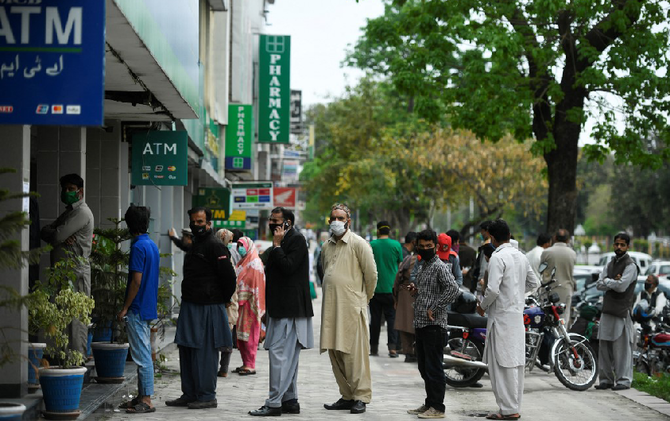
Residents wearing facemasks wait for their turn to withdraw money outside a bank in Islamabad on March 30, 2020. (AFP/File)
Short Url
Updated 25 March 2021
Follow

Pakistani Islamic banking sector posts 30% growth — central bank 

  • Overall industry assets increased to Rs4.3 trillion, deposits reached Rs3.4 trillion by end of December 2020
  • Bankers say growth driven by increasing access to shariah-compliant financial instruments and growing faith-based demand

KARACHI: The Islamic banking industry of Pakistan has posted 30% and 27.8% growth in overall assets and deposits respectively during 2020, the highest such increase since 2012, central bank data shows, driven by increasing access to shariah-compliant financial instruments and growing faith-based demand.
Twenty-two Islamic banking institutions currently operate in Pakistan: five Islamic banks and 17 conventional banks with standalone Islamic banking branches.
The overall assets of the industry increased to Rs4.3 trillion while deposits reached Rs3.4 trillion by the end of December 2020, accounting for 17% of all assets and 18.3% of all deposits of the country’s entire banking industry, according to the State Bank of Pakistan (SBP).
“This is the highest increase in assets in a year since 2012 and in deposits since 2015,” the SBP said on Wednesday in its Islamic Banking Bulletin report for the quarter that ended on December 31, 2020.
“Over the last five years, both assets and deposits of the Islamic banking industry have more than doubled,” the central bank said. “This growth in assets and deposits of the Islamic banking industry is encouraging, particularly due the fact that the industry was also faced with the COVID-19 pandemic challenges during 2020.”
Financing for the Islamic banking industry also grew by 16% during 2020, and the non-performing finances (NPFs) to financing (gross) ratio declined from 4.3 %, as of the end of December 2019, to 3.2%, as of the end of December 2020.
Bankers say the growth in Islamic banking, where under shariah the payment and receipt of interest is strictly prohibited, is driven main due to increasing access.
Sana Tawfik, banking sector analyst at Arif Habib Limited, said the central bank had been promoting the sector’s development through the introduction of legal, regulatory and shariah-compliant frameworks for instruments such as Naya Pakistan Certificates (NPCs) under the Roshan Digital Account (RDA) initiative, which are available to overseas Pakistanis and those who had declared assets abroad.
“Steps taken by SBP to promote Islamic banking, inflows through RDA in NPCs, Islamic sukuks and the increasing frequency of sukuk auctions are the other couple of reasons driving it,” Tawfik said.
Ahmed Ali Siddiqui, senior executive vice president of Meezan Bank — Pakistan’s first full-fledged Islamic bank — told Arab News there was “stronger public demand” for shariah based or interest free banking.
“It is continuously fueling growth,” he said. “The development of Islamic capital market and availability of financial instruments like Sukuk expedited the growth.”
He added that the COVID-19 pandemic had proven the stability of Islamic banking.
“Surprisingly Islamic banking has shown strongest growth during COVID-19 crisis,” Siddiqui said. “This shows the stability factors of the Islamic economic system based on real economic conditions.”


Ex-Pakistan spy chief’s conviction signals tougher days ahead for Imran Khan — analysts

Updated 4 sec ago
Follow

Ex-Pakistan spy chief’s conviction signals tougher days ahead for Imran Khan — analysts

  • Ex-ISI director-general sentenced to 14 years for political interference, misuse of authority
  • Hameed also investigated over his alleged role in May 9, 2023 nationwide unrest

ISLAMABAD: The recent conviction of former Pakistan spy chief Lt. General Faiz Hameed signals tougher days ahead for former Prime Minister Imran Khan and his political party, Pakistan Tehreek-e-Insaf (PTI), political and security analysts said Friday.

A military court on Thursday sentenced Hameed to 14 years of rigorous imprisonment after finding him guilty of engaging in political activities, violating the Official Secrets Act and misusing authority and government resources.

One of the most influential officers of his generation, Hameed served as director-general of Pakistan’s powerful Inter-Services Intelligence agency ISI from 2019 to 2021. He was widely seen as close to former prime minister Khan, who has been jailed since August 2023 on corruption charges that he says are politically motivated.

Dr. Ayesha Siddiqa, a security analyst who has written extensively on military affairs, told Arab News that, “Further punishments could be imposed on Faiz Hameed and Imran Khan.” 

“They may face stricter measures,” she added. 
 
Senator Faisal Vawda, a former federal minister, believes ex-spy chief Hameed would provide evidence against Khan in cases linked to the May 2023 unrest.

“Fourteen years’ imprisonment … this is the beginning … Hamid in his trial is giving evidence and testimony against Khan sahab/jadoogar and others in connection with May 9 events,” Vawda wrote on X on Dec. 11, 2025.

Dr. Siddiqa further adds that a recent press conference by Pakistan’s military spokesperson, in which he lashed out at Khan, suggested that a “further tightening of the PTI” would follow in the days ahead.

On Dec. 5, 2025, Pakistan’s military spokesperson, Lt. Gen. Ahmed Sharif Chaudhry, accused Khan of spreading an “anti-army” narrative, saying his rhetoric had moved beyond normal politics and posed a “national security threat.”

Hammed is accused of instigating attacks on government and military installations during nationwide unrest on May 9, 2023.

Protests erupted across Pakistan on May 9, 2023, following Khan’s arrest, with demonstrators from his party and supporters damaging military and government property. Khan and his political party PTI deny they instructed supporters to resort to violence.

Pakistan’s military said in August 2023 that it was separately examining Hameed’s alleged role in “fomenting vested political agitation and instability in cahoots with political elements.”

Minister for Parliamentary Affairs Tariq Fazal Chaudhry told reporters at a press conference Friday that the conviction would have “far-reaching political consequences” in the days ahead.

“This verdict ensures that no one will dare in future to repeat such political engineering or such unconstitutional abuse of authority,” Chaudhry said.

He added that Hameed’s conviction had reinforced public trust in the military’s accountability process.

PTI’s Secretary Information Sheikh Waqas told Arab News that Hameed’s conviction was “an internal matter of the military institution.”

“If and when the detailed verdict is made public and contains any reference, only then can a comment be considered,” he said. 

Dr. Siddiqa, however, questioned the impartiality of the verdict, saying it did not reflect a “broader pattern” of reform within the military.

“Corruption has occurred before, political involvement has taken place and occasional punishments have been meted out,” she said. “This is not the first punishment, nor does it indicate a pattern.”

She added, “The answer is no — this is selective justice.”

Journalist and political analyst Muneeb Farooq said the verdict was significant and “no joke,” adding that the current military leadership is “inexplicably hard and strict in every way.”

“It’s a move to punish the evil,” he said. “That’s how the current military leadership sees it.”

Lahore-based political analyst Salman Ghani said Hameed’s conviction is alarming for “corrupt elements” and those who once wielded influence in Pakistan.

However, he questioned why accountability had not extended to then-army chief General Qamar Javed Bajwa, who has also been accused by the ruling Pakistan Muslim League-Nawaz party, along with Hameed, of engineering the ouster of former Prime Minister Nawaz Sharif.

“Did he not have the support and approval of the army chief of the time for the actions he carried out?” Ghani asked.