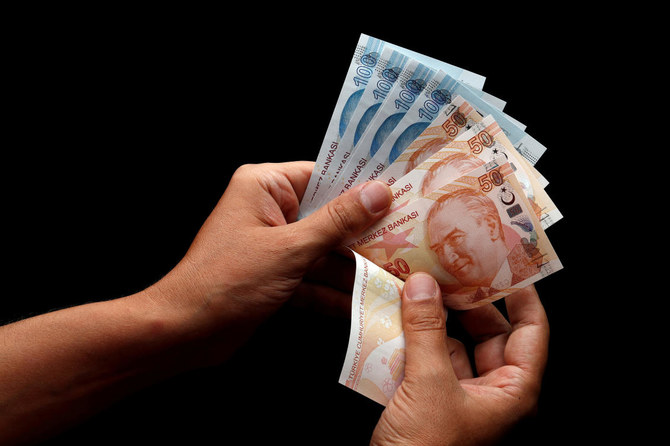
Turkey hikes main interest rate to 19% to counter inflation and weak lira

Turkey has increased interest rates to help shore up the value of its currency and counter accelerating inflation. (Reuters)
Short Url
Updated 18 March 2021
Follow

Turkey hikes main interest rate to 19% to counter inflation and weak lira

  • Main rate increased more than expected
  • Move follows climb in inflation to 15.6%

ANKARA: Turkey’s central bank on Thursday sharply hiked its main interest rate to 19 percent to counter rising inflation and the dropping value of the lira.
The bank said it “has decided to implement a front-loaded and strong additional monetary tightening” after seeing the annual inflation rate climb to 15.6 percent last month.
The bank’s main rate was raised by a greater-than-expected 200 basis points.
The lira gained two percent in value against the dollar moments after the decision was announced.
The Turkish lira has clawed back roughly 15 percent of its value against the dollar since President Recept Tayyip Erdogan overhauled his economic team and appointed Naci Agbal as the new central bank governor in November.
But rising crude oil prices have pushed up Turkey’s inflation rate more than expected while growing yields on US Treasuries have forced investors out of riskier emerging markets.
Economists blame Erdogan’s unorthodox belief that high interest rates cause inflation — instead of slowing it down — for many of Turkey’s current economic problems.
But Agbal appears to have won Erdogan’s blessing to keep the policy rate high for some time to ward off inflation and help the lira recover.
“Governor Abgal is clearly keen to embellish his inflation-fighting credentials and thus was willing to go above and beyond what investors had demanded,” Capital Economic analyst Jason Tuvey said in a research note.
Past central bank managers have burned through most of Turkey’s reserves trying to support the currency while rates remained well bellow the rate of inflation.
The central bank said its “tight monetary policy stance will be maintained decisively, taking into account the end-2021 forecast target, for an extended period until strong indicators point to a permanent fall in inflation and price stability.”
Turkey hopes to bring down the annual inflation rate to under 10 percent by the end of next year and to five percent by the time Erdogan is next scheduled to face an election


Saudi Arabia leads outcome-based education to prepare future-ready generations: Harvard Business Review

A Harvard sign is seen at the Harvard University campus in Boston, Massachusetts, on May 27, 2025. (AFP)
Updated 10 February 2026
Follow

Saudi Arabia leads outcome-based education to prepare future-ready generations: Harvard Business Review

  • The Riyadh-based school group developed a strategy that links every classroom activity to measurable student competencies, aiming to graduate learners equipped for the digital economy and real-world contexts

RIYADH: Saudi Arabia’s education system is undergoing a sweeping transformation aligned with Vision 2030, shifting from traditional, input-focused methods to outcome-based education designed to equip students with future-ready skills, Harvard Business Review Arabic reported.

The transformation is being adopted and spearheaded by institutions such as Al-Nobala Private Schools, which introduced the Kingdom’s first national “learning outcomes framework,” aimed at preparing a generation of leaders and innovators for an AI-driven future, the report said.

Al-Nobala has leveraged international expertise to localize advanced learning methodologies.

The Riyadh-based school group developed a strategy that links every classroom activity to measurable student competencies, aiming to graduate learners equipped for the digital economy and real-world contexts. The school’s group approach combines traditional values with 21st-century skills such as critical thinking, communication, innovation and digital fluency.

According to the report, the shift addresses the growing gap between outdated models built for low-tech, resource-constrained environments and today’s dynamic world, where learners must navigate real-time information, virtual platforms, and smart technologies.

“This is not just about teaching content, it’s about creating impact,” the report noted, citing how Al-Nobala’s model prepares students to thrive in an AI-driven world while aligning with national priorities.

The report noted that Saudi Arabia’s Ministry of Education has paved the way for this shift by transitioning from a centralized controller to a strategic enabler, allowing schools such as Al-Nobala to tailor their curriculum to meet evolving market and societal needs. This is part of the long-term goal to place the Kingdom among the top 20 global education systems.

Al-Nobala’s work, the report stated, has succeeded in serving the broader national effort to link education outcomes directly to labor market demands, helping to fulfill the Vision 2030 pillar of building a vibrant society with a thriving economy driven by knowledge and innovation.

Last February, Yousef bin Abdullah Al-Benyan, Saudi Arabia’s minister of education, said that the Kingdom was making “an unprecedented investment in education,” with spending aligned to the needs of growth and development. He said that in 2025, education received the second-largest share of the state budget, totaling $53.5 billion.