

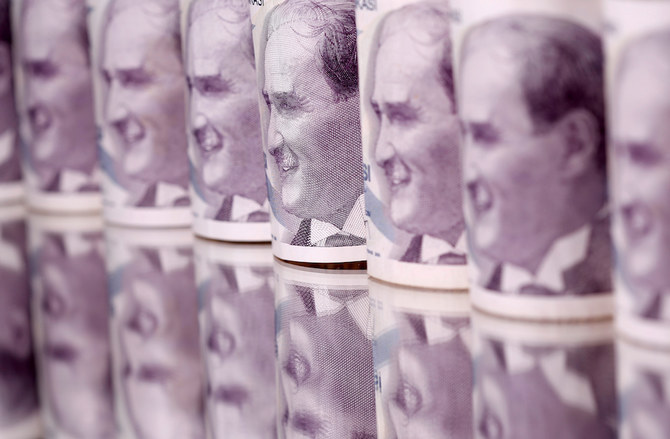
Turkish lira hits record low amid Erdogan feud

The Turkish lira dropped to a record low amid the country’s growing political and economic confrontation with France and the US. (Reuters)
Short Url
Updated 28 October 2020
Follow

Turkish lira hits record low amid Erdogan feud

  • The currency traded at over 8.3 to the dollar for the first time, breaking a dangerous new threshold, with the rate against the euro approaching 10
  • Investors are concerned about the management of the Turkish economy as President Recep Tayyip Erdogan stepped up his war of words with the country’s Western allies

ANKARA: The Turkish lira continued its freefall on Wednesday, dropping to a record low amid the country’s growing political and economic confrontation with France and the US.

The currency traded at over 8.3 to the dollar for the first time, breaking a dangerous new threshold, with the rate against the euro approaching 10.

Experts have called for higher rates, lower growth and faster current account adjustment to halt the downturn.

Investors are concerned about the management of the Turkish economy as President Recep Tayyip Erdogan stepped up his war of words with the country’s Western allies.

Turkish central bank governor Murat Uysal announced on Wednesday that it has no target on exchange rates.

Nikolay Markov, a senior economist at Pictet Asset Management, blamed the lira’s accelerating decline on several factors.

“The central bank did not provide the highly needed and expected rate hike last week. On the other hand, foreign currency reserves are plummeting and are now below the International Monetary Fund’s (IMF) critical level of two months of imports,” he told Arab News.

“Food inflation accelerated and inflation expectation is unanchored, while rising geopolitical risks are also a key factor,” Markov added.

Erdogan called for a nationwide boycott of French-labeled products on Monday following a personal attack on French President Emmanuel Macron.

In harsh criticism on Saturday, Erdogan said that Macron “needs mental treatment.” The comments pushed France to recall its ambassador from Ankara.

Amid the growing dispute some Turkish officials attacked state secularism, a tenet central to French national identity.

However, the Turkish economy stands to lose in a potential trade war. France is the 10th-largest source of its imports and seventh-largest market for Turkish exports, according to official figures.

Markov said the plunging lira is a political game-changer and could require IMF help in the future.

“We have most likely reached the point of no return. Without a strong reaction by the Turkish central bank in the short term, the situation will get out of control and will eventually require either the introduction of capital controls or an IMF assistance program,” he said.

Markov said that a strong rate hike with a signal of further rate increases would be an appropriate short-term response. The most pressing problem is the need to prevent further depreciation and potential inflation, he said.

“A new wave of sanctions before the US elections is unlikely. Then, further sanctions will depend on who wins the elections. I think they will become much more likely under a Joe Biden presidency than under a Donald Trump one,” he added.

Despite being faced with growing pressure over the state of the lira, Erdogan is a staunch opponent of high interest rates.

Turkish companies with high levels of external debt now will have to contend with rising foreign currency exposure in order to repay loans.

On top of that, the Turkish economy is also likely to face fresh US sanctions, Markov said. The US decision will depend on the state of a Turkish deal with Russia to buy the S-400 air defense system.

Last month, rating agency Moody’s warned that Ankara had “almost depleted the buffers that would allow it to stave off a potential balance-of-payments crisis.”


First EU–Saudi roundtable on critical raw materials reflects shared policy commitment

Updated 57 min 54 sec ago
Follow

First EU–Saudi roundtable on critical raw materials reflects shared policy commitment

RIYADH: The EU–Saudi Arabia Business and Investment Dialogue on Advancing Critical Raw Materials Value Chains, held in Riyadh as part of the Future Minerals Forum, brought together senior policymakers, industry leaders, and investors to advance strategic cooperation across critical raw materials value chains.

Organized under a Team Europe approach by the EU–GCC Cooperation on Green Transition Project, in coordination with the EU Delegation to Saudi Arabia, the European Chamber of Commerce in the Kingdom and in close cooperation with FMF, the dialogue provided a high-level platform to explore European actions under the EU Critical Raw Materials Act and ResourceEU alongside the Kingdom’s aspirations for minerals, industrial, and investment priorities.

This is in line with Saudi Vision 2030 and broader regional ambitions across the GCC, MENA, and Africa.

ResourceEU is the EU’s new strategic action plan, launched in late 2025, to secure a reliable supply of critical raw materials like lithium, rare earths, and cobalt, reducing dependency on single suppliers, such as China, by boosting domestic extraction, processing, recycling, stockpiling, and strategic partnerships with resource-rich nations.

The first ever EU–Saudi roundtable on critical raw materials was opened by the bloc’s Ambassador to the Kingdom, Christophe Farnaud, together with Saudi Deputy Minister for Mining Development Turki Al-Babtain, turning policy alignment into concrete cooperation.

Farnaud underlined the central role of international cooperation in the implementation of the EU’s critical raw materials policy framework.

“As the European Union advances the implementation of its Critical Raw Materials policy, international cooperation is indispensable to building secure, diversified, and sustainable value chains. Saudi Arabia is a key partner in this effort. This dialogue reflects our shared commitment to translate policy alignment into concrete business and investment cooperation that supports the green and digital transitions,” said the ambassador.

Discussions focused on strengthening resilient, diversified, and responsible CRM supply chains that are essential to the green and digital transitions.

Participants explored concrete opportunities for EU–Saudi cooperation across the full value chain, including exploration, mining, and processing and refining, as well as recycling, downstream manufacturing, and the mobilization of private investment and sustainable finance, underpinned by high environmental, social, and governance standards.

From the Saudi side, the dialogue was framed as a key contribution to the Kingdom’s industrial transformation and long-term economic diversification agenda under Vision 2030, with a strong focus on responsible resource development and global market integration.

“Developing globally competitive mineral hubs and sustainable value chains is a central pillar of Saudi Vision 2030 and the Kingdom’s industrial transformation. Our engagement with the European Union through this dialogue to strengthen upstream and downstream integration, attract high-quality investment, and advance responsible mining and processing. Enhanced cooperation with the EU, capitalizing on the demand dynamics of the EU Critical Raw Materials Act, will be key to delivering long-term value for both sides,” said Al-Babtain.

Valere Moutarlier, deputy director-general for European industry decarbonization, and directorate-general for the internal market, industry, entrepreneurship and SMEs at European Commission, said the EU Critical Raw Materials Act and ResourceEU provided a clear framework to strengthen Europe’s resilience while deepening its cooperation with international partners.

“Cooperation with Saudi Arabia is essential to advancing secure, sustainable, and diversified critical raw materials value chains. Dialogues such as this play a key role in translating policy ambitions into concrete industrial and investment cooperation,” she added.