

British-Iranian aid worker Zaghari-Ratcliffe appears in Iran court for propaganda trial

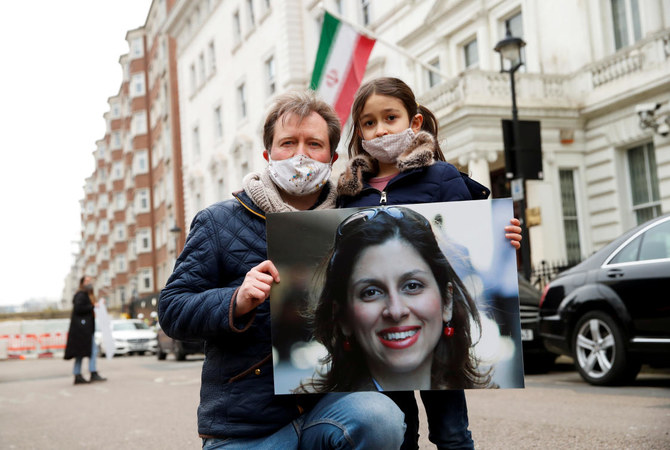
Richard Ratcliffe, husband of British-Iranian aid worker Nazanin Zaghari-Ratcliffe, and their daughter Gabriella protest outside the Iranian Embassy in London, Britain March 8, 2021. (Reuters)
Short Url
Updated 14 March 2021
Follow

British-Iranian aid worker Zaghari-Ratcliffe appears in Iran court for propaganda trial

  • Raab said the second trial was "unacceptable" and called on Iran to let Zaghari-Ratcliffe return to Britain
  • The propaganda charge relates to her alleged participation in a rally in front of the Iranian Embassy in London in 2009 and giving interview to the BBC Persian TV channel

DUBAI: British-Iranian aid worker Nazanin Zaghari-Ratcliffe was tried on a new charge of making "propaganda against the system" at Iran's Revolutionary court on Sunday, her lawyer said, one week after she completed a five-year jail sentence.
British foreign minister Dominic Raab said the second trial was "unacceptable" and called on Iran to let Zaghari-Ratcliffe return to Britain. He said Iran had subjected her to a "cruel and disgraceful ordeal".
Zaghari-Ratcliffe, a project manager with the Thomson Reuters Foundation, was arrested in April 2016 and later convicted of plotting to overthrow the clerical establishment.
Her family and the foundation, a charity that operates independently of media firm Thomson Reuters and its news subsidiary Reuters, deny the charge.
The propaganda charge relates to her alleged participation in a rally in front of the Iranian Embassy in London in 2009 and giving interview to the BBC Persian TV channel at the same time, according to her lawyer Hojjat Kermani.
After the trial on Sunday, Kermani said he expected the verdict within the next week.
"Zaghari-Ratcliffe was fine and calm at the court session," he told Reuters. "I am very hopeful that she will be acquitted."
The Iranian Judiciary was not immediately available to comment.
Zaghari-Ratcliffe, who served out most of her five-year sentence in Tehran's Evin prison, was released last March during the coronavirus pandemic and kept under house arrest until last Sunday. The authorities removed her ankle tag but immediately summoned her to court again on the other charge.
Her husband Richard, who has set up the “Free Nazanin” campaign group and lobbied the British government to secure his wife’s release, said in a statement that "at present, Nazanin’s future remains uncertain, and her detention effectively open ended".
Antonio Zappulla, CEO of the Thomson Reuters Foundation, said in a statement that the second trial was a deliberate move to prolong her ordeal and her suffering.
"It is incomprehensible that she faces further trauma as punishment for crimes that she did not commit," he said.
British Prime Minister Boris Johnson, in a call with Iranian President Hassan Rouhani on Wednesday, said Zaghari-Ratcliffe must be allowed to return home to her family.
Iranian media reported that during the call, Rouhani raised the issue of a historical debt of 400 million pounds ($557 million) which Tehran says Britain owes the Islamic Republic in capital and interest for a 1970s arms deal with the then-Shah of Iran. ($1 = 0.7183 pounds) 

Soleimani’s shadow
Qassem Soleimani left a trail of death and destruction in his wake as head of Iran’s Quds Force … until his assassination on Jan. 3, 2020. Yet still, his legacy of murderous interference continues to haunt the region

Enter


keywords

Death toll rises to at least 10 in violence around Iran protests

Updated 11 sec ago
Follow

Death toll rises to at least 10 in violence around Iran protests

DUBAI: Violence surrounding protests in Iran sparked by the Islamic Republic’s ailing economy killed two other people, authorities said Saturday, raising the death toll in the demonstrations to at least 10 as they showed no signs of stopping.
The new deaths follow US President Donald Trump warning Iran on Friday that if Tehran “violently kills peaceful protesters,” the United States “will come to their rescue.” While it remains unclear how and if Trump will intervene, his comments sparked an immediate, angry response from officials within the theocracy threatening to target American troops in the Mideast.
The weeklong protests, have become the biggest in Iran since 2022, when the death of 22-year-old Mahsa Amini in police custody triggered nationwide demonstrations. However, the protests have yet to be as widespread and intense as those surrounding the death of Amini, who was detained over not wearing her hijab, or headscarf, to the liking of authorities.
The deaths overnight into Saturday involved a new level of violence. In Qom, home to the country’s major Shiite seminaries, a grenade exploded, killing a man there, the state-owned IRAN newspaper reported. It quoted security officials alleging the man carried the grenade to attack people in the city, some 130 kilometers (80 miles) south of the capital, Tehran.
Online videos from Qom purportedly showed fires in the street overnight.
The second death happened in the town of Harsin, some 370 kilometers (230 miles) southwest of Tehran. There, the newspaper said a member of the Basij, the all-volunteer arm of Iran’s paramilitary Revolutionary Guard, died in a gun and knife attack in the town in Kermanshah province.
Demonstrations have reached over 100 locations in 22 of Iran’s 31 provinces, the US-based Human Rights Activists News Agency reported.
Iran’s civilian government under reformist President Masoud Pezeshkian has been trying to signal it wants to negotiate with protesters. However, Pezeshkian has acknowledged there is not much he can do as Iran’s rial has rapidly depreciated, with $1 now costing some 1.4 million rials. That sparked the initial protests.
