LONDON: British Prime Minister Boris Johnson on Wednesday told Iran’s President Hassan Rouhani to free all dual nationals, including a woman facing further court action despite her sentence having ended, his office said.
“The prime minister raised the case of Nazanin Zaghari-Ratcliffe and other British-Iranian dual nationals detained in Iran and demanded their immediate release,” Johnson’s office said in a statement following a call between them.
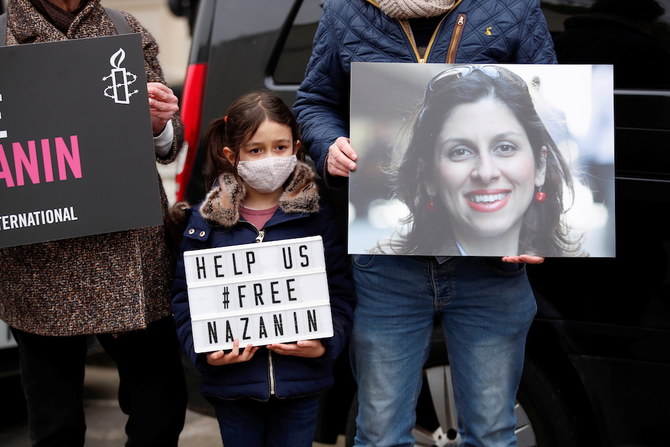
Following the official conclusion of Zaghari-Ratcliffe’s five-year sentence for sedition in Iran on Sunday, Britain has called for her to be able to return to her family in the UK.
The former aid worker, 42, had an ankle tag removed and was allowed to leave home detention to visit relatives in Tehran on the day she was supposed to be freed.
But she now faces another court appearance in Iran next Sunday, confounding hopes among her family, friends and supporters of an immediate return home.
Downing Street said Johnson had told Rouhani “while the removal of Nazanin Zaghari-Ratcliffe’s ankle monitor was welcome, her continued confinement remains completely unacceptable.”
On Sunday, Zaghari-Ratcliffe’s husband, Richard Ratcliffe, said she was “genuinely happy” to have been given a greater degree of freedom but he cautioned she “remained in harm’s way” with the fresh court summons hanging over her.
Iran’s presidency said during the Johnson call Rouhani had raised historical UK debt to Iran, which dates back over 40 years to when the shah of Iran paid Britain £400 million for 1,500 Chieftain tanks.
When the shah was ousted in 1979, Britain refused to deliver the tanks to the new Islamic republic but kept the money.
“It’s quite strange that the process of paying the (UK) defense debts to Iran, which are forty years old, has not yet progressed in reality,” the Iranian presidency said in its statement.
“Without any doubt, accelerating the payment of these debts to Iran will also be useful to solving other issues in the (bilateral) relations.”
Johnson and Rouhani also discussed negotiations to resurrect Iran’s 2015 nuclear deal with world powers.
Britain has remained one of the signatories to the deal, known as the Joint Comprehensive Plan of Action (JCPOA), despite US withdrawal under former president Donald Trump in 2018.
“The prime minister also stressed that while the UK remains committed to making the Iran nuclear deal a success, Iran must stop all its nuclear activity that breaches the terms of the JCPOA and come back into compliance,” his office said.
“He stressed the importance of Iran seizing the opportunity presented by the United States’ willingness to return to the deal if Iran comes back into compliance,” it added.
Britain, along with France and Germany — known as the E3 — has criticized Iran for failing to comply with the nuclear deal and grant unfettered access to the UN’s nuclear watchdog to its sites.
US President Joe Biden has signalled a readiness to return to the nuclear deal.
But Washington said on Wednesday it would not look to revive the accord before Iranian elections in June, which are expected to fall in the favor of a more hard-line president in Tehran.
Iran said Rouhani had reaffirmed to Johnson that the country’s position on the JCPOA remained “action for action.”
It added he welcomed the E3 last week dropping a planned resolution at the UN nuclear watchdog the International Atomic Energy Agency (IAEA) denouncing Iran’s suspension of some inspections.


![]()

UK demands immediate release of Zaghari-Ratcliffe, other dual nationals held in Iran
Short Url
https://arab.news/mff99
UK demands immediate release of Zaghari-Ratcliffe, other dual nationals held in Iran
- Johnson also urged Rouhani to end Iranian breaches of nuclear deal


Latest updates



Recommended


© 2026 SAUDI RESEARCH & PUBLISHING COMPANY, All Rights Reserved And subject to Terms of Use Agreement.