

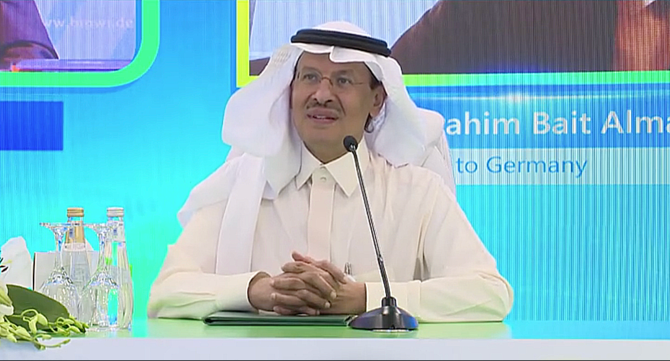

DUBAI: Saudi Arabia and Germany have launched a landmark energy partnership to help implement the goals of the Paris Agreement on climate change.
The two countries will cooperate closely in the emerging fuel of “green” hydrogen, which many experts regard as a “fuel of the future,” in the global effort to reduce harmful greenhouse gas emissions.
Prince Abdul Aziz bin Salman, the Kingdom’s energy minister, signed a memorandum of understanding (MOU) with Peter Altmaier, Germany’s minister for economics and energy, in a ceremony organized from Riyadh.
The groundbreaking MOU recognized both countries’ shared objective to create an appropriate environment for economically and ecologically sustainable development, and to work together toward implementing the goals of the Paris Agreement to reduce greenhouse gas emissions.
FASTFACT
The groundbreaking MOU recognized both countries’ shared objective to create an appropriate environment for economically and ecologically sustainable development, and to work together toward implementing the goals of the Paris Agreement to reduce greenhouse gas emissions.
The agreement seeks to promote cooperation between Saudi Arabia and Germany regarding the generation, processing, use and transportation of clean hydrogen for the benefit of both countries.
Prince Abdul Aziz said: “The potential of hydrogen has always been there, but now it is entering the mainstream of strategic energy thinking. As countries work jointly to address climate change, we affirm our commitment to lead the response in managing emissions, while continuing our socio-economic development. Our commitment to tackle climate change is firm, a commitment I know Germany shares.
“It is also a compelling investment proposition, with huge investment opportunities in hydrogen over the coming decades,” he added.
Saudi Arabia has targeted “green” hydrogen — made from renewable sources such as wind and solar power — as a priority for the energy sector’s diversification under the Vision 2030 strategy, and is in the process of building a facility to generate the fuel on a large scale at the NEOM megacity.
“Saudi Arabia is blessed with an abundance of wind and solar energy, in addition to our renowned hydrocarbon resources. The Kingdom has all the ingredients to be a world leader in the field of hydrogen,” the prince added.
The Kingdom last year also exported the first-ever shipment of “blue” hydrogen — manufactured as a byproduct of oil and gas production — to Japan to power clean electricity generation there.
Germany, which is trying to wean itself off coal, regarded as the worst form of hydrocarbon pollutant, last year launched its National Hydrogen Strategy and passed legislation to enable the incorporation of “green” hydrogen as a fuel for national electricity generation.
READ MORE
Saudi Arabia is building a $5-billion green fuel plant for export in a bid to become the world’s largest supplier of hydrogen, Bloomberg reported. Click here for more.
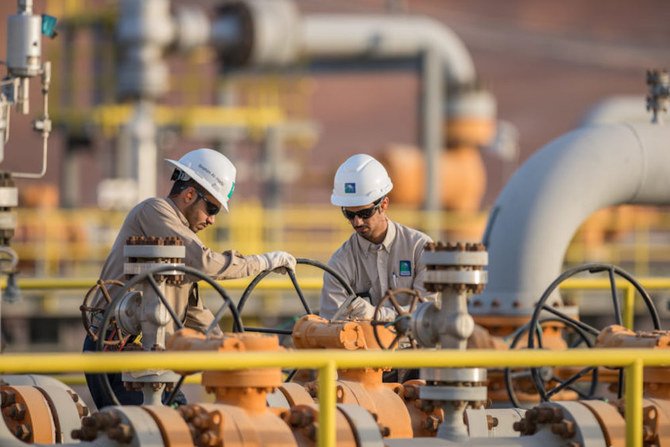
Scientists and economists have endorsed the potential value of hydrogen for some time, but in the past it has been expensive to produce compared with hydrocarbon fuels, and difficult to transport because of its explosive qualities.
But the cost is coming down, along with cheaper renewable energy sources, and engineers are working to make it more practical to transport across long distances.
Prince Abdul Aziz told a recent conference that the Kingdom might consider building a green hydrogen pipeline to Europe if the economic rationale was viable.
He highlighted the benefits of the Saudi-German collaboration in technology transfer, research and development and workforce enhancement, as well as the economic impact.
“Germany’s excellence in technology is world renowned, as is its status as a global economic power. Therefore, the fact that Germany and Saudi Arabia have joined together in this strategic cooperation is a testament to our serious mutual intentions,” he said.
“Relations between our two countries go back many decades, and this MOU will lend additional support to further our friendship for generations to come.”
The collaboration between Europe’s biggest economy and technology powerhouse, and the Middle East’s leading energy supplier was welcomed by energy experts.
Joseph McMonigle, secretary-general of the International Energy Forum, told Arab News: “Both Saudi Arabia and Germany have embarked on new net-zero emission pathways, but experts report that the emissions cut needed to meet the world’s climate goals need to come from technologies that do not exist yet.
“Green hydrogen is one example, and the missing link between renewables and hydrocarbon technologies that holds great promise for the energy transition,” he added.


