Saudi UN mission hails Kingdom’s successes in empowering women

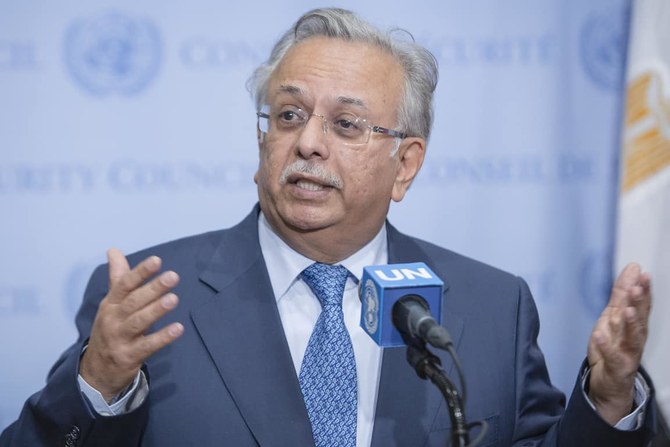
Ambassador Abdallah Al-Mouallimi, the Kingdom’s permanent representative to the UN, convened a high-level meeting to celebrate the event. (UN)
Short Url
Updated 10 March 2021
Follow

Saudi UN mission hails Kingdom’s successes in empowering women

  • Government is working to ensure females play an increasingly important role in the country, envoy says during Women’s Day event
  • The empowerment of women and gender equality are key aspects of the Saudi Vision 2030 development plan

NEW YORK: As part of its celebrations for International Women’s Day, the Saudi mission to the UN in New York on Tuesday highlighted the Kingdom’s recent successes in its efforts to empower women.

Ambassador Abdallah Al-Mouallimi, the permanent Saudi representative to the UN, organized a high-level meeting during which he talked about some of the remarkable reforms and achievements that are ensuring women in Saudi Arabia play an increasingly important role in the decision-making processes in all aspects of daily life.

“Since launching Vision 2030 in 2016, the government of the Kingdom of Saudi Arabia has made qualitative legislative reforms that confirm the strong commitment (to) women’s full and effective participation (in) decision-making, (as) well as the elimination of violence, achieving gender equality and the empowerment of all Saudi women and girls in all fields in public and private sectors,” the Saudi mission said in a statement.

It also reiterated the three pillars of Vision 2030: a vibrant society, a thriving economy, and an ambitious nation in which Saudi women are invited to engage “more than ever” as active partners in society, government and economic decisions.

Organizers of the Saudi event looked for inspiration to the words of Crown Prince Mohammad bin Salman, chairman of the Council of Economic and Development Affairs, who said at the launch of Vision 2030: “We commit ourselves to provide world-class government services which effectively and efficiently meet the needs of our citizens. Together we will continue building a better country, fulfilling our dream of prosperity and unlocking the talent, potential, and dedication of our young men and women.”

In his opening remarks on Tuesday, Al-Mouallimi invoked the words of a hadith by the Prophet Muhammad which teaches that in Islam women are independent of and equal to men: “Assuredly, women are the twin halves of men.”

The ambassador said that the theme of International Women’s Day this year — Women in Leadership: Achieving an Equal Future — has therefore been a familiar idea to Muslims for more than 1400 years. This same, true model of Islam is being restored through Vision 2030, he added.

Al-Mouallimi said that since the launch of Vision 2030, the Saudi government has re-examined civil and labor laws and regulations, and through an ongoing process of reforms and initiatives it has set the stage for the empowerment of women in all spheres of public life, while advocating for gender equality and inclusivity at the highest levels of decision-making.

Guests at the meeting included Phumzile Mlambo-Ngcuka, the executive director of UN women; Miguel Moratinos, the UN’s high-representative for the Alliance of Civilizations; Thoraya Obaid, chair of W20, the G20 engagement group that focuses on women’s empowerment and gender equality; Amal Yahya Al-Mouallimi, the Saudi ambassador to Norway; Hala Altwaijry, secretary-general of the Family Affairs Council of Saudi Arabia; Hind Al-Zahid, Saudi deputy minister of women’s empowerment; and Sarah Al-Tamimi, vice chair of the Kingdom’s National Committee to Combat Human Trafficking.

Al-Mouallimi told the participants that, just five years into the Vision 2030 process, the benefits to women in Saudi Arabia already exceed simple empowerment, with some already achieving success as young leaders.

“Today we can see Saudi women in senior positions playing a crucial role with their male twin halves: ambassadors, members of the Shoura Council, general directors, CEOs, ministries’ and entities’ spokespersons, athletes and scientists.”

The envoy added that women have also achieved leadership positions in the Kingdom’s Armed Forces.

Al-Mouallimi thanked the guests for being part of the celebration of “Saudi women flourishing beautifully and admirably.”

He also called on them to take note of the ongoing socioeconomic reforms in the Kingdom and its achievements in female empowerment during a time of “complex and global humanitarian and economic challenges” resulting from the COVID-19 pandemic.

In particular, he highlighted the W20 summit that took place during the Saudi presidency of the G20 last year, and the declaration of Riyadh as the capital of Arab Women for 2020, during the 39th session of Arab Women Committee under the auspices of the Arab League.

International Women’s Day, which is celebrated on March 8 each year, commemorates the social, economic, cultural and political achievements of women around the world.


Air force partnerships are stabilizing force in region, US army lieutenant says

Updated 6 sec ago
Follow

Air force partnerships are stabilizing force in region, US army lieutenant says

  • Lt. Gen. Derek France: The purpose of being here today is to support our friends in the Kingdom of Saudi Arabia
  • France: A great example is the Spears of Victory exercise, where US F-16s and American airmen participated alongside the Royal Saudi Air Force

RIYADH: Saudi Arabia and the US have long enjoyed a strong military relationship, one that continues to grow even as regional and global tensions increase.

US Army Lt. Gen. Derek France, commander of the Ninth Air Force, spoke to Arab News on the sidelines of the World Defense Show in Riyadh about the two nations’ history and future.

“The purpose of being here today is to support our friends in the Kingdom of Saudi Arabia,” he said.

During his visit, the lieutenant met Commander of the Royal Saudi Air Force Lt. Gen. Turki bin Bandar, to discuss the scope of cooperation between the two air forces.

“A great example is the Spears of Victory exercise, where US F-16s and American airmen participated alongside the Royal Saudi Air Force,” France said.

Spears of Victory was a large-scale, multinational air exercise hosted by Saudi Arabia at the King Abdulaziz Air Base in Dhahran from Jan. 18 to Feb. 7.

The exercise, widely regarded as one of the most comprehensive air drills in the Middle East, brought together the RSAF and regional and international partners, including the US, to enhance combat readiness and interoperability.

Beyond providing a platform for strengthening military partnerships and reinforcing collective deterrence and regional stability, Spears of Victory had participating forces conducting complex joint operations, advanced mission planning, and integrated airpower scenarios designed to reflect modern, multi-domain warfare.

“It was a fantastic success and a strong demonstration of partnership,” France said.

According to the commander, the US military’s role in the region is built on partnerships, citing a history of “airmen working with airmen.”

“There is a common language in airpower that transcends cultures and border.”

That cooperation, he said, dates back to Operation Desert Storm through the fight against the Islamic State (Daesh), and beyond.

Operation Desert Storm was the combat phase of the US-led international coalition’s response to Iraq’s invasion of Kuwait in 1990-1991.

Following months of military buildup and diplomacy, the operation combined a sustained air campaign with a brief but decisive ground offensive that liberated Kuwait and significantly degraded Iraq’s military capabilities.

Saudi Arabia played a central role as a host nation and key partner, providing basing, logistical support and regional coordination for coalition forces; laying the foundation for long-standing US-Saudi defense cooperation and a defining moment for modern warfare.

“When air forces are interoperable, understand one another, and train together, it becomes a deterrent and contributes to stability in the region against those who seek to destabilize it.”

The US Embassy Chargee d’Affaires Alison Dilworth in a statement to Arab News added that “the United States is committed to supporting the defense of Saudi Arabia as well as regional security and stability.

“As President Trump said when he designated Saudi Arabia as a major non-NATO ally, ‘A stronger and more capable alliance will advance the interests of both countries, and it will serve the highest interests of peace.’”

The main priority in the US-Saudi military partnership over the next few years is robust integration, France explained.

That includes technical integration through common communications, shared platforms where possible, and strong training and exercise programs to test and improve interoperability.

“There is also a crucial human element. When US and Saudi forces operate side by side, it creates opportunities to learn from each other and understand each other’s cultures.”

France added that many US airmen arrived with preconceived notions of the Middle East that were almost immediately challenged.

However, the US is no stranger to criticism for its military operations worldwide, with recent concern raised over President Trump’s ambitions in Iran, Greenland and Gaza.

Responding to that criticism, France said that a strong military-to-military relationship helped to stabilize regions, often enduring longer than political cycles, and could remain steady even when diplomacy came under pressure.

“I’ve seen this not just here, but elsewhere. These relationships often underpin stability even when political relationships become strained.”

He recalled the time when he flew with the Saudi Air Force in Dhahran in 2004-2005 and formed personal relationships that still exist today.

“One of the general officers who now runs their (Air) Warfare Center is a close friend.

“Those relationships can resurface years later and become enduring bonds between nations, helping sustain broader cooperation even during political challenges.”