Air force partnerships are stabilizing force in region, US Air Force Lieutenant General says

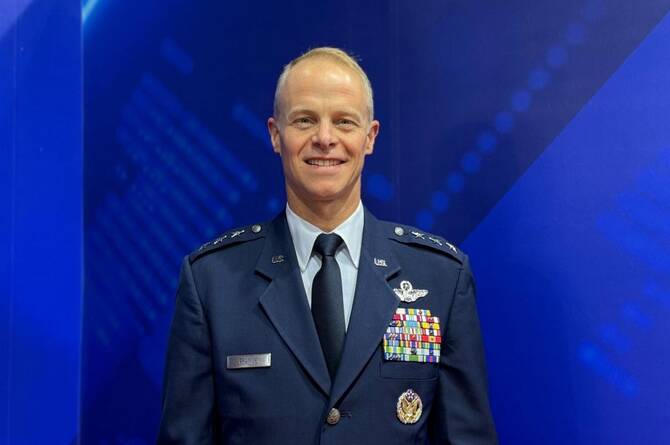
US Air Force Lieutenant General Derek France, commander of the Ninth Air Force, spoke to Arab News on the sidelines of the World Defense Show in Riyadh. (AN Photo)
Short Url
Updated 10 February 2026
Follow

Air force partnerships are stabilizing force in region, US Air Force Lieutenant General says

  • Lt. Gen. Derek France: The purpose of being here today is to support our friends in the Kingdom of Saudi Arabia
  • France: A great example is the Spears of Victory exercise, where US F-16s and American airmen participated alongside the Royal Saudi Air Force

RIYADH: Saudi Arabia and the US have long enjoyed a strong military relationship, one that continues to grow even as regional and global tensions increase.

US Air Force Lt. Gen. Derek France, commander of the Ninth Air Force, spoke to Arab News on the sidelines of the World Defense Show in Riyadh about the two nations’ history and future.

“The purpose of being here today is to support our friends in the Kingdom of Saudi Arabia,” he said.

During his visit, the lieutenant general met Commander of the Royal Saudi Air Force Lt. Gen. Turki bin Bandar, to discuss the scope of cooperation between the two air forces.

“A great example is the Spears of Victory exercise, where US F-16s and American airmen participated alongside the Royal Saudi Air Force,” France said.

Spears of Victory was a large-scale, multinational air exercise hosted by Saudi Arabia at the King Abdulaziz Air Base in Dhahran from Jan. 18 to Feb. 7.

The exercise, widely regarded as one of the most comprehensive air drills in the Middle East, brought together the RSAF and regional and international partners, including the US, to enhance combat readiness and interoperability.

Beyond providing a platform for strengthening military partnerships and reinforcing collective deterrence and regional stability, Spears of Victory had participating forces conducting complex joint operations, advanced mission planning, and integrated airpower scenarios designed to reflect modern, multi-domain warfare.

“It was a fantastic success and a strong demonstration of partnership,” France said.

According to the commander, the US military’s role in the region is built on partnerships, citing a history of “airmen working with airmen.”

“There is a common language in airpower that transcends cultures and border.”

That cooperation, he said, dates back to Operation Desert Storm through the fight against the Islamic State (Daesh), and beyond.

Operation Desert Storm was the combat phase of the US-led international coalition’s response to Iraq’s invasion of Kuwait in 1990-1991.

Following months of military buildup and diplomacy, the operation combined a sustained air campaign with a brief but decisive ground offensive that liberated Kuwait and significantly degraded Iraq’s military capabilities.

Saudi Arabia played a central role as a host nation and key partner, providing basing, logistical support and regional coordination for coalition forces; laying the foundation for long-standing US-Saudi defense cooperation and a defining moment for modern warfare.

“When air forces are interoperable, understand one another, and train together, it becomes a deterrent and contributes to stability in the region against those who seek to destabilize it.”

The US Embassy Chargee d’Affaires Alison Dilworth in a statement to Arab News added that “the United States is committed to supporting the defense of Saudi Arabia as well as regional security and stability.

“As President Trump said when he designated Saudi Arabia as a major non-NATO ally, ‘A stronger and more capable alliance will advance the interests of both countries, and it will serve the highest interests of peace.’”

The main priority in the US-Saudi military partnership over the next few years is robust integration, France explained.

That includes technical integration through common communications, shared platforms where possible, and strong training and exercise programs to test and improve interoperability.

“There is also a crucial human element. When US and Saudi forces operate side by side, it creates opportunities to learn from each other and understand each other’s cultures.”

France added that many US airmen arrived with preconceived notions of the Middle East that were almost immediately challenged.

However, the US is no stranger to criticism for its military operations worldwide, with recent concern raised over President Trump’s ambitions in Iran, Greenland and Gaza.

Responding to that criticism, France said that a strong military-to-military relationship helped to stabilize regions, often enduring longer than political cycles, and could remain steady even when diplomacy came under pressure.

“I’ve seen this not just here, but elsewhere. These relationships often underpin stability even when political relationships become strained.”

He recalled the time when he flew with the Saudi Air Force in Dhahran in 2004-2005 and formed personal relationships that still exist today.

“One of the general officers who now runs their (Air) Warfare Center is a close friend.

“Those relationships can resurface years later and become enduring bonds between nations, helping sustain broader cooperation even during political challenges.”


Saudi Arabia witnessing comprehensive cultural development, says expert

Updated 14 February 2026
Follow

Saudi Arabia witnessing comprehensive cultural development, says expert

  • Clotilde Entrecanales of Acciona hails pace of change in Kingdom

JEDDAH: Museums, exhibitions and art centers play a crucial role in the development of free and educated societies such as the one now burgeoning in Saudi Arabia, an expert has told Arab News.

Clotilde Entrecanales, the Spanish art historian and cultural executive who heads Acciona Living & Culture, a leading creator of technology-driven interactive museums, exhibits and events, said the Kingdom is making efforts to expand the role of culture development to show the world the greatest possible cultural offer.

She added that the Kingdom has quickly infused new energy into the region, and is rapidly establishing itself as a global cultural hub through massive investment in world-class museums, public art and international events, aligning with its 2030 vision.

She said: “With around 70 percent of the population under 30, cultural consumption looks very different than in Europe or the US. These spaces can’t feel like quiet, isolated institutions … they need to be fast, dynamic, brave and deeply connected to the city, blending into everyday urban life rather than sitting apart from it.”

Asked about the role of these sites in the evolving global cultural landscape, particularly in emerging cultural hubs like Saudi Arabia, Entrecanales said: “Our vision is to be a purpose-led partner for cultural and entertainment institutions, helping them be more relevant, connected, inclusive and sustainable.”

She added: “In emerging cultural hubs like Saudi Arabia, that approach feels especially relevant. The cultural transformation underway is moving fast — with major heritage and cultural destinations being developed and opened to the world.”

Speaking about her impression of the Kingdom’s approach to blending heritage with modernity face, Entrecanales said: “Others who attempt to achieve this balance often end up turning heritage into a theme, a layer of storytelling or a cultural program. What feels different about Saudi’s approach is how much pressure there is to treat heritage as the foundation, not just the surface.

“When you’re building at this speed and scale, there’s always a risk that history becomes a backdrop instead of a backbone. The projects that work best are the ones that slow down just enough to let the past set the rhythm for the present.”

Regarding opportunities and challenges, she said: “The opportunity is nothing less than positioning Saudi Arabia as a global cultural center. The challenge, as always, lies in balancing the speed and scale of that ambition with long-term sustainability and a sense of authenticity that remains credible and rooted.”

She added: “You can really feel this in places like the Islamic Arts Biennale, which shows hundreds of historical artefacts of the Islamic world, while re-framing them through contemporary scenography and designs by some of the best design studios in the world; or in AlUla, a world-class heritage site that hosts a major contemporary platform like Desert X, allowing ancient context and present-day artistic practice to coexist in a way that feels genuine.”

Under her guidance, ACCIONA Cultura aspires to create museums and cultural experiences that function as landmarks while fostering sustainable, inclusive and immersive interactions.

She elaborated on how the company is integrating technology, culture, and sustainability to preserve and promote the region’s cultural heritage: “We always start with human connection and storytelling: what’s the story, what should people leave with? Tech comes later.”

Recently, ACCIONA Cultura has been involved in significant projects in Saudi Arabia and is looking forward for more.

She said: “Right now, for example, we’re designing and curating a museum gallery where the entire space is shaped by the practice of a Saudi artist. Another example is the Net Zero exhibition at the King Abdulaziz Center for World Culture (Ithra), where we brought together Saudi and international artists to explore sustainability and our relationship with the planet, including voices like Dina Haddadin, Mohammed Al-Faraj, and Zahrah Al-Ghamdi.”

She added: “One of the projects I’m most proud of isn’t a museum, but our NEXT IN Summit, which we’ve hosted in two editions in our ACCIONA Campus in Madrid, highlighting the Kingdom’s unprecedented cultural momentum as it builds future-facing institutions with a startup mindset.”

About further collaboration with Saudi Arabia, she said: “Let’s just say … something’s definitely simmering in the kitchen.”

Commenting on being recognized among the Blooloop 50 Museum Influencers for 2025, she said: “It means a lot. More than anything, it feels like a nod to the years of teamwork and dedication behind Acciona Cultura, rather than to me personally.”