

Judge orders Lebanese health ministry to give COVID-19 vaccine to 80-year-old

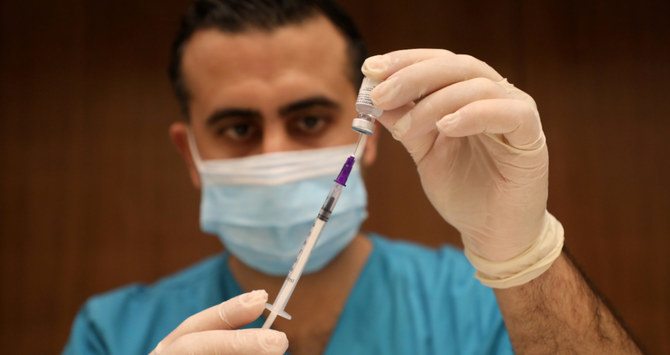
A judge has ordered the Lebanese health ministry to vaccinate an 80-year-old man against coronavirus disease (COVID-19) after members of parliament jumped the queue to receive the jab. (Reuters/File Photo)
Short Url
Updated 05 March 2021
Follow

Judge orders Lebanese health ministry to give COVID-19 vaccine to 80-year-old

  • Joseph Al-Hajj took legal action after MPs, public officials jumped inoculation queue

BEIRUT: A judge has ordered the Lebanese health ministry to vaccinate an 80-year-old man against coronavirus disease (COVID-19) after members of parliament jumped the queue to receive the jab.

Joseph Al-Hajj registered in January for a vaccination along with other elderly Lebanese after they were asked to do so by Lebanon’s health authorities.

But after more than a month of waiting, during which a scandal erupted over MPs getting inoculated ahead of the public, Al-Hajj became increasingly frustrated.

Urgent matters judge, Carla Chawwah, on Wednesday issued a decision at Beirut civil court ordering the health ministry to provide vaccination to Al-Hajj by Friday.

The ruling, seen by Arab News, gave instructions that Al-Hajj should be given a COVID-19 vaccine jab within 48 hours, otherwise a fine of 10 million Lebanese pounds ($6,618) would be levied for every subsequent day it was delayed.

Chawwah provided the justice ministry with a copy of her decision.

In his lawsuit, Al-Hajj’s lawyer argued that his client had been waiting to be contacted by the health ministry about his appointment for the vaccination when it emerged that 16 lawmakers and some public officials were inoculated at the Lebanese parliament on Feb. 23.

The lawyer said his client’s health condition should be a “top priority.” As well as his age, he suffered from a clogged artery in his left leg and required permanent medication.

Al-Hajj’s attorney added that vaccinating the MPs and public officials before his client, flouted the set conditions and mechanisms of inoculation procedures.

Chawwah’s ruling said vaccinating the MPs and officials ahead of many vulnerable citizens was a breach of human and health rights.


Lebanese finance minister denies any plans for a Kushner-run economic zone in the south

Updated 5 sec ago
Follow

Lebanese finance minister denies any plans for a Kushner-run economic zone in the south

  • Proposal was made by US Envoy Morgan Ortagus but was ‘killed on the spot’
  • Priority is to regain control of state in all aspects, Yassine Jaber tells Arab News

DAVOS: Lebanon’s finance minister dismissed any plans of turning Lebanon’s battered southern region into an economic zone, telling Arab News on the sidelines of the World Economic Forum’s meeting in Davos that the proposal had died “on the spot.”

Yassine Jaber explained that US Envoy to Lebanon Morgan Ortagus had proposed the idea for the region, which has faced daily airstrikes by Israel, and it was immediately dismissed.

Jaber’s comments, made to Arab News on the sidelines of the World Economic Forum in Davos, were in response to reports which appeared in Lebanese media in December which suggested that parts of southern Lebanon would be turned into an economic zone, managed by a plan proposed by Jared Kushner, US President Donald Trump’s son in law.

Meanwhile, Jaber also dismissed information which had surfaced in Davos over the past two days of a bilateral meeting between Lebanese ministers, US Middle East Envoy Steve Witkoff and Kushner.

Jaber said that the meeting on Tuesday was a gathering of “all Arab ministers of finance and foreign affairs, where they (Witkoff and Kushner) came in for a small while, and explained to the audience the idea about deciding the board of peace for Gaza.”

He stressed that it did not develop beyond that.

When asked about attracting investment and boosting the economy, Jaber said: “The reality now is that we need to reach the situation where there is stability that will allow the Lebanese army, so the (Israeli) aggression has to stop.”

Over the past few years, Lebanon has witnessed one catastrophe after another: one of the world’s worst economic meltdowns, the largest non-nuclear explosion in its capital’s port, a paralyzed parliament and a war with Israel.

A formal mechanism was put in place between Lebanon and Israel to maintain a ceasefire and the plan to disarm Hezbollah in areas below the Litani river.

But, the minister said, Israel’s next step is not always so predictable.

“They’re actually putting pressure on the whole region. So, a lot of effort is being put on that issue,” he added.

“There are still attacks in the south of the country also, so stability is a top necessity that will really succeed in pushing the economy forward and making the reforms beneficial,” he said.

Lawmakers had also enacted reforms to overhaul the banking sector, curb the cash economy and abolish bank secrecy, alongside a bank resolution framework.

Jaber also stressed that the government had recently passed a “gap law” intended to help depositors recover funds and restore the banking system’s functionality.

“One of the priorities we have is really to deal with all the losses of the war, basically reconstruction … and we have started to get loans for reconstructing the destroyed infrastructure in the attacked areas.”

As Hezbollah was battered during the war, Lebanon had a political breakthrough as the army’s general, Joseph Aoun, was inaugurated as president. His chosen prime minister was the former president of the International Court of Justice, Nawaf Salam.

This year marks the first time a solid delegation from the country makes its way to Davos, with Salam being joined by Jaber, Economy and Trade Minister Amr Bisat, and Telecoms Minister Charles Al-Hage.

“Our priority is to really regain the role of the state in all aspects, and specifically in rebuilding the institutions,” Jaber said.