

Thousands flee Ethiopia violence, seek asylum in Sudan

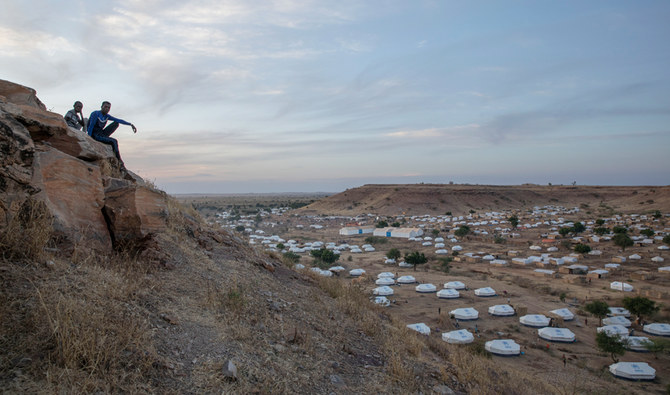
Tigray men sit atop a hill overlooking part of the Umm Rakouba refugee camp, hosting people who fled the conflict in the Tigray region of Ethiopia, in Qadarif, eastern Sudan. (AP)
Short Url
Updated 24 February 2021
Follow

Thousands flee Ethiopia violence, seek asylum in Sudan

  • Violence in Metekel Zone of Benishangul-Gumuz region is separate from conflict in Tigray region

CAIRO: At least 7,000 people who fled escalating ethnic violence in western Ethiopia have sought asylum in neighboring Sudan, the UN refugee agency said on Tuesday, amid heightened tensions between the two Eastern African nations.

Violence in the Metekel Zone of the Benishangul-Gumuz region is separate from the deadly conflict in Ethiopia’s northern Tigray region. That’s where Ethiopian and allied regional forces began fighting Tigray regional forces in early November. The Tigray war sent more than 61,000 Ethiopians into Sudan’s provinces of Al-Qadarif and Kassala.
The UNHCR said most of the 7,000 asylum seekers who fled Metekel have been living among Sudanese host communities. It said it was working with local authorities in the Blue Nile province to respond to the humanitarian needs of the newly arrived, many of whom have arrived in hard-to-reach places along the border.
Tensions escalated in the past three months in Metekel Zone, prompting Ethiopia’s government to declare a state of emergency in the area on Jan. 21, the UN agency said. The Ethiopian Human Rights Commission said more than 180 people were killed in separate massacres in Metekel in December and January.
Amnesty International reported in December that members of the ethnic Gumuz community — the ethnic majority in the region — attacked the homes of ethnic Amhara, Oromo and Shinasha. The rights group said the Gumuz set the homes on fire and stabbed and shot residents. The Gumuz see minorities as “settlers,” the rights group said.
Ethnic violence poses a major challenge to Ethiopian Prime Minister Abiy Ahmed as he tries to promote national unity in a country with more than 80 ethnic groups.
Amharas are the second most populous ethnic group in Ethiopia and they have been targeted repeatedly over the last year.


Starmer’s chief of staff quits over former US ambassador's Epstein ties

Updated 11 sec ago
Follow

Starmer’s chief of staff quits over former US ambassador's Epstein ties

  • Morgan McSweeney said he took responsibility for advising UK's PM to appoint Peter Mandelson as Washington envoy
  • Epstein files suggest that Mandelson sent market-sensitive information to the convicted sex offender when he was part of UK government
LONDON: British Prime Minister Keir Starmer's chief of staff resigned Sunday over the furor surrounding the appointment of Peter Mandelson as the UK ambassador to the US despite his ties to Jeffrey Epstein.
Morgan McSweeney said he took responsibility for advising Starmer to appoint Mandelson, 72, to Britain’s most important diplomatic post in 2024.
“The decision to appoint Peter Mandelson was wrong. He has damaged our party, our country and trust in politics itself,” McSweeney said in a statement. “When asked, I advised the Prime Minister to make that appointment and I take full responsibility for that advice.”
Starmer is facing a political storm and questions about his judgment after newly published documents, part of a huge trove of Epstein files made public in the United States, suggested that Mandelson sent market-sensitive information to the convicted sex offender when he was the UK government’s business secretary during the 2008 financial crisis.
Starmer’s government has promised to release its own emails and other documentation related to Mandelson’s appointment, which it says will show that Mandelson misled officials.
The prime minister apologized this week for “having believed Mandelson’s lies.”
He acknowledged that when Mandelson was chosen for the top diplomat job in 2024, the vetting process had revealed that Mandelson’s friendship with Epstein continued after the latter’s 2008 conviction. But Starmer maintained that “none of us knew the depth of the darkness” of that relationship at the time.
A number of lawmakers said Starmer is ultimately responsible for the scandal.
“Keir Starmer has to take responsibility for his own terrible decisions,” said Kemi Badenoch, leader of the opposition Conservative Party.
Mandelson, a former Cabinet minister, ambassador and elder statesman of the governing Labour Party, has not been arrested or charged.
Metropolitan Police officers searched Mandelson’s London home and another property linked to him on Friday. Police said the investigation is complex and will require “a significant amount of further evidence gathering and analysis.”
The UK police investigation centers on potential misconduct in public office, and Mandelson is not accused of any sexual offenses.
Starmer had fired Mandelson in September from his ambassadorial job over earlier revelations about his Epstein ties. But critics say the emails recently published by the US Justice Department have brought serious concerns about Starmer’s judgment to the fore. They argue that he should have known better than to appoint Mandelson in the first place.
The new revelations include documents suggesting Mandelson shared sensitive government information with Epstein after the 2008 global financial crisis. They also include records of payments totaling $75,000 in 2003 and 2004 from Epstein to accounts linked to Mandelson or his husband Reinaldo Avila da Silva.
Aside from his association with Epstein, Mandelson previously had to resign twice from senior government posts because of scandals over money or ethics.
Starmer had faced growing pressure over the past week to fire McSweeney, who is regarded as a key adviser in Downing Street and seen as a close ally of Mandelson.
Starmer on Sunday credited McSweeney as a central figure in running Labour’s recent election campaign and the party’s 2004 landslide victory. His statement did not mention the Mandelson scandal.