Airbus CEO urges trade war cease-fire, easing of COVID travel bans

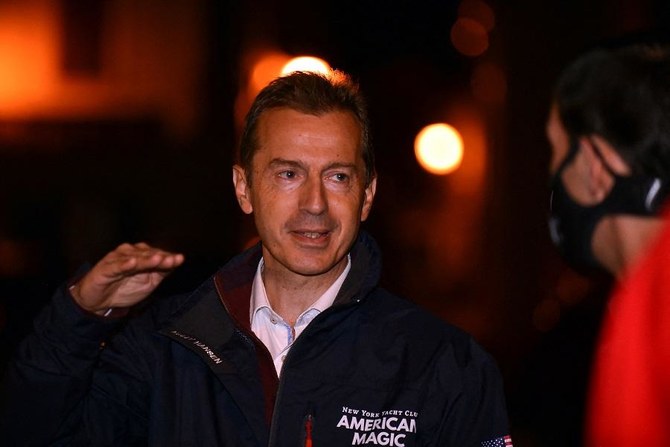
Faury said the dispute with Boeing was particularly damaging during the COVID-19 pandemic, which has badly hit air travel. (File/AFP)
Updated 20 February 2021
Follow

Airbus CEO urges trade war cease-fire, easing of COVID travel bans

PARIS: The head of European planemaker Airbus called on Saturday for a “cease-fire” in a transatlantic trade war over aircraft subsidies, saying tit-for-tat tariffs on planes and other goods had aggravated damage from the COVID-19 crisis.
Washington progressively imposed import duties of 15% on Airbus jets from 2019 after a prolonged dispute at the World Trade Organization, and the EU responded with matching tariffs on Boeing jets a year later. Wine, whisky and other goods are also affected.
“This dispute, which is now an old dispute, has put us in a lose-lose situation,” Airbus Chief Executive Guillaume Faury said in a radio interview.
“We have ended up in a situation where wisdom would normally dictate that we have a cease-fire and resolve this conflict,” he told France Inter.
Boeing was not immediately available for comment.
Brazil, which has waged separate battles with Canada over subsidies for smaller regional jets, on Thursday dropped its own complaint against Ottawa and called for a global peace deal between producing nations on support for aerospace.
Faury said the dispute with Boeing was particularly damaging during the COVID-19 pandemic, which has badly hit air travel and led to travel restrictions or border closures. He expressed particular concern about widening bans within Europe.
“We are extremely frustrated by the barriers that restrict personal movement and it is almost impossible today to travel in Europe by plane, even domestically,” he said.
“The priority no. 1 for countries in general is to reopen frontiers and allow people to travel on the basis of tests and then eventually vaccinations.”
The comments come as businesses increase pressure on governments to reopen economies as coronavirus vaccine roll-outs gather pace across Europe.
France has defended recently introduced border restrictions, saying they will help the government avoid a new lockdown and stay in force until at least the end of February.
Germany installed border controls with the Czech Republic and Austria last Sunday, drawing protest from Austria and concerns about supply-chain disruptions.
Berlin calls the move a temporary measure of last resort.
Poland said on Saturday it had not ruled out imposing restrictions at the country’s borders with Slovakia and the Czech Republic due to rising COVID-19 cases.


Jordan’s capital spending hits $1.97bn in 2025, achieves record budget execution rate

Updated 14 sec ago
Follow

Jordan’s capital spending hits $1.97bn in 2025, achieves record budget execution rate

JEDDAH: Jordan’s capital spending surged 20 percent in 2025 to 1.4 billion dinars ($1.97 billion), achieving a record 96 percent execution rate as the government boosted growth, infrastructure, and development projects nationwide.

This aligns with government directives to implement capital projects funded under the General Budget Law, aimed at stimulating economic growth and accelerating economic activity, according to Jordan News Agency, Petra.

Jordan’s record 2025 capital spending supports its Economic Modernization Vision, funding strategic infrastructure, energy, and industrial projects to drive growth, create jobs, and strengthen fiscal and economic resilience.

The increase also reflects the government’s strategy to encourage private sector participation while enhancing public services and infrastructure across the Kingdom.

“According to preliminary financial data, capital spending increased by approximately 230 million dinars by the end of 2025, or 20 percent, compared with 2024,” Petra reported.

It added: “With this increase, the ratio of actual capital spending to targeted allocations under the 2025 General Budget Law reached about 96 percent, marking the highest execution rate on record, compared with an average of 82 percent in previous years.”

Detailed figures show that approximately 333 million dinars were spent on projects under the Economic Modernization Vision, while around 180 million dinars were allocated to municipal development and 123 million dinars to decentralization initiatives in the governorates.

An additional 55 million dinars supported projects of the Jordan Tourism Board, as per the same source.

Capital funding also targeted major initiatives, including 50 million dinars for initial works on the National Carrier Project, part of the government’s planned 250 million dinars investment. 

A further 29 million dinars went toward completing Princess Basma Hospital, supplying natural gas to industrial zones, maintaining school buildings, and rehabilitating roads nationwide.

Allocations were also directed to upgrading computer systems and advancing the digital transformation of services across several ministries.

Looking ahead, Jordan’s 2026 budget is set to build on the momentum of 2025 by prioritizing the second phase of the Economic Modernization Vision.

With capital spending estimated at 1.6 billion dinars, including 400 million dinars for EMV projects, the government plans over $10 billion in strategic investments across water, energy, and transport, health, as well as infrastructure, largely in partnership with the private sector and funded primarily from external sources.

Flagship projects such as the National Water Carrier, the Aqaba–Shidiyah/Maan–Ghor Al-Safi railway, and the Risheh gas pipeline are expected to spur growth, create jobs, and enhance public services, while fiscal discipline and transparent oversight seek to maintain macroeconomic stability and expand reliance on domestic revenue for public spending.