Oil edges higher but demand fears set in

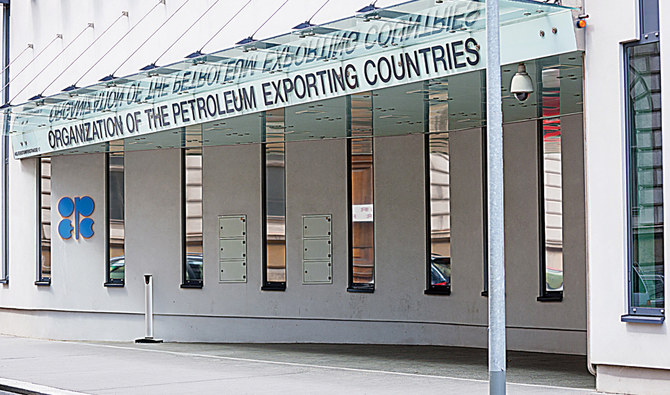
This week OPEC said it expects global oil demand to recover more slowly than thought in 2021, trimming its forecast by 110,000 bpd to 5.79 million bpd. (Shutterstock)
Short Url
Updated 13 February 2021
Follow

Oil edges higher but demand fears set in

  • US oil ups 14 cents, or 0.2 percent, at $58.38 after falling to a session low of $57.41

LONDON: Oil prices edged higher on Friday after declining earlier in the session, but a weaker market outlook from OPEC and the International Energy Agency capped gains.

Brent crude was up 29 cents, or 0.5 percent, at $61.43 a barrel, having dropped to a session low of $60.35. US oil was up 14 cents, or 0.2 percent, at $58.38 after falling to a session low of $57.41. Both contracts are on course for weekly gains.
Prices have risen over recent weeks partly owing to oil production cuts from the Organization of the Petroleum Exporting Countries (OPEC) and other producers in the group known as OPEC+.
Hopes that vaccine rollouts to combat the coronavirus will spur a demand recovery also gave oil prices a lift.
This week however OPEC said it expects global oil demand to recover more slowly than thought in 2021, trimming its forecast by 110,000 barrels per day (bpd) to 5.79 million bpd.
The International Energy Agency (IEA) said that oil supply was still outstripping global demand, though COVID-19 vaccines are expected to support a demand recovery.

HIGHLIGHTS

● A weaker market outlook from OPEC and the International Energy Agency capped gains.

● Brent crude was up 29 cents, or 0.5 percent, at $61.43 a barrel, having dropped to a session low of $60.35.

● Prices have risen over recent weeks partly owing to oil production cuts from OPEC and OPEC+.

● Hopes that vaccine rollouts to combat the coronavirus will spur a demand recovery also gave oil prices a lift.

“The (IEA) report paints a more pessimistic picture than market participants have presumably been envisaging given the current high prices,” Commerzbank said.
Demand data from the world’s biggest oil importer also paints a bleak picture.
The number of people who traveled in China ahead of Lunar New Year holidays plummeted by 70 percent from two years ago as coronavirus restrictions curbed the world’s largest annual domestic migration, official data showed.
ABN Amro revised its 2021 Brent oil prices forecast slightly higher to $55 a barrel but warned of demand headwinds.
“The biggest recovery in demand will have to come from the aviation sector,” the bank said. “Especially for aviation, we do not yet see a major recovery this year.”


Saudi Arabia leads outcome-based education to prepare future-ready generations: Harvard Business Review

A Harvard sign is seen at the Harvard University campus in Boston, Massachusetts, on May 27, 2025. (AFP)
Updated 10 February 2026
Follow

Saudi Arabia leads outcome-based education to prepare future-ready generations: Harvard Business Review

  • The Riyadh-based school group developed a strategy that links every classroom activity to measurable student competencies, aiming to graduate learners equipped for the digital economy and real-world contexts

RIYADH: Saudi Arabia’s education system is undergoing a sweeping transformation aligned with Vision 2030, shifting from traditional, input-focused methods to outcome-based education designed to equip students with future-ready skills, Harvard Business Review Arabic reported.

The transformation is being adopted and spearheaded by institutions such as Al-Nobala Private Schools, which introduced the Kingdom’s first national “learning outcomes framework,” aimed at preparing a generation of leaders and innovators for an AI-driven future, the report said.

Al-Nobala has leveraged international expertise to localize advanced learning methodologies.

The Riyadh-based school group developed a strategy that links every classroom activity to measurable student competencies, aiming to graduate learners equipped for the digital economy and real-world contexts. The school’s group approach combines traditional values with 21st-century skills such as critical thinking, communication, innovation and digital fluency.

According to the report, the shift addresses the growing gap between outdated models built for low-tech, resource-constrained environments and today’s dynamic world, where learners must navigate real-time information, virtual platforms, and smart technologies.

“This is not just about teaching content, it’s about creating impact,” the report noted, citing how Al-Nobala’s model prepares students to thrive in an AI-driven world while aligning with national priorities.

The report noted that Saudi Arabia’s Ministry of Education has paved the way for this shift by transitioning from a centralized controller to a strategic enabler, allowing schools such as Al-Nobala to tailor their curriculum to meet evolving market and societal needs. This is part of the long-term goal to place the Kingdom among the top 20 global education systems.

Al-Nobala’s work, the report stated, has succeeded in serving the broader national effort to link education outcomes directly to labor market demands, helping to fulfill the Vision 2030 pillar of building a vibrant society with a thriving economy driven by knowledge and innovation.

Last February, Yousef bin Abdullah Al-Benyan, Saudi Arabia’s minister of education, said that the Kingdom was making “an unprecedented investment in education,” with spending aligned to the needs of growth and development. He said that in 2025, education received the second-largest share of the state budget, totaling $53.5 billion.