

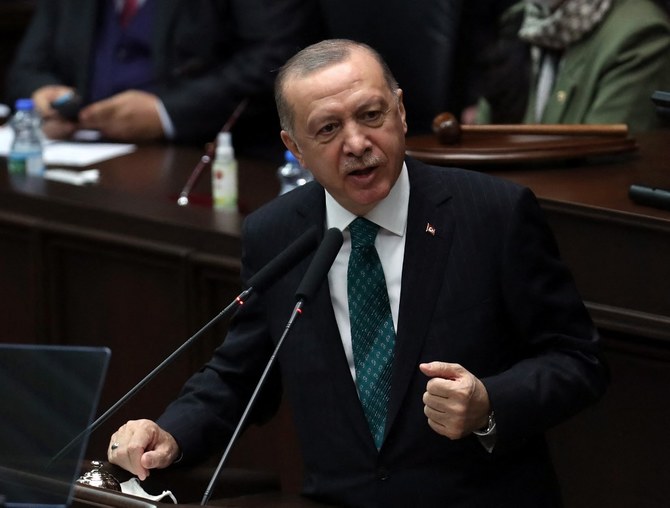

ANKARA: Turkish President Recep Tayyip Erdogan has dismissed an offer by Greece for a federation system to reunify ethnically divided Cyprus.
However, experts say that Turkey’s insistence on separate sovereign states on the island could undermine international efforts to end a deadlock stretching back decades.
“There no longer is a way out for Cyprus other than the two-state solution,” Erdogan said during an address to his ruling party members.
“Whether you accept it or not, there can no longer be such a thing as a federation.”
Following its established policy line, Ankara and Turkish Cypriot leader Ersin Tatar insist on retaining the two-state model rather than turning Cyprus into a federation.
“We can talk and negotiate two separate states based on two equal sovereign states and societies,” Turkish Vice President Fuat Oktay told BRT, the Turkish Cypriot broadcaster, on Wednesday.
READ MORE: Cyprus FM accuses Turkey of using gunboat diplomacy to promote own interests
Greece’s Prime Minister, Kyriakos Mitsotakis, said on Monday that “significant” talks to reunify Cyprus could not be resumed if Turkey insists on a two-state accord that disregards the UN and EU framework for a peace deal.
Mitsotakis believes Turkey’s two-state model ignores the federation model suggested by the UN.
Next month, UN Secretary-General Antonio Guterres is expected to bring together Greek and Turkish Cypriots as well as Greece, Turkey and the UK as guarantor countries to assess the possibility of resuming talks.
Gallia Lindenstrauss, senior research fellow at the Institute for National Security Studies, believes that Turkey’s growing emphasis on a two-state solution for Cyprus shows a fundamental change in policy.
“But the Greek Cypriot side must also share responsibility for the fact that over the years, despite progress, the reunification talks have not brought a solution. So the EU cannot blame only Turkey,” she told Arab News.
Lindenstrauss said that Turkey’s position on the future of Cyprus is part a more aggressive foreign policy line that should be viewed with suspicion by Brussels.
A two-state solution might translate into a Turkish annexation of Northern Cyprus, she said.
Greek Cypriots reject granting veto powers to Turkish Cypriots, and oppose any permanent troop presence and the continuation of military intervention rights by Turkey.
However, Turkey and Turkish Cypriots have rejected suggestions of a federation with Greek and Turkish speaking zones.
Turkey is also asking for hydrocarbon resources in the Eastern Mediterranean to be shared.
READ MORE: British foreign minister says compromise needed for Cyprus talks restart
Fiona Mullen, director of Cyprus-based Sapienta Economics, described Turkey’s latest comments on Cyprus as “positioning” ahead of the UN-led five-party meeting in March.
“Turkey clearly wants better relations with the EU, but Brussels and the UN Security Council have been very clear about rejecting a two-state solution. This means that one of the fastest ways to achieve better relations with the EU is to support a settlement of the Cyprus problem,” she said.
The alternative, according to Mullen, is to spend further years arguing. “But that means Turkey will fail to get what it wants from the EU on the customs union and migration issues,” she said.
Last month, Greek and Turkish officials held their first meeting in Istanbul for exploratory talks on longstanding issues, including Cyprus.
George Tzogopoulos, a senior fellow at the International Center of European Formation, said that Turkey needs to persuade Greek Cypriots and the international community of the validity of its argument and whether it is compatible with the UN framework.
He said that the EU can at least work to ensure the fair distribution of hydrocarbon resources among the two communities.
“This might be its objective in view of the March summit along with the preparation for a multilateral conference for the Eastern Mediterranean,” he said.
However, experts believe a breakthrough in the Cyprus dispute is unlikely.
“I expect Turkey to push for a two-state solution and the international community to preserve the UN framework,” Tzogopoulos said.
“For now, it is important to keep tensions low and encourage cooperation where possible. But this is difficult in the Eastern Mediterranean. Even exploratory talks, which started last month, remain fragile.”


