ISLAMABAD: Pakistan's government on Thursday reached yet another agreement with a hardline religious party that launched a major protest movement last year demanding an end to diplomatic relations with France due to the publishing of caricatures of the Prophet Muhammad (pbuh).
The Tehreek-e-Labbaik Pakistan (TLP) party, which has often paralyzed the country's federal capital with its demonstrations, said last November the government had promised to take a decision regarding the expulsion of the French ambassador in Islamabad after consulting the national parliament within three months.
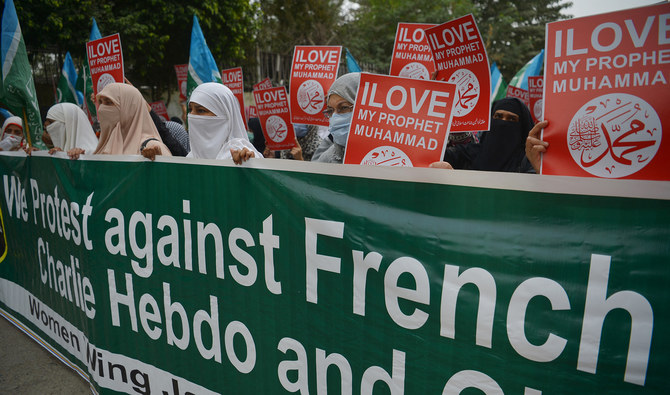
The TLP-led protesters arrived on the outskirts of Islamabad in November, calling for the government to end diplomatic ties with France against the printing of blasphemous images. The protests turned violent, and the government had to step in and negotiate with the demonstrators.
Muslims around the world have protested against France and President Emmanuel Macron, who has vowed to stand firm against what he has described as attacks on French values and freedom of expression by radicals.
Prime Minister Imran Khan said on Thursday his team had been negotiating with TLP leadership and the two sides had made a deal extending the religious party's earlier February deadline to April 20.
"After that, we will take their demands to parliament," the PM announced.
Earlier in the day, the TLP circulated a document carrying the signatures of Religious Affairs Minister Pir Noorul Haq Qadri and Interior Minister Shaikh Rashid Ahmed.
The document said the government had entered into an agreement with the religious party on November 16, 2020 but had not implemented it yet.
In this context, it added that the two sides resumed their negotiations and agreed to present TLP's demands before parliament by April 20, 2021.
Among other things, TLP has asked the government to remove the names of its workers from the fourth schedule, a list which mentions individuals and organizations suspected of being involved in militant activities.
The document also said the prime minister would announce the temporary agreement after which it would become applicable.
The TLP, founded in August 2015 by the late cleric Khadim Hussain Rizvi, has turned blasphemy into a major political issue.
While the party initially focused on domestic events, its protests last year had implications for the country's foreign policy since it demanded a complete ban on French products and an end to diplomatic ties with the country.

Religious party’s demand to break France ties to be put before parliament — PM
https://arab.news/c63z7
Religious party’s demand to break France ties to be put before parliament — PM
- Tehreek-e-Labbaik Pakistan held protests in the capital last year after a French magazine republished caricatures of Prophet Muhammad (PBUH)
- The government entered into an agreement with the religious party on November 16, 2020 but it has not been implemented as yet
Pakistan urges concessional finance for developing nations to boost clean energy security
- Pakistan has emerged as one of world’s fastest growing solar markets, with 12GWs of off-grid and 6GWs of net-metered capacity in 2025
- PM’s aide says Islamabad remains committed to Paris Agreement, looks for continued support in building a resilient and low-carbon future
ISLAMABAD: Pakistan has urged international partners to scale up concessional financing for developing countries, the country’s Press Information Department (PID) said on Sunday, citing an aide to Prime Minister Shehbaz Sharif.
The call was made by Sharif’s coordinator on climate change, Romina Khurshid Alam, while delivering Pakistan’s national statement at the 16th International Renewable Energy Agency (IRENA) Assembly in Abu Dhabi.
Pakistan has emerged as one of the world’s fastest growing solar markets, with 12 gigawatts (GWs) of off-grid and over 6GWs of net-metered solar capacity by the end of 2025. Last fiscal year, renewables accounted for a historic 53 percent of total electricity generation, according to Alam.
The prime minister’s aide stressed that affordable funding for developing nations is critical to accelerating their transition to clean energy and strengthening energy security amid rising climate and economic challenges.
“Alam reaffirmed Pakistan’s target of achieving 60 percent renewables in the power mix by 2030,” the PID said in a statement.
“In her call to action, she urged IRENA and Member States to increase concessional finance for developing nations, treat technologies such as energy storage and green hydrogen as global public goods, and strengthen regional cooperation for shared energy security.”
IRENA is a global intergovernmental agency for energy transformation that serves as the principal platform for international cooperation, supports countries in their energy transition, and provides state of the art data and analyzes on technology, innovation, policy, finance and investment. Its membership comprises 170 countries and the European Union (EU).
The 16th session of the IRENA Assembly is taking place on Jan. 10-12 in Abu Dhabi and focuses on the theme of “Powering Humanity: Renewable Energy for Shared Prosperity.” The session has gathered global leaders and energy decision-makers to discuss strategies and underline necessary actions for the acceleration of renewable energy across countries, regions, and the world, driving economic inclusion, equity, and human well-being.
Alam shared that Pakistan is taking action against energy poverty through initiatives like the Punjab Solar Panel Scheme 2026, which provides free or subsidized systems to low-income households.
She highlighted how distributed solar kits have restored power and livelihoods in flood-affected communities and offer a replicable model for climate-resilient recovery.
“Pakistan remains fully committed to the Paris Agreement and looks to IRENA for continued technical and financial support in building a resilient, inclusive, and low-carbon future,” Alam said.
Adopted in 2015 to combat climate change, the Paris Agreement binds nations to hold “the increase in the global average temperature to well below 2°C above pre-industrial levels” and pursue efforts “to limit the temperature increase to 1.5°C above pre-industrial levels.”


