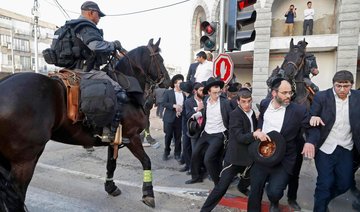
JERUSALEM: Four people were arrested in Jerusalem after clashes between Israeli security forces and ultra-orthodox Jews opposed to coronavirus restrictions, the police said Wednesday.
Such protests have taken place repeatedly in recent weeks, sometimes leading to violence.
In late January a bus was torched and its driver hospitalized in the ultra-Orthodox neighborhood of Bnei Brak, near Tel Aviv.
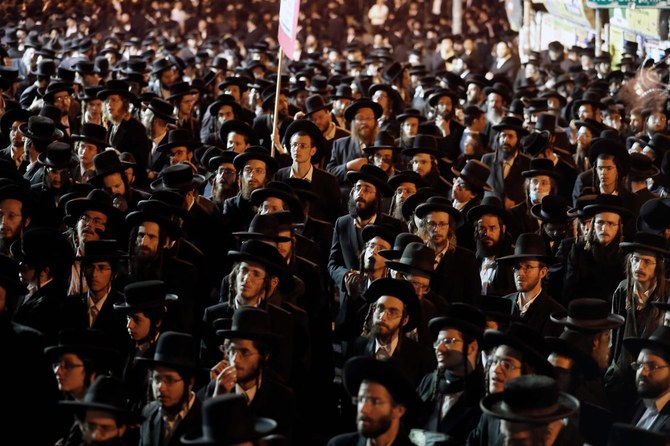
On Tuesday evening, hundreds of people gathered once more in the ultra-orthodox district of Jerusalem, most of them neglecting the obligation to wear a mask, according to an AFP journalist.
Some burned bins or “threw stones and other objects toward security forces at the scene,” police said in a statement.
Four people were arrested and then released, the police said.
“Stop the harassment of religion on health grounds,” read one banner in Hebrew carried by protesters.
Israel on Sunday began to ease its third lockdown, which came into force in December.
But ultra-orthodox districts are mostly in “red” zones where infection rates are high and restrictions are being lifted less rapidly.
Some Israelis accuse ultra-Orthodox Jews, who make up around 12 percent of Israel’s population, of being disproportionately responsible for the spread of coronavirus.
Many of the community’s schools have stayed open during lockdown, in defiance of regulations.
The easing of the lockdown will see kindergartens and schools for some age brackets resume from Thursday in “green” and “yellow” zones.
But in “red” zones, educational activities will be restricted to outdoors, with a maximum of 10 people, including the teacher.
The country of nine million has officially recorded more than 706,400 cases of coronavirus, including 5,200 deaths.
But it is racing ahead with its vaccine program, having so far given a quarter of its population two doses.
Forty-one percent have received at least one dose.

Four arrested as Israeli police, ultra-Orthodox Jews clash
https://arab.news/jameb
Four arrested as Israeli police, ultra-Orthodox Jews clash
- Ultra-orthodox districts are mostly in ‘red’ zones where infection rates are high and restrictions are being lifted less rapidly
- Some Israelis accuse ultra-Orthodox Jews, who make up around 12% of the population, of being disproportionately responsible for the spread of COVID-19
Lebanon PM says IMF wants rescue plan changes as crisis deepens
- “We want to engage with the IMF. We want to improve. This is a draft law,” Salam said
- “They wanted the hierarchy of claims to be clearer. The talks are all positive”
DAVOS, Switzerland: The International Monetary Fund has demanded amendments to a draft rescue law aimed at hauling Lebanon out of its worst financial crisis on record and giving depositors access to savings frozen for six years, Prime Minister Nawaf Salam said.
The “financial gap” law is part of a series of reform measures required by the IMF in order to access its funding and aims to allocate the losses from Lebanon’s 2019 crash between the state, the central bank, commercial banks and depositors.
Salam told Reuters the IMF wants clearer provisions in the hierarchy of claims, which is a core element of the draft legislation designed to determine how losses are allocated.
“We want to engage with the IMF. We want to improve. This is a draft law,” Salam said in an interview at the World Economic Forum annual meeting in the Swiss mountain resort of Davos.
“They wanted the hierarchy of claims to be clearer. The talks are all positive,” Salam added.
In 2022, the government put losses from the financial crisis at about $70 billion, a figure that analysts and economists forecast is now likely to be higher.
Salam stressed that Lebanon is still pushing for a long-delayed IMF program, but warned the clock is ticking as the country has already been placed on a financial ‘grey list’ and risks falling onto the ‘blacklist’ if reforms stall further.
“We want an IMF program and we want to continue our discussions until we get there,” he said, adding: “International pressure is real ... The longer we delay, the more people’s money will evaporate.”
The draft law, which was passed by Salam’s government in December, is under parliamentary review. It aims to give depositors a guaranteed path to recovering their funds, restart bank lending, and end a financial crisis that has left nearly a million accounts frozen and confidence in the system shattered.
The roadmap would repay depositors up to $100,000 over four years, starting with smaller accounts, while launching forensic audits to determine losses and responsibility.
Lebanon’s Finance Minister Yassine Jaber, who is driving the reform push with Salam, told Reuters it was essential to salvage a hollowed-out banking system, and to stop the country from sliding deeper into its cash-only, paralyzed economy.
The aim, Jaber said, is to give depositors clarity after years of uncertainty and to end a system that has crippled Lebanon’s international standing.
He framed the law as part of a broader reckoning: the first time a Lebanese government has confronted a combined collapse of the banking sector, the central bank and the state treasury.
Financial reforms have been repeatedly derailed by political and private vested interests over the last six years and Jaber said the responsibility now lies with lawmakers.
Failure to act, he said, would leave Lebanon trapped in “a deep, dark tunnel” with no way back to a functioning system.
“Lebanon has become a cash economy, and the real question is whether we want to stay on the grey list, or sleepwalk into a blacklist,” Jaber added.