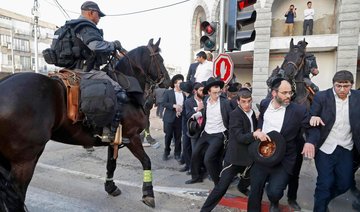
Ultra-Orthodox jews protest Israeli military draft

1 / 4
Israeli ultra-Orthodox Jewish men protest against the detention of a member of their community who refuses to serve in the Israeli army, in Jerusalem. (Reuters)
2 / 4
Israeli ultra-Orthodox Jewish men protest against the detention of a member of their community who refuses to serve in the Israeli army, in Jerusalem. (Reuters)
3 / 4
Israeli ultra-Orthodox Jewish men protest against the detention of a member of their community who refuses to serve in the Israeli army, in Jerusalem. (Reuters)
4 / 4
Israeli ultra-Orthodox Jewish men protest against the detention of a member of their community who refuses to serve in the Israeli army, in Jerusalem. (Reuters)
Updated 28 November 2018
Follow

Ultra-Orthodox jews protest Israeli military draft

  • Demonstrators brought rush hour traffic to a standstill on Wednesday evening, singing and chanting: We will die and not be drafted
  • Politically powerful ultra-Orthodox parties have traditionally secured exemptions from military service for their followers

JERUSALEM: Hundreds of ultra-Orthodox Jews have blocked main roads in Jerusalem to protest the arrest of a community member for refusing to register for the country’s military service.
Demonstrators brought rush hour traffic to a standstill on Wednesday evening, singing and chanting: “We will die and not be drafted.”
Israel has compulsory military service for most Jewish men. But politically powerful ultra-Orthodox parties have secured exemptions for their followers, and attempts to legislate a new draft law have repeatedly faltered.
The exemptions have bred resentment among members of Israel’s secular majority.
Police and protesters wrangled in the streets and police said 24 protesters were arrested.
A female pedestrian screamed at the crowds of protesters, calling their disturbance “intolerable.”


Israel’s Supreme Court suspends govt move to shut army radio

Updated 29 December 2025
Follow

Israel’s Supreme Court suspends govt move to shut army radio

  • Israel’s Supreme Court has issued an interim order suspending a government decision to shut down Galei Tsahal, the country’s decades-old and widely listened-to military radio station

JERUSALEM: Israel’s Supreme Court has issued an interim order suspending a government decision to shut down Galei Tsahal, the country’s decades-old and widely listened-to military radio station.
In a ruling issued late Sunday, Supreme Court President Isaac Amit said the suspension was partly because the government “did not provide a clear commitment not to take irreversible steps before the court reaches a final decision.”
He added that Attorney General Gali Baharav-Miara supported the suspension.
The cabinet last week approved the closure of Galei Tsahal, with the shutdown scheduled to take effect before March 1, 2026.
Founded in 1950, Galei Tsahal is widely known for its flagship news programs and has long been followed by both domestic and foreign correspondents.
A government audience survey ranks it as Israel’s third most listened-to radio station, with a market share of 17.7 percent.
Prime Minister Benjamin Netanyahu had urged ministers to back the closure, saying there had been repeated proposals over the years to remove the station from the military, abolish it or privatise it.
But Baharav-Miara, who also serves as the government’s legal adviser and is facing dismissal proceedings initiated by the premier, has warned that closing the station raised “concerns about possible political interference in public broadcasting.”
She added that it “poses questions regarding an infringement on freedom of expression and of the press.”
Defense Minister Israel Katz said last week that Galei Tsahal broadcasts “political and divisive content” that does not align with military values.
He said soldiers, civilians and bereaved families had complained that the station did not represent them and undermined morale and the war effort.
Katz also argued that a military-run radio station serving the general public is an anomaly in democratic countries.
Opposition leader Yair Lapid had condemned the closure decision, calling it part of the government’s effort to suppress freedom of expression ahead of elections.
Israel is due to hold parliamentary elections in 2026, and Netanyahu has said he will seek another term as prime minister.

Grendizer at 50
The anime that conquered Arab hearts and minds
Enter
keywords