


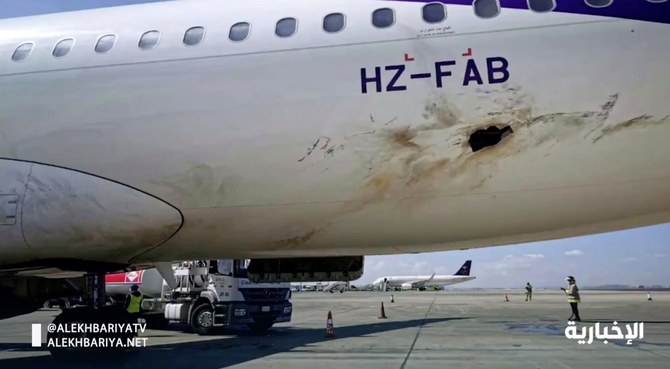

DUBAI: The Houthi militia in Yemen attacked Saudi Arabia’s Abha Airport on Wednesday with explosive drones, leaving a passenger plane ablaze.
No one was reported killed or injured in the attack, which sparked international condemnation of the Iran-backed group.
The Arab coalition said it had controlled the fire on the plane at the aiport.
Opinion
This section contains relevant reference points, placed in (Opinion field)
Spokesman Col. Turki Al-Maliki said the attack was a war crime that had threatened the lives of civilian travelers.
“We are taking the necessary measures to protect civilians from the threats of the Houthis,” he said.
Saudi state TV reported earlier that the coalition had intercepted and destroyed two armed drones targeting civilians and civilian infrastructure in southern Saudi Arabia.

Saudi state television shows an airplane damaged in the attack by Yemen's Houthi militants at Abha Airport. (AP)
Al-Ekhbariya news channel showed images of damage to a plane on the tarmac with a large whole in its side.
Further images showed the wreckage of drones at the airport including wing sections and an engine.
Al-Ekhbariya said the drones were the Qasef-1 model used regularly to attack Saudi Arabia. It is virtually identical in design to the Iranian-manufactured Ababil-T.
Abha Airport, which is about 120 kilometers north of the Yemen border, has been attacked by the Houthis several times before.
The airport was hit three times in three weeks in the summer of 2019. The first attack on June 12 that year caused an explosion in the arrivals hall, while the second killed a Syrian man and wounded 21 people.
Wednesday’s attack comes after an increase in attempted strikes by the Houthis in recent weeks.
It was the third day this week that the coalition said it had intercepted Houthi drones fired towards the southern region of the Kingdom that borders Yemen.
“This is not the first terrorist attack from the Houthis, because we know the Houthis are not looking for peace,” political analyst, Hamdan Al-Shehri told Arab News.
He said the attack comes just days after the UN special envoy to Yemen Martin Griffiths visited Tehran with hopes to reach a political solution to the conflict.
Shehri said he believes it is not possible to reach any solution when engaging with Iran, which he says is pushing the Houthis to carry out the attack “because Tehran is not looking for any solution to the crisis.”
“There is no point in negotiation (with the Houthis) and we also ask the Biden administration to keep them listed as a terrorist organization,” Shehri said, claiming that removing them from the list was “catastrophic.”
The attack comes just days after President Joe Biden moved to declassify the Houthis as a terrorist organization.
Former US President Donald Trump gave the Houthis the designation shortly before he left office.
It also follows a warning from the State Department that the Houthis must stop attacks on civilian targets.
“It would be very strange if the Biden administration keeps the Houthis off the terror list after what happened because over the past three weeks, we have seen many attacks from the Houthi side towards Saudi Arabia and also in Yemen, using ballistic missiles and drones,” Shehri said.
The Arab coalition, which includes Saudi Arabia, intervened in Yemen in 2015 after the Houthis ousted the internationally recognized government from power in the capital, Sanaa.
The Houthis hold northern Yemen, from where they launch missiles and drones toward Saudi cities.


