TALLAHASSEE: Florida lawmakers, including Gov. Ron DeSantis, intensified their battle with Facebook, Twitter and Silicon Valley when they announced new proposals Tuesday aimed at reigning in platforms they accuse of squelching the free speech of conservatives.
“Over the years, these platforms have changed from neutral platforms that provide Americans with the freedom to speak to enforcers of preferred narratives,” the governor said Tuesday during a news conference at the Florida Capitol.
Social media companies have been simultaneously praised and condemned in recent weeks as they cracked down on inciteful posts they said could foment further violence after the Jan. 6 insurrection at the US Capitol.
Conservatives have long accused social media companies and other tech giants of harboring bias against them. Republicans in other states are considering similar bills that push back against social media giants they deem unfriendly.
“Florida is taking back the virtual public square as a place where information and ideas can flow freely. We’re demanding transparency from the big tech giants,” state House Speaker Chris Sprowls said.
About four in every five Americans — some 250 million people — have profiles on social media. Th ose with substantial followings, including elected officials, celebrities and other public figures, have platforms they can readily deploy to amplify their messaging.
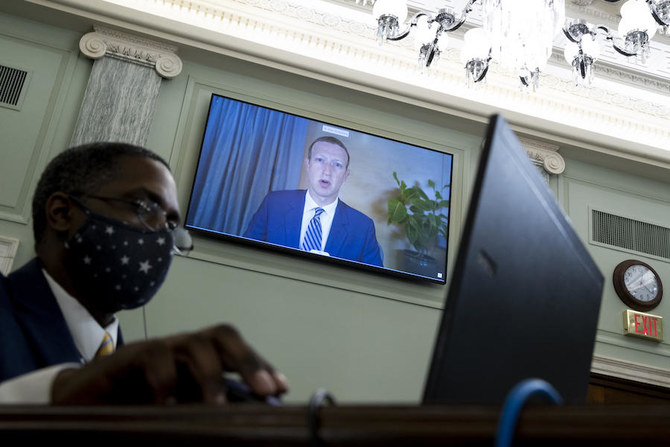
On a call with analysts last week, Facebook founder Mark Zuckerberg said the social media giant was attempting to “turn down the temperature and discourage divisive conversations and communities.” He added that “people don’t want politics and fighting to take over their experience on our services.”
Amazon booted Parler off its web-hosting service five days after the Capitol insurrection. It said in court filings that it did so as a last resort to keep Parler from being used as a venue to disseminate plans for disrupting government and last month’s inauguration of President Joe Biden.
A federal judge in Seattle later ruled Amazon would not be required to restore web service to Parler, an online social media platform that mostly attracts conservatives and supporters of former President Donald Trump.
The moves by Florida lawmakers may end up being mere political theater because it’s uncertain if the state would have the authority to act on companies with such national and global reach. In fact, the federal Telecommunications Act of 1996 shields Internet companies from many legal challenges.
Legal experts say states and other local jurisdictions have a high bar in justifying regulations that might infringe on free speech issues — but the matter could be ripe for a national discussion on how to regulate Internet companies, according to Clay Calvert, a first amendment expert at the University of Florida’s law school.
Besides, he said, “do we want a crazy quilt of state regulations or do we want uniform rules adopted on the federal level?”
State Senate President Wilton Simpson suggested that the federal arena may be the proper venue for regulating tech companies.
“There’s not much we can do as a state. But we need Congress to act on a nationwide basis,” he said.
“The big tech companies have the duty to allow differing views on their public platforms. No one should be excluded,” Simpson said. “But let’s be clear: They are targeting conservatives.”
He said it amounts to political censorship.
One proposal in the state Senate would force Facebook, Twitter and other social media platforms to give users a month’s notice before their accounts are disabled or suspended. The bill was filed after Twitter suspended Trump’s account after his supporters stormed the US Capitol.
Another proposal that was to be filed Tuesday would prohibit companies from suspending the account of a political candidate and be subject to a fine of $100,000 for each day the account of a statewide candidate is blocked, or $10,000 a day for other office seekers.
The proposal also would allow consumers to the sue if they’ve been treated unfairly and would authorize the state attorney general to take on the country’s largest tech companies for anti-competitive practices. Social media companies would be required to reveal how they became aware of any content they censor.
“We’re definitely at a boiling point,” said Darrell West, the vice president of governance studies at the Brookings Institution. “Most of these issues have come up just in the last year, as social media platforms have become more aggressive about regulating their own space.”
While Republicans lawmakers assert bias against conservative thought, a New York University study released Monday concludes that is a baseless claim.
“Conservatives are drawn to the established platforms for the same reason liberals are: That’s where you can reach the largest audiences and enjoy the benefits of the network effect,” said the study’s authors.
“And as much as they condemn supposed social media favoritism,” the authors continued, “conservatives appear to relish wielding the bias-claim cudgel, even though it’s based on distortions and falsehoods.”

Florida lawmakers challenge Silicon Valley over ‘censorship’
https://arab.news/cgghw
Florida lawmakers challenge Silicon Valley over ‘censorship’
- Florida lawmakers are taking aim at Twitter, Facebook and other tech giants over free speech and censorship
- Proposals before the state’s Republican-controlled Legislature would seek to limit Big Tech’s ability to disable or suspend a person’s account
‘AI race is on’: Saudi minister at Davos stresses need for global optionality
- Minister of Investment Khalid Al-Falih said ‘we don’t know who’s going to be ahead in the next few years’ and the Kingdom therefore reserves the right for optionality
- On Tuesday, the WEF announced the first phase of a Digital Embassy Framework aimed at bringing greater clarity and consistency
DAVOS: Saudi Minister of Investment Khalid Al-Falih told Davos that the artificial intelligence “race is on,” with the Kingdom determined to use its diplomatic reach while preserving strategic “optionality.”
Speaking on Tuesday’s “AI Power Play, No Referees” panel at the World Economic Forum, Al-Falih described AI as “truly the transformation of this century,” but warned that it will soon be commoditized and not monopolized by any single company or country.
He stressed the need for global diffusion, saying: “The essence of AI’s power is that it has to be accessible. So the word ‘diffusion’ is not just within economies that have to compete, but I believe it has to be done globally.”
While acknowledging the US lead, Al-Falih said optionality is critical. “We don’t know who’s going to be ahead four or five years from now,” he said, adding that the Kingdom reserves the right for optionality amid shifting dynamics.
Riyadh has emerged as a global AI player, buoyed by its huge Davos delegation and heavy investments in technology and supporting infrastructure. Low energy costs — a factor that has driven human development worldwide — position Saudi Arabia uniquely, Al-Falih said, with renewables poised to power AI data centers as part of the Kingdom’s diversification strategy.
“We know this is not just about infrastructure, data center and the energy competitive advantage that we believe Saudi Arabia has is second to none. We’re investing across the technology stack, in applications and LLMs and in connectivity, because we believe that this is going to be a global good. Just as important as building the data hub that Saudi Arabia is building, we need to be connected, and we are connected to Europe, Asia, because we want that data, that AI power, to be transmitted across borders and across economies.”
Saudi Arabia, while strategically aligned with the US, has also backed Chinese, Korean and Japanese companies to maintain flexibility. “Optionality is very important. It’s something we have now, and we protect because we believe that we are the owners of our own destiny, and we will not let go of that.”

On Tuesday, the WEF announced the first phase of a Digital Embassy Framework aimed at bringing greater clarity and consistency to how trusted digital embassies are designed and governed worldwide.
Also known as “data embassies,” the initiative seeks to address practical challenges in cross-border sovereign AI infrastructure and data hosting, with an emphasis on trust, security and governance, and is expected to be formally launched at the forum’s meeting in Jeddah in April.
The initiative was announced during a separate panel titled “Digital Embassies for Sovereign AI” at the forum’s annual meeting on Tuesday, featuring Gobind Singh Deo, minister of digital for Malaysia and Alexandre Fasel, state secretary for foreign affairs of Switzerland.
Fasel said the value of such a global framework lies in preventing countries from having to start from scratch each time they negotiate bilateral arrangements. By setting out shared principles and approaches, spanning technical, legal and governance issues, the framework can provide common reference points for countries seeking to establish such entities, even if the term “digital embassy” itself remains imperfect.
Both speakers acknowledged that the term can be a misnomer, since it suggests traditional diplomatic arrangements. The focus, they said, is the function: allowing data and computing to be hosted abroad while maintaining safeguards around sovereignty, access and control.
Deo said the concept is driven by practical realities, as some countries lack the energy and water needed to support large-scale data centers, even though those resources are available elsewhere.
Hosting infrastructure in better-resourced countries can offer a solution, he said, provided robust safeguards are in place to ensure data is secure and that access and control stay with the originating state.
Saudi Arabia has already moved early on the concept. In April 2025, it published a draft Global AI Hub Law — described as the first G20 attempt to set out a comprehensive legal framework that embraces the “digital embassy” approach.
A key question at Davos this year is how a state can maintain data sovereignty — and apply its laws to certain categories of data - when that data must be hosted in a foreign jurisdiction.

Al-Falih said policy work on data sovereignty — from regulation and platforms to data centers — began well before the recent acceleration in AI.
“But in addition to data privacy, we had an open data we talked about diffusion and access to compute, but access to data to achieve the same purpose of research, drug discovery, productivity improvement, having a policy also of open access to data was a pillar that was launched before Covid.”
In an earlier panel, Anthropic CEO Dario Amodei said predicting exactly when AI will match a Nobel Laureate’s capabilities in multiple fields remains difficult due to internal and external factors, but said that “something fast is going to happen.”
“AI is going to be incredibly powerful. It’s just a question of exactly when. And because it’s incredibly powerful, it will do all these wonderful things, will help us cure cancer, it may help us to eradicate tropical diseases, it will help us understand the universe. But there are these immense and grave risks that we need to think about and we need to address them.”
Amodei said tackling those risks requires action on several fronts: “It’s a mixture of things that we individually need to do as leaders of the companies, and that we can do working together. And then there’s going to need to be some role for wider societal institutions, like the government.
“If we are all working together, we can address, we can learn through science to properly control and direct these creations that we’re building. But if we build them poorly, if we’re all racing and we go so fast that there’s no guardrails, then I think there is risk of something going wrong.”


