

Hate groups migrate online, making tracking more difficult

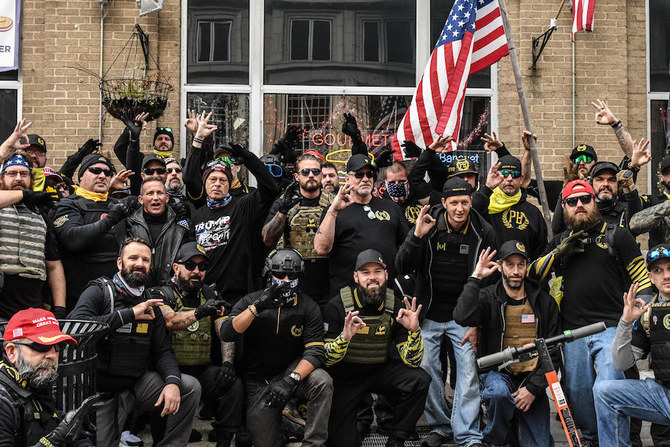
Members of the Proud Boys pose for a photo while flashing a gesture associated with the white power movement outside of Harry's bar during a protest on December 12, 2020 in Washington, DC. (AFP)
Short Url
Updated 02 February 2021
Follow

Hate groups migrate online, making tracking more difficult

  • The Southern Poverty Law Center said it identified 838 active hate groups operating across the US in 2020
  • White nationalist organizations, a subset of the hate groups listed in the report, declined last year from 155 to 128

NEW YORK: During one of the most politically divisive years in recent memory, the number of active hate groups in the US actually declined as far-right extremists migrated further to online networks, a move that has made it harder to track adherents of white nationalist and neo-Nazi ideologies.
In its annual report, released Monday, the Southern Poverty Law Center said it identified 838 active hate groups operating across the US in 2020. That’s a decrease from the 940 documented in 2019 and the record-high of 1,020 in 2018, said the law center, which tracks racism, xenophobia and anti-government militias.
“It is important to understand that the number of hate groups is merely one metric for measuring the level of hate and racism in America, and that the decline in groups should not be interpreted as a reduction in bigoted beliefs and actions motivated by hate,” said the report, first shared exclusively with The Associated Press.
The Montgomery, Alabama-based law center said many hate groups have moved to social media platforms and use of encrypted apps, while others have been banned altogether from mainstream social media networks.
Still, the law center said, online platforms allow individuals to interact with hate and anti-government groups without becoming members, maintain connections with likeminded people, and take part in real-world actions, such as last month’s siege on the US Capitol.
White nationalist organizations, a subset of the hate groups listed in the report, declined last year from 155 to 128. Those groups had seen huge growth the previous two years after being energized by Donald Trump’s campaign and presidency, the report said.
The number of anti-immigrant, anti-Muslim and anti-LGBTQ hate groups remained largely stable, while their in-person organizing was hampered by the coronavirus pandemic.
Bottom line, the levels of hate and bigotry in America have not diminished, said SPLC President and CEO Margaret Huang.
“What’s important is that we start to reckon with all the reasons why those groups have persisted for so long and been able to get so much influence in the last White House, that they actually feel emboldened,” Huang told the AP.
Last month, as President Joe Biden’s administration began settling in, the Department of Homeland Security issued an early national terrorism bulletin in response to a growing threat from home-grown extremists, including anti-government militias and white supremacists. The extremists are coalescing under a broader, more loosely affiliated movement of people who reject democratic institutions and multiculturalism, Huang said.

The SPLC’s report comes out nearly a month after a mostly white mob of Trump supporters and members of far-right groups violently breached the US Capitol building. At least five deaths have been linked to the assault, including a Capitol police officer. Some in the mob waved Confederate battle flags and wore clothing with neo-Nazi symbolism.
Federal authorities have made more than 160 arrests and sought hundreds more for criminal charges related to the deadly Jan. 6 assault. Authorities have also linked roughly 30 defendants to a group or movement, according to an AP review of court records.
That includes seven defendants linked to QAnon, a once-fringe Internet conspiracy movement that recently grew into a powerful force in mainstream conservative politics; six linked to the Proud Boys, a misogynistic, anti-immigrant and anti-Semitic group with ties to white supremacism; four linked to the Oath Keepers, a paramilitary organization that recruits current and former military, law enforcement and first-responder personnel; four linked to the Three Percenters, an anti-government militia movement; and two leaders of “Super Happy Fun America,” a group with ties to white nationalists known for organizing a so-called “straight pride” parade in downtown Boston in 2019.
Bipartisan critics of Trump have blamed him for inciting the attack on the Capitol, which some far-right groups have declared a success and are using as a recruitment tool to grow membership, according to the SPLC.
The final year of the Trump presidency, marked by a wide-ranging reckoning over systemic racism, also propelled racist conspiracy theories and white nationalist ideology into the political mainstream, the law center said.
According to an SPLC survey conducted in August, 29% of respondents said they personally know someone who believes that white people are the superior race. The poll also found that 51% of Americans thought the looting and vandalism that occurred across the country around Black Lives Matter demonstrations was a bigger problem than excessive force by police.
Protests over the Minneapolis police killing of George Floyd last May spurred a push to make the November election a referendum on white supremacy. Nestled in Trump’s baseless claims of widespread voter fraud was a reality that turnout among Black and Hispanic voters played a significant role in handing victory to Biden and Vice President Kamala Harris, the first woman and first person of Black and South Asian heritage to hold that office.
During his inaugural address, Biden issued a strong repudiation of white supremacy and domestic terrorism, which is rare for such consequential speeches.
The SPLC made several recommendations for the new administration in its latest report. It called for establishing offices within the Department of Homeland Security, the Justice Department and the FBI to monitor, investigate and prosecute cases of domestic terrorism. It also urged improving federal hate crime data collection, training, and prevention; and for enacting federal legislation that shifts funding away from punishment models and toward preventing violent extremism.
People who support or express hatred and bigotry are not always card-carrying members of far-right groups. But that doesn’t mean they can’t be activated into violence, said Christian Picciolini, a former far-right extremist and founder of the Free Radicals Project, a group that helps people disengage from hate organizations.
It also doesn’t mean that they can’t be reached and deradicalized, he said.
“We have to have kind of a dual approach to stop what’s happening now, but also to make sure that we are not creating a problem for us in the future, to understand how the propaganda is spread that is recruiting these people,” Picciolini said.
“Right now, it’s in a very self-service format online,” he added. “We’re facing a really big problem.”


From injury to influence: Khaled Olyan — the new voice of Arab football

Updated 30 January 2026
Follow

From injury to influence: Khaled Olyan — the new voice of Arab football

  • The Saudi social media star — TikTok’s Arab Creator of the Year — recounts how a setback ended his playing ambitions and pushed him to redirect his passion 
  • Known for memes and commentary that blend football, travel, culture and everyday life, Olyan is FIFA-accredited as a sport informant and covered AFCON 2025 in Morocco

LONDON: A broken dream launched Khaled Olyan’s unexpected rise as a Saudi social media star. Passion and perseverance took him from shattered ambitions to the Africa Cup of Nations 2025 in Morocco, where he surfed the hype while representing Arab culture.

“The journey began with a child who dreamed of becoming a football player to fulfill his own dreams and those of his family and community. After an injury ended that path, I didn’t break, I redirected my passion toward football media,” he said.

In an interview with Arab News, shortly after being crowned TikTok’s Arab Content Creator of the Year, Olyan — who has 13.2 million followers on that platform and 5 million on Instagram — credited his rise to “pure passion and honest content,” and said he had learned over time that “consistency matters more than fast virality.”

He added: “The turning point came when I realized that content can genuinely impact people, not just generate numbers or views. (Then I) stepped outside the traditional sports-content framework and linked football to culture, people, and place. It wasn’t a guaranteed path, but it shaped my identity today as a creator with a clear message and purpose.”

Olyan made history as the first regional creator to be accredited by FIFA as a ‘sport informant,’ a milestone that, he said, has given “local content global credibility and reach.”

Most recently, he was in Morocco to document AFCON, where he highlighted both the host country’s hospitality and the electric atmosphere in the grounds.

“It felt like a responsibility before it was an achievement,” he said. “I felt that my role went beyond coverage to building cultural bridges between people.”


A post shared by KHALID ALOLAYAN (@olyan15k)

Known for his memes and commentaries blending football, travel, culture and everyday life with feel-good humor, fans hail his “unmatched enthusiasm” and refer to him as “the voice of Saudi football fans.”

“Content today is no longer just entertainment,” he said. “It has become documentation of moments and an influence on collective awareness, especially in sports and culture across the Arab world. That (means there is) a much greater responsibility on everything I create.”

Saudi Arabia’s content-creator ecosystem has evolved dramatically in recent years, driven by a wider national transformation that has reshaped almost all aspects of public life, including sports and entertainment.

“The transformation has been rapid and significant, opening unprecedented opportunities for creators,” Olyan said. As the country moves “quickly toward global leadership in sports,” he added, it has also raised ambitions and created new routes for people to turn dreams into reality.

Across the region, the creator economy is booming, powered by a young audience, government investment and platforms such as TikTok. In 2025, the GCC alone was home to 263,000 social media influencers — a 75-percent increase in just two years according to data from Qoruz, an influencer-marketing intelligence platform.

Globally, fashion and entertainment dominate the influencer industry, but the GCC market has followed a slightly different trajectory. Lifestyle and travel also lead the charts, reflecting both regional affluence and a cultural emphasis on luxury, aesthetics, and experience-led content.

href="https://www.tiktok.com/tag/%D8%AE%D8%A7%D9%84%D8%AF_%D8%A7%D9%84%D8%B9%D9%84%D9%8A%D8%A7%D9%86?refer=embed">#خالد_العليان #المغرب #كاس_امم_افريقيا #هدايا #سحوبات ♬ original sound - KHALID ALOLYAN

While sport is not a major category, the research underscores what makes the GCC ecosystem distinctive: high digital penetration, brand-conscious audiences, and multilingual, multi-ethnic creators, with campaign planning often shaped by strategic decisions about language and identity.

Olyan said he sees many regional influencers following the same path as him — though not necessarily through sport. “I believe we are contributing to clearer roadmaps for anyone aiming for success through creative, values-driven content rooted in strong human principles,” he added. “Opportunities are abundant, but the real challenge lies in consistency and maintaining quality amid pressure and high expectations.”

For Olyan, Arab culture is not an add-on to, but the backbone of, his storytelling. He frames the region’s passion for football alongside questions of Arab identity, delivering it in an entertaining format that can travel beyond the usual language barriers.

“What makes sport special is that it’s a universal language. Many non-Arab audiences already follow my content daily, supported by AI tools. Arabic is my language and a core part of my identity, and I won’t change it. Instead, I’ll rely on smart translation tools and solutions to reach wider audiences.”

Olyan also noted that the region has long been framed through the narratives of people from elsewhere, often in ways that highlight only its darker corners.

“The Arab world is full of inspiring stories and a rich culture that deserves to be told through the eyes of its people, not only from the outside,” he said, adding that he hopes viewers value his videos for “changing their perspective and helped them see the truth more clearly.”

Olyan was crowned TikTok Arab Content Creator of the Year 2026 at a ceremony held in partnership with the 1 Billion Followers Summit in Dubai.

He said the recognition was a result of more than just a run of viral moments, explaining that it came about “through structured, institutional work, team development, and linking content to long-term goals. Sustainability comes from creating moments and building value, not relying on trends or short-lived hype.”

Underscoring the double-edged nature of social media, Olyan argued that attention alone is not the point. “Real impact happens when content is used to educate and inspire people, not just capture their attention.”

He also expressed skepticism about banning under-16s from social media. Regulation matters, he said, but “awareness, smart supervision, and teaching safe usage matter more than complete bans.”

Creators, he added, are not immune to the platforms’ darker side. Psychological pressure, mental exhaustion, and long periods away from family due to frequent travel are part of the job. “I manage it through time organization, temporary breaks, and returning with renewed passion,” he explained.


href="https://www.tiktok.com/tag/%D8%AE%D8%A7%D9%84%D8%AF_%D8%A7%D9%84%D8%B9%D9%84%D9%8A%D8%A7%D9%86?refer=embed">#خالد_العليان #كاس_العرب #السعودية #المغرب ♬ original sound - KHALID ALOLYAN

Olyan is also the founder of the O15 Football Academy, a project rooted in his childhood dream and one he sees as part of a broader sporting movement gaining traction in the Kingdom. For him, the academy is not just about competition, but about giving children a supportive environment where sport becomes a formative social practice.

“As a child, I wished such an academy existed for me and my friends,” he said. “Many talents were playing in local neighborhoods without professional guidance or support, causing real potential to be lost due to the absence of proper training environments, follow-up, and opportunities. The environment was often challenging and unmotivating.”

His academy aims to identify talent early, develop it “scientifically,” and prepare players to compete at club and national levels, but Olyan added that even those who do not pursue the sport professionally can also benefit “educationally, culturally, and socially.” 

Football, he said, is “a form of soft power that, by God’s will, can positively impact many aspects of life.”

Whether creating content or helping others pursue their sporting dreams, Olyan said his guiding principle comes from a line by the late Saudi politician and poet Ghazi Al-Qusaibi — a reminder that what you hope for in small measure can arrive, unexpectedly, in abundance: “You wish for a drop of good news, but God wishes to help you with rain.”