



ANKARA: A tough new line in Washington against the Erdogan regime in Turkey has raised alarm bells in Ankara, analysts have told Arab News.
Turkey has embarked on a charm offensive toward the Western world, but US decision-makers are increasingly questioning the state of the “strategic partnership” between the traditional allies.
In talks between Jake Sullivan, US President Joe Biden’s national security adviser, and Bjoern Seibert, European Commission President Ursula von der Leyen’s cabinet chief, the two men “agreed to work together on issues of mutual concern, including China and Turkey,” the White House said.
Linking Turkey with China, the main US geopolitical adversary, is a blow to President Recep Tayyip Erdogan’s hopes of a close relationship with the new Biden administration. The US has already imposed sanctions over Turkey’s controversial purchase of the S-400 missile defense system from Russia, and now looks likely to side with the EU over Erdogan’s adventurism in the eastern Mediterranean, including incursions into Greek territorial waters to search for oil.
At the UN on the same day, Washington called for the “immediate withdrawal” of Turkish and Russian troops from Libya. This is in line with the UN-backed cease-fire agreement signed in October last year, which required Turkey to withdraw its forces within three months. That deadline expired on Jan. 23.
During a Security Council meeting about Libya, Richard Mills, the acting US ambassador to the UN, demanded “the removal of the foreign mercenaries and military proxies that they have recruited, financed, deployed and supported in Libya.”

A Turkish Navy warship patrols next to the drilling ship "Fatih" as it sailed toward the eastern Mediterranean near Cyprus in July 2019. (AFP file photo)
Samuel Ramani, a Middle East analyst at Oxford University, said it appears the Biden administration is struggling to develop a consistent policy on Turkey.
“On the one hand, it wants a de-escalation of the eastern Mediterranean dispute, and probably welcomes efforts by Saudi Arabia and, to a lesser extent, the UAE to ease tensions with Turkey,” he said.
“Yet on the other hand, it is siding with Greece and France on Turkey’s threat to regional stability, and trying to engage both countries around this.”
These mixed signals are a result of Biden’s desire to sit on the fence between those who want containment and those who advocate accommodation of Turkey, Ramani said, and also to appease the Democratic Party, which opposed Trump’s permissive stance on Turkish President Recep Tayyip Erdogan’s approach to Syria.
“The US needs to clarify its position on Turkey as soon as possible to avoid a needless escalation on Erdogan’s side,” he added.
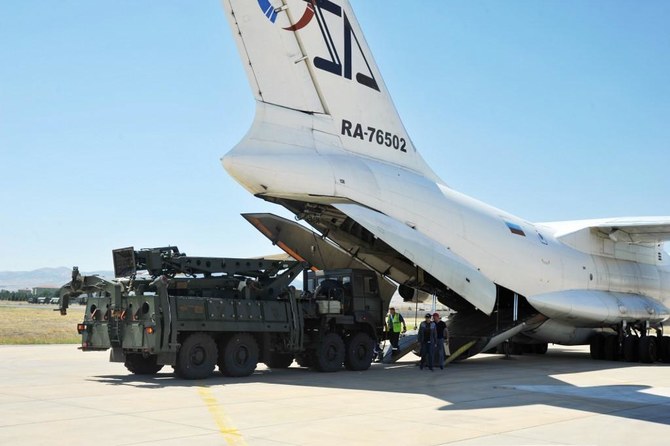
A Russian military cargo plane unloads S-400 missile defense systems at the Murted military airbase, northwest of Ankara, on Aug. 27, 2019. (File photo?Turkish Defense Ministry via AFP)
Turkey’s controversial purchase of the Russian-made S-400 missile system, and its claims on resources in the eastern Mediterranean are among the key concerns shared by Brussels and Washington.
On the same day as Sullivan and Seibert talked, Turkey’s National Security Council, the country’s top national security body, declared that the country will continue to assert its rights in the eastern Mediterranean, the Aegean Sea and Cyprus.
“It was stressed once again that Turkey primarily favors diplomacy and dialogue at every platform in the settlement of Aegean, eastern Mediterranean and Cyprus issues, but that it is also determined to protect its rights, relevance and interests emanating from international law and agreements,” according to an official statement.
HIGHLIGHT
These mixed signals are a result of Biden’s desire to sit on the fence between those who want containment and those who advocate accommodation of Turkey, Ramani said, and also to appease the Democratic Party, which opposed Trump’s permissive stance on Turkish President Recep Tayyip Erdogan’s approach to Syria.
Matthew Goldman, an expert on Turkey from the Swedish Research Institute in Istanbul, said that he believes the Biden administration will not be afraid to adopt a relatively tough line in dealings with Ankara.
“But the national security adviser may have grouped China and Turkey together because they want to signal that US support for the EU in its fraught relations with Turkey is to some extent contingent on the EU’s willingness to help the Americans deal with China,” he said.
Goldman said that while Turkey has become a major concern for the EU, given the tensions in the eastern Mediterranean and elsewhere, European nations tend to view China more as an economic opportunity than a threat.
“And while the US is concerned about Turkey’s recent moves, its main security focus is China,” he added. “The Biden administration was upset by the EU’s willingness to sign a major investment deal with China in December, just before Biden became president, wishing that the Europeans had instead waited to consult the new US administration.”
While the Biden team wants to repair relations with Europe after the damage caused by the Trump administration, Goldman predicted that this will not preclude some traditional diplomatic give-and-take.
“While US Secretary of State Anthony Blinken, Sullivan and the rest of the Biden team will be eager to show that the transatlantic alliance is strong, they may also want to signal that if the EU coordinates with them more closely on China, they will, in turn, be more responsive to the EU as it deals with the challenge of Turkey,” he added.
During his Senate Foreign Relations Committee confirmation hearing last week, Blinken accused fellow NATO member Turkey of not acting like an ally. He said Washington will review the possibility of further sanctions on Ankara over its purchase of the S-400 system.
In December, the US imposed sanctions on Turkey, through the Countering America’s Adversaries Through Sanctions Act, to punish the country for its military deals with Russia and to discourage any further flirting with the Kremlin. Washington considers the presence of S-400s on Turkish soil as a threat to its F-35 fighter jets and to NATO defense systems in general.


