Agreement between Fatah and Hamas paves way for Palestine coalition

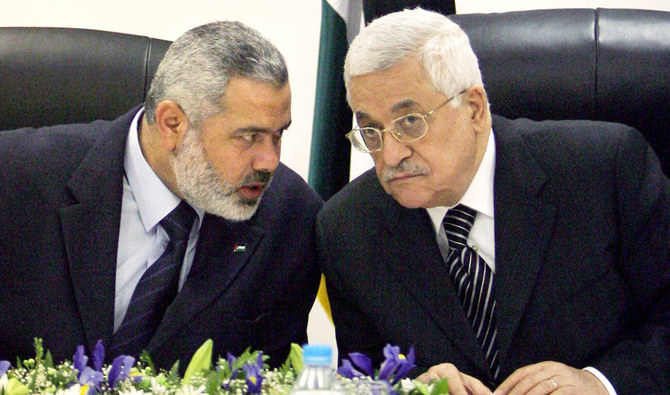
Hamas leader Ismael Haniyeh and Palestinian President Mahmoud Abbas. (Supplied)
Short Url
Updated 23 January 2021
Follow

Agreement between Fatah and Hamas paves way for Palestine coalition

  • Both sides agreed that the new government “will work on unifying laws and institutions, and have security control over all areas”

AMMAN: Fatah and Hamas leaders appear to be moving closer to setting up a unified list that will be the basis of a Palestinian coalition government, a draft agreement between the rival factions reveals.
The agreement, seen by Arab News, was a key factor in the decision to hold elections — Palestine’s first in 15 years — on May 22.
Details of the accord were discussed at meetings in Istanbul and Cairo, and became the basis of an exchange of letters between Hamas leader Ismael Haniyeh and Palestinian President Mahmoud Abbas.
Compromises appear to have been made by both sides, but particularly by Hamas, which accepts that “the PLO (Palestine Liberation Organization) is the sole, legitimate representative of the Palestinian people, and is responsible for all external political issues and negotiations as well as all issues related to war and peace.”
However, Fatah, which has effectively controlled the PLO for decades, acknowledges that the organization requires reform and strengthening so it can better represent all Palestinian groups and in order for its decisions to be mandatory.
By agreeing to be part of the PLO and under its political umbrella, Hamas can avoid the problems it faced in 2006 when it refused to recognize Israel. The PLO exchanged letters of recognition with Israel in 1993.
Hamas and Fatah also agreed to share surplus votes in elections for a national unity government that will run affairs in Gaza and the West Bank, and have total control over all Palestinian areas.

BACKGROUND

Details of the accord were discussed at meetings in Istanbul and Cairo, and became the basis of an exchange of letters between Hamas leader Ismael Haniyeh and President Mahmoud Abbas.

Both sides agreed that the new government “will work on unifying laws and institutions, and have security control over all areas.”
A coalition government appears to give the people of Gaza a chance to exercise freedom of movement and benefit from rebuilding work in the enclave.
According to the agreement, one of the main goals of a coalition government seeking to revive Gaza’s battered economy will be a long-term cease-fire with Israel to prepare the groundwork for extensive rebuilding.
The agreement also calls for Gaza airport and all crossings to be permanently restored along with the establishment of a security corridor between Gaza and the West Bank.
Hamas and Fatah also appear to agree on the need for a change in the role of the Palestinian president, with calls for an overhaul of Palestine’s political structure, “especially the roles of the president, government and legislative council.”
“It is either a presidential structure or a parliamentary one,” the accord said. “The hybrid is a source of conflict.”
Changes should take place before the presidential elections due on July 31, it adds.
The two factions also agreed that the “election campaigns must be civilized, respectful, and avoid abuse and libel from all sides.”
According to the agreement, election results “will be recognized no matter what they are.”


Syrian government and SDF agree to de-escalate after Aleppo violence

Updated 23 December 2025
Follow

Syrian government and SDF agree to de-escalate after Aleppo violence

  • Turkiye views the US-backed SDF, which controls swathes of northeastern Syria, as a ⁠terrorist organization and has warned of military action if the group does not honor the agreement

DAMASCUS: Syrian government forces and the Kurdish-led Syrian Democratic Forces agreed to de-escalate on Monday evening in the northern city of Aleppo, after a wave of attacks that both sides blamed on each other left at least two civilians dead and several wounded.
Syria’s state news agency SANA, citing the defense ministry, said the army’s general command issued an order to stop targeting the SDF’s fire sources. The SDF said in a statement later that it had issued instructions to stop responding ‌to attacks ‌by Syrian government forces following de-escalation contacts.

HIGHLIGHTS

• SDF and Syrian government forces blame each other for Aleppo violence

• Turkiye threatens military action if SDF fails integration deadline

• Aleppo schools and offices closed on Tuesday following the violence

The Syrian health ministry ‌said ⁠two ​people ‌were killed and several were wounded in shelling by the SDF on residential neighborhoods in the city. The injuries included two children and two civil defense workers. The violence erupted hours after Turkish Foreign Minister Hakan Fidan said during a visit to Damascus that the SDF appeared to have no intention of honoring a commitment to integrate into the state’s armed forces by an agreed year-end deadline.
Turkiye views the US-backed SDF, which controls swathes of northeastern Syria, as a ⁠terrorist organization and has warned of military action if the group does not honor the agreement.
Integrating the SDF would ‌mend Syria’s deepest remaining fracture, but failing to do ‍so risks an armed clash that ‍could derail the country’s emergence from 14 years of war and potentially draw in Turkiye, ‍which has threatened an incursion against Kurdish fighters it views as terrorists.
Both sides have accused the other of stalling and acting in bad faith. The SDF is reluctant to give up autonomy it won as the main US ally during the war, which left it with control of Daesh prisons and rich oil resources.
SANA, citing the defense ministry, reported earlier that the SDF had launched a sudden attack on security forces ⁠and the army in the Sheikh Maqsoud and Ashrafiyah neighborhoods of Aleppo, resulting in injuries.
The SDF denied this and said the attack was carried out by factions affiliated with the Syrian government. It said those factions were using tanks and artillery against residential neighborhoods in the city.
The defense ministry denied the SDF’s statements, saying the army was responding to sources of fire from Kurdish forces. “We’re hearing the sounds of artillery and mortar shells, and there is a heavy army presence in most areas of Aleppo,” an eyewitness in Aleppo told Reuters earlier on Monday. Another eyewitness said the sound of strikes had been very strong and described the situation as “terrifying.”
Aleppo’s governor announced a temporary suspension of attendance in all public and private schools ‌and universities on Tuesday, as well as government offices within the city center.