

Lebanon lockdown extension recommended as cabbies, soldiers clash at airport

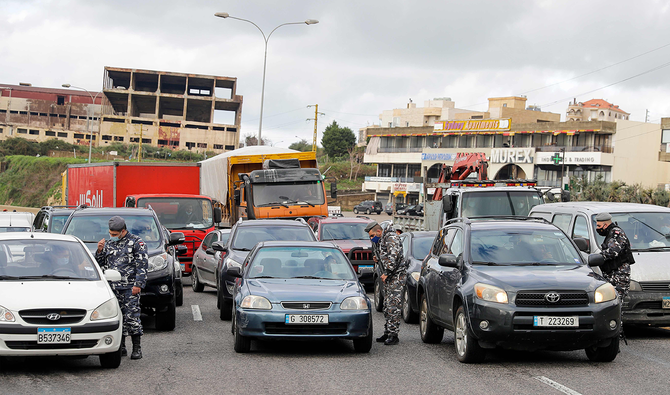
Members of the Lebanese security forces check citizens' documents at a COVID-19 checkpoint near the coastal town of Safra on the Tripoli-Beirut main highway on January 19, 2021, as Lebanon enters a second week under lockdown aimed at preventing the country's creaking healthcare system from collapsing. (AFP)
Short Url
Updated 20 January 2021
Follow

Lebanon lockdown extension recommended as cabbies, soldiers clash at airport

  • On Wednesday, taxi drivers clashed with soldiers in front of the Rafic Hariri International Airport in Beirut

BEIRUT: The Lebanese Health Ministry’s Scientific Committee on Combating the Coronavirus Pandemic has recommended extending lockdown by at least two weeks.

In the past week, the country registered a new record for daily coronavirus disease (COVID-19) cases. More than 78,812 cases were recorded in the past 20 days, which has led doctors to conclude that Lebanon has lost control over the virus.

Sixty-one new deaths were announced on Tuesday, a record high in Lebanon. The Higher Defense Council is expected to hold an emergency session on Thursday to assess the situation.

On Wednesday, taxi drivers clashed with soldiers in front of the Rafic Hariri International Airport in Beirut. Taxi drivers had previously blocked the road leading to the airport with their vehicles, protesting the effect of lockdown measures on their work. 

The army intervened to reopen the road. Some protesters were injured after being beaten with rifle butts.

The airport’s security command said: “Due to the lockdown and curfew in place, taxi drivers are banned from operating without permission. The current measures to transport travelers at the airport are temporary and everything will go back to normal once the lockdown is over. However, the command will not allow the airport’s security to be jeopardized for any reason.”

Bshara Al-Asmar, head of the General Labor Union, said: “As health and official authorities are insisting on extending the lockdown period, the Lebanese state, bodies and ministries must coordinate with the union, economic commissions and civil society to find a mechanism to support employees and daily workers of the private sector who are not getting paid during the lockdown, as well as daily and hourly-paid workers in the public sector, low-income and self-employed persons who depend on their daily work to earn their living.”

Al-Asmar urged officials to “expedite the government’s formation to achieve a minimum of political stability, which would pave the way for the economic reforms the country urgently needs, as poverty and unemployment have reached every Lebanese house.”

Dr. Firas Al-Abyad, director of the Hariri Governmental University Hospital, stressed “the need to adopt and abide by extremely strict containment measures and implement effective and fast measures to track down the infected persons and those who have had contact with them, instead of only focusing on the numbers of available beds in hospitals.”

Pending the decision of any lockdown extension, Hani Bohsali, head of the Syndicate of Importers of Foodstuffs in Lebanon, has called on “relevant authorities not to improvise or rush into any decisions, especially those related to food security of citizens.”

Bohsali added: “Seven days after the beginning of the lockdown, the demand of food items, especially vegetables, bread and dairy products, has dramatically decreased, which is not the result of citizens’ decreasing need as much as their inability to buy the food items they need, after they have disappeared from the shelves.”

Bohsali also shed light on the incapacity of “delivery services, especially in supermarkets across Lebanon, to meet the needs of Lebanese.”

He warned that “extending the lockdown and keeping supermarkets closed will increase citizen’s needs of foods and goods, which will eventually lead to congestion and overcrowding in supermarkets.

“This will be a similar situation to before the lockdown, risking citizens’ health again.”


Turkiye’s approval of peace roadmap is important step, PKK source says

Updated 8 sec ago
Follow

Turkiye’s approval of peace roadmap is important step, PKK source says

  • “The vote is considered an achievement and an important step toward consolidating democracy in Turkiye,” said the PKK source
  • There were foundations for resolving the Kurdish issue, but there was a lack of clarity on the issue in the report

BAGHDAD: A Turkish parliamentary commission’s approval of a report setting out a roadmap for legal reforms alongside the disbandment of the Kurdistan Workers Party (PKK) militant group is an important step and the beginning of a fundamental change in Turkish policy, a PKK source told Reuters on Thursday.
The commission voted overwhelmingly on Wednesday to approve the report, advancing a peace process designed to end decades of conflict.
“The vote is considered an achievement and an important step toward consolidating democracy in Turkiye,” said the PKK source.
The PKK — designated a terrorist ⁠organization by Turkiye, ⁠the United States and the European Union — halted attacks last year and said in May it had decided to disband and end its armed struggle.
The parliamentary vote shifts the peace process to the legislative theater, as President Tayyip Erdogan, Turkiye’s leader of more than two decades, bids to end a conflict focused on mainly Kurdish southeast Turkiye.
The insurgency began in 1984 and has killed more than 40,000 people, sowing deep discord at home and ⁠spreading violence across borders into Iraq and Syria.

IMPORTANT ISSUES OUTSTANDING
The PKK source said there were foundations for resolving the Kurdish issue, but there was a lack of clarity on the issue in the report.
“There also remain other important issues, such as initiating constitutional amendments, especially in aspects related to the Kurdish language as well as amendments to the anti-terrorism law,” the source said.
Another issue was legislation concerning the return of PKK militants to Turkiye and their integration into society, the source said.
A key element of Wednesday’s report recommended strengthening mechanisms to ensure compliance with decisions by the European Court of Human Rights (ECHR) and the Constitutional Court.
Among key ECHR decisions related to Turkiye are rulings that the rights of ⁠jailed former pro-Kurdish ⁠party leader Selahattin Demirtas had been violated and that he should be released immediately.
Ankara’s final appeal against that was rejected in November.

SIGN OF INTENT
Demirtas’ lawyer Mahsuni Karaman told Reuters the report’s comments on the ECHR were important as a sign of intent.
“We hope this will be reflected in judicial practice— that is our wish and expectation,” Karaman said.
Demirtas was detained in November 2016 on terrorism-related charges, which he denies. In May 2024, a court convicted him in connection with deadly 2014 protests and sentenced him to more than 40 years in prison.
Turkish nationalist leader Devlet Bahceli, a key Erdogan ally whose call in 2024 triggered the current PKK peace process, said in November that it “would be beneficial” to release Demirtas from prison.
The opposition pro-Kurdish DEM Party — the successor party of Demirtas’ HDP — remains parliament’s third-largest bloc and has cooperated closely with the parliamentary commission.