

Egypt, UAE resume first Qatar flights since 2017

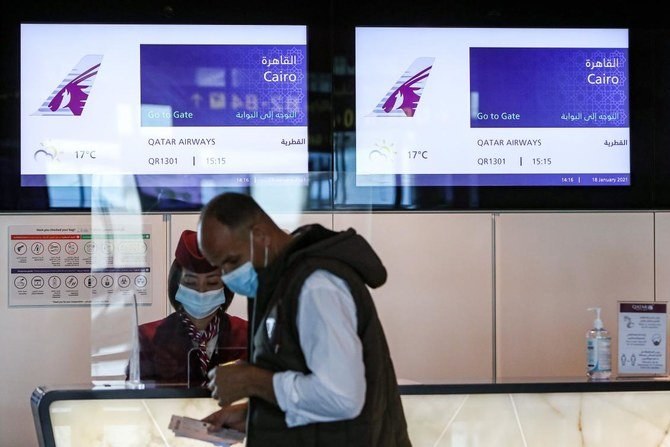
A mask-clad traveller prepares to board the first Qatar Airways flight bound for Cairo after the resumption of flights between Qatar and Egypt, at Qatar's Hamad International Airport near the capital Doha on January 18, 2021. Egypt reopened its airspace to Qatari flights on January 18 following a thaw in relations between Doha and a Saudi-led bloc. (AFP)
Short Url
Updated 19 January 2021
Follow

Egypt, UAE resume first Qatar flights since 2017

  • An EgyptAir flight took off from Doha to Cairo, making it the first commercial flight in three and a half years between both countries
  • It was followed shortly after by the arrival of an Air Arabia flight from Sharjah in the UAE

DOHA: The first direct flights since 2017 between Qatar and its former rivals Egypt and the UAE took to the skies on Monday, following the end of a regional crisis.
Egypt and the United Arab Emirates (UAE) joined Saudi Arabia and Bahrain in cutting ties with Qatar in June 2017, accusing it of being too close to Iran and of backing Islamic extremists, charges Doha denies.


The quartet agreed to heal the rift at a Gulf summit on January 5 in Saudi Arabia, after a flurry of diplomatic activity by outgoing US President Donald Trump’s administration.
The first commercial flight from Qatar to Egypt in three and a half years, an EgyptAir service to Cairo, took off from windswept Doha airport.
It was followed shortly after by the arrival of an Air Arabia flight from Sharjah in the UAE.
The resumption of flights from Doha to Cairo will simplify travel for the large contingent of Egyptians living in Qatar.
As many as 300,000 Egyptians call Qatar home, according to official statistics, but many were unable to travel home during the crisis.
In May 2020, frustrated Egyptians protested outside the compound housing Egypt’s then-empty embassy.
Following the demonstration, 18 repatriation flights operated via neutral Oman to comply with Cairo’s ban on direct air traffic.
A Qatar Airways plane was due to also make the trip to Cairo later Monday.
Flights between Doha and Saudi Arabia, which has also opened its land border to Qatar, resumed on January 11.
The row complicated regional travel, divided families and raised costs faced by Qatari businesses.
Mustafa Ahmed, 38, an Egyptian technical engineer, said he was “very happy.”
“With direct flights, life will be easier, especially for families and children, avoiding the torment of changing airports and planes and waiting for hours for transit flights,” he told AFP.
Egyptians in Qatar work in a number of sectors including education, health care and engineering.
Thousands of Qatar’s majority-expatriate workforce, however, have lost their jobs as a result of a downturn caused by the coronavirus epidemic.



Sudanese nomads trapped as war fuels banditry and ethnic splits

Updated 4 sec ago
Follow

Sudanese nomads trapped as war fuels banditry and ethnic splits

  • War disrupts nomads’ traditional routes and livelihoods
  • Nomads face threats from bandits as well as ethnic tensions
NEAR AL-OBEID: Gubara Al-Basheer and his family used ​to traverse Sudan’s desert with their camels and livestock, moving freely between markets, water sources, and green pastures. But since war erupted in 2023, he and other Arab nomads have been stuck in the desert outside the central Sudanese city of Al-Obeid, threatened by marauding bandits and ethnic tensions. The war between the Sudanese army and the paramilitary Rapid Support Forces (RSF) has left nearly 14 million people displaced, triggered rounds of ethnic bloodshed, and spread famine ‌and disease. It ‌has also upset the delicate balance of ‌land ⁠ownership ​and livestock routes ‌that had maintained the nomads’ livelihoods and wider relations in the area, local researcher Ibrahim Jumaa said. Al-Obeid is one of Sudan’s largest cities and capital of North Kordofan state, which has seen the war’s heaviest fighting in recent months. Those who spoke to Reuters from North Kordofan said they found themselves trapped as ethnic hatred, linked to the war and fueled largely online, spreads.
“We used to be ⁠able to move as we wanted. Now there is no choice and no side accepts you,” ‌al-Basheer said. “In the past there were a ‍lot of markets where we ‍could buy and sell. No one hated anyone or rejected anyone. Now ‍it’s dangerous,” he said.
RISK OF ROBBERY
As well as the encroaching war, the nomads — who Jumaa said number in the millions across Sudan — face a threat from bandits who steal livestock.
“There are so many problems now. We can’t go anywhere and if we ​try we get robbed,” said Hamid Mohamed, another shepherd confined to the outskirts of Al-Obeid. The RSF emerged from Arab militias known ⁠as the Janjaweed, which were accused of genocide in Darfur in the early 2000s. The US and rights groups have accused the RSF of committing genocide against non-Arabs in West Darfur during the current conflict, in an extension of long-running violence stemming from disputes over land. The RSF has denied responsibility for ethnically charged killings and has said those responsible for abuses will be held to account. Throughout the war the force has formed linkages with other Arab tribes, at times giving them free rein to loot and kidnap.
But some Arab tribes, and many tribesmen, have not joined the fight.
“We require a national program to counter ‌hate speech, to impose the rule of law, and to promote social reconciliation, as the war has torn the social fabric,” said Jumaa.