Egypt: Iranian nuclear issue should be linked to its regional interference

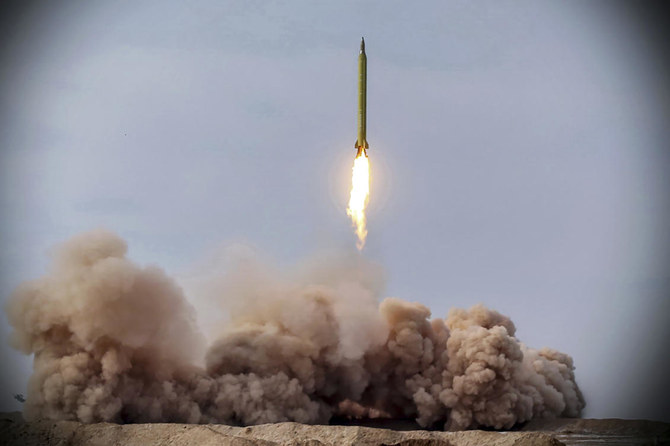
In this photo released on Saturday, Jan. 16, 2021, by the Iranian Revolutionary Guard, a missile is launched in a drill in Iran. (AP)
Short Url
Updated 16 January 2021
Follow

Egypt: Iranian nuclear issue should be linked to its regional interference

  • Cairo’s ambassador to the US calls for cooperation with the new administration on range of issues
  • Zahran: Many opportunities for cooperation between Egypt and the US in various fields under new administration

CAIRO: Egypt believes that the Iranian nuclear issue is not the only problem with regard to Iran and its position in the region, according to Motaz Zahran, Cairo’s ambassador in Washington. Tehran’s interference and its efforts to destroy the assets of Arab countries throughout the region is another issue that must be confronted, he said.
Zahran said in a virtual interview with the National Council for US-Arab Relations that there is an opportunity for cooperation with the new US administration in light of the Iranian interference in various conflicts in the region, whether in Lebanon, Syria, Iraq or Yemen, which led to the deepening of their problems.
“The Iranian nuclear issue should not be dealt with separately from Iranian interference in all regional conflicts, and there are discussions between Egypt and the US regarding Iran, with the Republicans and the Democrats,” he added.
The ambassador said Egypt believes that there should not be any unilateral move on the issue of the Grand Ethiopian Renaissance Dam. He saw a need for the new US administration to play a constructive role in resolving the dam dispute.
There are, he said, many opportunities for cooperation between Egypt and the US in various fields under the new administration of President-elect Joe Biden.
The meeting was moderated by Ed Royce, former US representative, who chaired the House Committee on Foreign Affairs.
Answering a question on the storming of the Capitol building on Jan. 6, Zahran said it was sad and shocking for Egypt and the whole world, and he linked what happened in America to what Egypt witnessed when some extremist groups — mainly the Muslim Brotherhood — took advantage of large-scale demonstrations and turned them into violent protests.
He pointed out that in both nations there was a widespread national desire for unity among the people which followed the state of chaos. There are some lessons to be learned, the most important of which is that rights and freedoms, in general, are not absolute, but are linked to guaranteeing others’ rights, as well as achieving order, security and public peace.


UN rights chief Shocked by ‘unbearable’ Darfur atrocities

Updated 18 January 2026
Follow

UN rights chief Shocked by ‘unbearable’ Darfur atrocities

  • Mediation efforts have failed to produce a ceasefire, even after international outrage intensified last year with reports of mass killings, rape, and abductions during the RSF’s takeover of El-Fasher in Darfur

PORT SUDAN: Nearly three years of war have put the Sudanese people through “hell,” the UN’s rights chief said on Sunday, blasting the vast sums spent on advanced weaponry at the expense of humanitarian aid and the recruitment of child soldiers.
Since April 2023, Sudan has been gripped by a conflict between the army and the paramilitary Rapid Support Forces that has left tens of thousands of people dead and around 11 million displaced.
Speaking in Port Sudan during his first wartime visit, UN Human Rights commissioner Volker Turk said the population had endured “horror and hell,” calling it “despicable” that funds that “should be used to alleviate the suffering of the population” are instead spent on advanced weapons, particularly drones.
More than 21 million people are facing acute food insecurity, and two-thirds of Sudan’s population is in urgent need of humanitarian aid, according to the UN.
In addition to the world’s largest hunger and displacement crisis, Sudan is also facing “the increasing militarization of society by all parties to the conflict, including through the arming of civilians and recruitment and use of children,” Turk added.
He said he had heard testimony of “unbearable” atrocities from survivors of attacks in Darfur, and warned of similar crimes unfolding in the Kordofan region — the current epicenter of the fighting.
Testimony of these atrocities must be heard by “the commanders of this conflict and those who are arming, funding and profiting from this war,” he said.
Mediation efforts have failed to produce a ceasefire, even after international outrage intensified last year with reports of mass killings, rape, and abductions during the RSF’s takeover of El-Fasher in Darfur.
“We must ensure that the perpetrators of these horrific violations face justice regardless of the affiliation,” Turk said on Sunday, adding that repeated attacks on civilian infrastructure could constitute “war crimes.”
He called on both sides to “cease intolerable attacks against civilian objects that are indispensable to the civilian population, including markets, health facilities, schools and shelters.”
Turk again warned on Sunday that crimes similar to those seen in El-Fasher could recur in volatile Kordofan, where the RSF has advanced, besieging and attacking several key cities.
Hundreds of thousands face starvation across the region, where more than 65,000 people have been displaced since October, according to the latest UN figures.