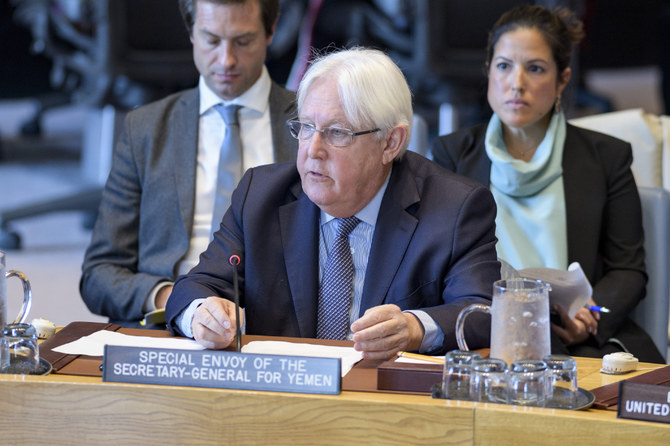
NEW YORK: Even though it was a virtual session, one could sense the emotional atmosphere during a meeting of the Security Council on Thursday as Martin Griffiths, the UN special envoy for Yemen, briefed members about the “harrowing note” on which 2020 had ended in the war-ravaged country.
He spoke of his shock when he visited Aden’s civilian airport and saw the damage caused by “a vicious attack” on Dec. 30 targeting the Yemeni government’s newly formed cabinet as they arrived at the airport. Dozens of civilians were killed or injured, including government officials, humanitarian-aid workers and a journalist.
As he condemned the attack “in the strongest terms possible” and hailed the resolve of the members of the new government, who chose to remain in Aden and carry out their duties despite the security risks, Griffiths reminded the council that “deliberate attacks on civilians (may) constitute a war crime.”
The members of the Security Council echoed his condemnation of the attack.
“The UK assesses that it is highly likely that the Houthis were responsible for this cowardly and craven attack,” said Barbara Woodward, the UK permanent representative to the UN.
“Only the Houthis have the means, the motive and the opportunity. It was a clear and deplorable attempt to destabilize the newly formed Yemeni government. The Houthi attack casts a dark shadow over a group that claims to be pursuing peace in Yemen.”
Woodward also condemned “Houthi cross-border attacks on Saudi Arabia” and said the UK “shares US concerns about the Houthi commitment to peace.”
A Yemeni government investigation into the assault on the airport also concluded that the Houthis were responsible for an attack that “casts a dark shadow over what should have been a moment of hope in the efforts to achieve peace in Yemen.”
Griffiths said the formation of the Yemeni cabinet and its return to Aden “was a major milestone for the (Saudi-brokered) Riyadh Agreement, and for the stability of state institutions, the economy and the peace process.” He once again commended Saudi Arabia for its “successful mediation role.”
He added: “Progress on the Riyadh Agreement is significant. It shows us that reconciliation between opposing parties can be achieved. Despite all their bitter opposition, and with the tireless efforts of the Kingdom of Saudi Arabia as mediator, the two sides made peace with each other. So it can be done.”
Turning to the “cumbersome and frustrating” negotiations for a joint declaration by the government and the Houthis — a set of proposals for measures including a nationwide ceasefire, humanitarian aid and economic relief, and the resumption of the peace process — Griffiths acknowledged that they cannot continue indefinitely.
“But let me be clear: the parties can slice and dice the set of proposals contained in the joint declaration any way they wish,” he said. “It can be a whole package. It can be done in parts. I have no objection to the way these measures are adopted.”
He called for the focus to remain on the political process, irrespective of the outcome of the joint declaration negotiations.
Mark Lowcock, the UN’s under-secretary-general for humanitarian affairs and emergency relief coordinator, warned that the people of Yemen face a looming “massive famine,” amid projections that 16 million Yemenis will go hungry this year. He said that 50,000 people are already starving to death in what is “essentially a small famine,” and another five million are “just one step behind them.”
There is impending danger of an even larger-scale famine, Lowcock said, if US authorities do not reconsider their decision to designate the Houthis as a foreign terrorist organization. He joined Griffiths and World Food Program Executive Director David Beasley in calling on Washington to reverse the decision on humanitarian grounds.
“We fear that there will be inevitably a chilling effect on my efforts to bring the parties together,” Griffiths told the 15-member Security Council.
Beasley said: “We are struggling now, without the designation — with the designation, it’s going to be catastrophic. It literally is going to be a death sentence to hundreds of thousands, if not millions, of innocent people in Yemen.”
Richard Mills, the deputy US ambassador to the UN, said the terrorist designation is a response to a stalling political process that “has produced little results despite the heroic efforts of (Griffiths).”
He assured the officials that their concerns will inform Washington’s approach to the implementation of the designation, but was adamant that “this step is the right move forward to send the right signal if we want the political process to move forward.”
Details of exemptions that would allow aid agencies to distribute food in Yemen despite US regulations have reportedly not been finalized yet by the State Department in Washington, with only days to go until the designation takes effect on Jan. 19.
On top of this, about 30 million Yemenis rely on aid from UN organizations, but Lowcock said that 90 percent of the food they distribute is imported. Even if exemptions are granted quickly to aid agencies, it will not be enough to prevent famine, he warned, because the agencies cannot adequately replace commercial imports. A number of NGOs have expressed concerns that the US designation of the Houthis will disrupt their ability to maintain shipments of food to Yemen.
Lowcock also said that fears of being sanctioned by the US is discouraging many traders from continuing to supply food because they consider the risks too great.
“What would prevent (famine?)” he asked? “A reversal of the US decision.”
Beasley additionally warned that there is a massive deficit in the funding of aid for Yemen and urged countries in the region to contribute more.
He called on “the Gulf states, the Saudis to pick up the financial tab for the needs inside Yemen because the needs in other parts of the world are so great.”


![]()

Still hope for Yemen despite violence and famine, says UN envoy
Short Url
https://arab.news/ymth9
Still hope for Yemen despite violence and famine, says UN envoy
- Martin Griffiths hails resolve of newly formed Yemeni cabinet after they were targeted in airport attack
- US urged to reverse designation of Houthis as terrorists to safeguard peace talks and avoid humanitarian disaster


Latest updates






© 2026 SAUDI RESEARCH & PUBLISHING COMPANY, All Rights Reserved And subject to Terms of Use Agreement.