Egypt, Germany, France, Jordan meet to revive Mideast talks

1 / 2
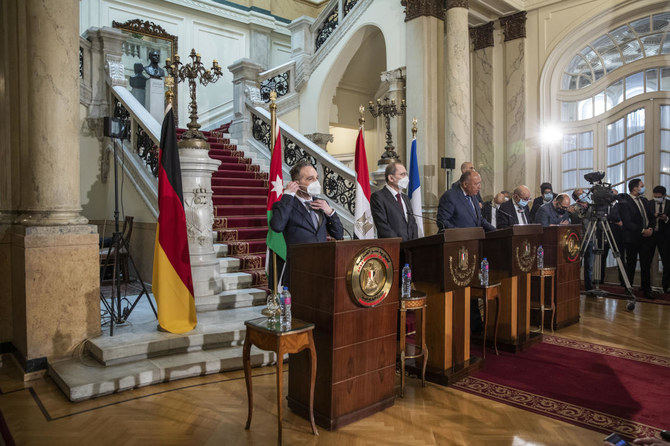
Foreign Ministers of (L to R) Germany Heiko Maas, Jordan Ayman Safadi, Egypt Sameh Shoukry, and France Jean-Yves Le Drian, hold a joint press conference after a meeting to discuss the Middle East peace process, in the Egyptian capital Cairo, on January 11, 2021. (AFP)
2 / 2
From left to right, German Foreign Minister Heiko Maas, wears his mask after speaking during a joint press conference with Jordanian Foreign Minister Ayman Safadi, Egyptian Foreign Minister Sameh Shoukry, and French Foreign Minister Jean-Yves Le Drian, at Tahrir Palace, in Cairo, Egypt, Monday, Jan. 11, 2021. (AP)
Short Url
Updated 11 January 2021
Follow

Egypt, Germany, France, Jordan meet to revive Mideast talks

  • France’s Foreign Ministry said the meeting would discuss ways to have Israelis and Palestinians embark on talks

CAIRO: Egypt on Monday hosted the foreign ministers of Germany, France and Jordan to discuss ways to revive peace talks between Israel and the Palestinians, a week before President-elect Joe Biden takes office.
In Cairo, the Foreign Ministry said the aim of the meeting was to urge the Palestinians and Israelis to negotiate a “just and comprehensive political settlement” on the basis of achieving a Palestinian state with east Jerusalem as its capital on territory Israel captured in the 1967 Mideast war.
The Palestinians suffered numerous setbacks under the outgoing administration of President Donald Trump and complained about what they say were pro-Israeli steps from Washington.
Trump has sidelined the Palestinian Authority, recognized Jerusalem as Israel’s capital and moved the U.S. Embassy there from Tel Aviv, slashed financial assistance for the Palestinians and reversed course on the illegitimacy of Israeli settlements on land claimed by the Palestinians.
Egypt’s President Abdel-Fattah el-Sissi said last month that Cairo has been working toward a two-state solution to the Israeli-Palestinian conflict, “taking into account the regional and international changes.” He was apparently referring to Biden's election and the establishment of ties with Israel by four Arab countries — the United Arab Emirates, Bahrain, Sudan and Morocco.
France’s Foreign Ministry said the meeting would discuss ways to have Israelis and Palestinians embark on talks, building on “the positive regional context” related to the recent normalization deals.
“It is a question of contributing, at the same time, to a resumption of dialogue between Israelis and Palestinians, with a view to resolving the conflict in the framework of international law," the statement said.
Germany’s Foreign Minister Heiko Maas tweeted before leaving for Cairo on Sunday that the ministers would discuss “which concrete steps” that could help “build trust” between Israel and the Palestinians.

In September, Palestinian President Mahmoud Abbas called for an international conference early in 2021 to launch a “genuine peace process,” based on the U.N. resolutions and past agreements with Israel. The Palestinians no longer see the U.S. as an honest broker.
Palestinian Foreign Minister Riyad al-Malki said last month that the Palestinian Authority was ready to cooperate with the incoming Biden administration, and urged Israel to return to talks based on a two-state solution for the Israeli-Palestinian conflict.



Egyptian woman faces death threats for filming alleged harasser

Updated 13 February 2026
Follow

Egyptian woman faces death threats for filming alleged harasser

  • Case revives longstanding national debate in Egypt over harassment and violence against women
  • A 2013 UN study found that 99.3 percent of Egyptian women reported experiencing harassment

CAIRO: A young Egyptian woman is facing death threats after posting a video showing the face of a man she says repeatedly harassed her, reviving debate over how victims are treated in the country.
Mariam Shawky, an actress in her twenties, filmed the man aboard a crowded Cairo bus earlier this week, accusing him of stalking and harassing her near her workplace on multiple occasions.
“This time, he followed me on the bus,” Shawky, who has been dubbed “the bus girl” by local media, said in a clip posted on TikTok.
“He kept harassing me,” added the woman, who did not respond to an AFP request for comment.
Hoping other passengers would intervene, Shawky instead found herself isolated. The video shows several men at the back of the bus staring at her coldly as she confronts her alleged harasser.
The man mocks her appearance, calls her “trash,” questions her clothing and moves toward her in what appears to be a threatening manner.
No one steps in to help. One male passenger, holding prayer beads, orders her to sit down and be quiet, while another gently restrains the man but does not defend Shawky.
Death threats
As the video spread across social media, the woman received a brief flurry of support, but it was quickly overwhelmed by a torrent of abuse.
Some high-profile public figures fueled the backlash.
Singer Hassan Shakosh suggested she had provoked the situation by wearing a piercing, saying it was “obvious what she was looking for.”
Online, the comments were more extreme. “I’ll be the first to kill you,” one user wrote. “If you were killed, no one would mourn you,” said another.
The case has revived a longstanding national debate in Egypt over harassment and violence against women.
A 2013 UN study found that 99.3 percent of Egyptian women reported experiencing harassment, with more than 80 percent saying they faced it regularly on public transport.
That same year, widespread protests against sexual violence rocked the Egyptian capital.
In 2014, a law criminalizing street harassment was passed. However, progress since then has been limited. Enforcement remains inconsistent and authorities have never released figures on the number of convictions.
Public concern spiked after previous high-profile incidents, including the 2022 killing of university student Nayera Ashraf, stabbed to death by a man whose advances she had rejected.
The perpetrator was executed, yet at the time “some asked for his release,” said prominent Egyptian feminist activist Nadeen Ashraf, whose social-media campaigning helped spark Egypt’s MeToo movement in 2020.
Denials
In the latest case, the authorities moved to act even though the bus company denied any incident had taken place in a statement later reissued by the Ministry of Transport.
The Interior Ministry said that the man seen in the video had been “identified and arrested” the day after the clip went viral.
Confronted with the footage, he denied both the harassment and ever having met the woman before, according to the ministry.
Local media reported he was later released on bail of 1,000 Egyptian pounds (around $20), before being detained again over a pre-existing loan case.
His lawyer has called for a psychiatric evaluation of Shawky, accusing her of damaging Egypt’s reputation.
These images tell “the whole world that there are harassers in Egypt and that Egyptian men encourage harassment, defend it and remain silent,” said lawyer Ali Fayez on Facebook.
Ashraf told AFP that the case revealed above all “a systemic and structural problem.”
She said such incidents were “never taken seriously” and that blame was almost always shifted onto women’s appearance.
“If the woman is veiled, they’ll say her clothes are tight. And if her hair is uncovered, they’ll look at her hair. And even if she wears a niqab, they’ll say she’s wearing makeup.”
“There will always be something.”