

Displaced Cambodians in limbo as nationalist victory in Thailand adds to pressure

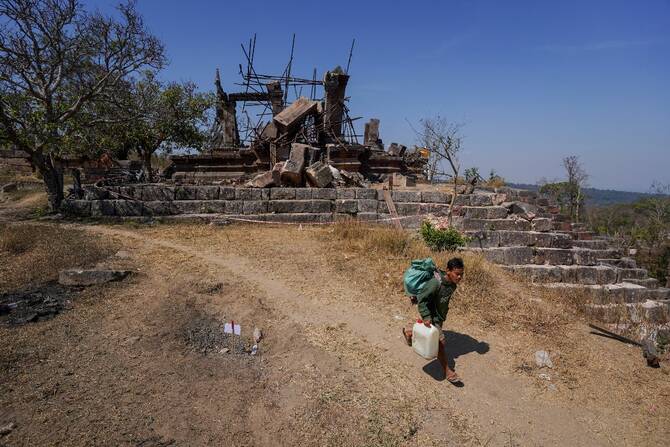
A person carries supplies as he walks past the damaged Preah Vihear temple in Preah Vihear province, Cambodia. (Reuters)
Short Url
Updated 13 February 2026
Follow

Displaced Cambodians in limbo as nationalist victory in Thailand adds to pressure

  • The border clashes killed at least 149 people and displaced hundreds of thousands along ‌the 817-kilometer border before Thailand and Cambodia agreed to a second ceasefire in late December

PREAH VIHEAR: Six weeks after a ceasefire ended fighting at ‌the Thai-Cambodian border, thousands of displaced Cambodians still hope to return home, despite an election victory in Thailand by nationalists who want to wall off the disputed frontier.
In Banteay Meanchey province, Proeung Sopheap, 59, was visiting her abandoned home ​in the border village of Prey Chan for the first time since the December clashes to collect some personal belongings and cooking utensils.
“I don’t know what led to this fighting,” she said. “Like other Cambodians, I want peace, not war.”
In an election last week, Thailand’s Prime Minister Anutin Charnvirakul romped to victory on a platform that includes building a wall at the border.
During a visit to the area on the Cambodian side, most of the people Reuters spoke to said they knew nothing about last week’s Thai vote or what the implications might be for the area.
Pich Vorn, displaced from ‌the neighboring village ‌of Chouk Chey, said he just wanted his house and land ​back.
“Even ‌if ⁠it is ​small, ⁠it is where I have lived for many years.”
The worst fighting in more than a decade has left Sopheap’s village Prey Chan divided: Thai authorities say part of it is in Thailand, and have put up barbed wire fencing, now reinforced with a barrier formed of metal shipping containers.
On the Thai side, authorities say all residents have been able to return home since fighting ended.
But on the Cambodian side, officials estimate that about 80 percent of land and homes in Prey Chan and Chouk Chey communes are now inaccessible, ⁠leaving more than 4,600 people living in temporary shelters.
Thailand said in a ‌statement on Friday the installation of barriers “to enhance safety and ‌security along the border” was “fully consistent” with the joint statement ​agreed by the two countries during the ceasefire ‌on December 27.
The border clashes killed at least 149 people and displaced hundreds of thousands along ‌the 817-kilometer border (508-mile) before Thailand and Cambodia agreed to a second ceasefire in late December, after an earlier truce from July collapsed.
Both sides have traded accusations of aggression. They have tussled over their shared border for decades.

FIGHTING SCARS THOUSAND-YEAR-OLD TEMPLE
At the Preah Vihear Temple, an 11th-century UNESCO World Heritage site at the border, Cambodian authorities ‌say bullet holes, dents and unexploded ordnance scattered across the complex were the result of Thai artillery during border clashes.
The Thai foreign ministry did ⁠not comment on this ⁠issue when asked by Reuters.
“It is truly regrettable to see a World Heritage site fired at and destroyed like this,” Pheng Sam Oeun, deputy director general of National Authority for Preah Vihear temple said.
Cambodia has submitted damage reports to UNESCO and implemented emergency measures to stabilize the most severely affected sections of the temple. Sam Oeun said funding for full restoration remains uncertain.
The Cambodian Mine Action Center is clearing cluster munitions and unexploded artillery shells around the grounds.
Mines and unexploded ordnance remain a menace on both sides of the frontier. Demining manager Ean Sothea said Cambodian authorities had shut more than 40 schools across Preah Vihear province and prioritized clearance at hospitals, pagodas and homes of returning residents.
On the Thai side, a soldier lost a limb on Wednesday after stepping on a land mine at a ​border area in Kantharalak district of Sisaket province, ​the Thai army said.
Landmine blasts along disputed frontier areas were among the catalysts behind the border clashes last year, with at least 12 Thai soldiers severely injured since last July.


Pakistan Embassy denies role in Kabul visa black market as Afghans turn to agents

Updated 5 sec ago
Follow

Pakistan Embassy denies role in Kabul visa black market as Afghans turn to agents

  • Arab News investigation earlier found how Afghans resort to tour agents, pay up to $1,800 to obtain Pakistani visas
  • Any additional money charged by travel agents is ‘outside the purview’ of the embassy, spokesperson says

KABUL: The Pakistani Embassy in Kabul has rejected reports of knowledge of a black market for Pakistani visas, emphasizing its unwavering commitment to a fair and accessible visa system for Afghans.

An Arab News investigation published last month found Afghans resorting to tour agents and paying exorbitant prices to obtain Pakistani travel documents, with desperate applicants paying between $1,300 and $1,800 for visas that officially cost more than 50 times less.

In a rebuttal shared with Arab News, the Embassy of Pakistan in Kabul said it “has no official agents, intermediaries, or affiliated travel companies authorized to collect money” from visa applicants.

“The embassy’s official visa fee is published transparently and must be paid directly via credit card. We are aware that many applicants lack credit cards and often rely on local agents for assistance with the online payment,” Sayed Khizar Ali, the embassy’s press counsellor, said in a statement to Arab News.

“Our commitment to a transparent, fair, and accessible visa system for our Afghan brothers remains unwavering.”

Multiple travel agencies in Kabul and Nangarhar that earlier confirmed to Arab News that Pakistani visas are traded on the black market have maintained their statements.

“How can it be outside their control when we send applications and they come back approved within three days?” one manager of a travel agency who declined to be named told Arab News this week.

“The embassy stamps the visas. They know where they come from.”

He said his agency has been processing dozens of visas weekly since October, after tensions between Afghanistan and Pakistan rose following a week of deadly clashes at their shared border.

“The travel agencies that are registered with them, we are the only way. If you don’t go through us, you won’t get a visa,” he said.

Despite the embassy’s denial that it does not work through travel agents, public advertisements by several tour agents offering services for “guaranteed” medical and tourist visas can be seen both online and on their storefronts. Though prices are negotiated privately, many openly promise quick turnarounds of just a few days.

The Afghan Ministry of Interior and Ministry of Foreign Affairs did not respond to requests for comment, despite repeated attempts by Arab News.

Pakistan’s visa fee for Afghan nationals is approximately $25, paid through a fully digital online system. But applicants who attempt to follow this channel told Arab News the process often ends in silent rejection after months of waiting.

Asma, an Afghan national who has been trying to join her fiance in Switzerland, had to go through tour agents to obtain her and her father’s Pakistan visas.

“I applied online through the official channel. That was four months ago. I never heard anything back. No response, no explanation — just complete silence,” Asma told Arab News earlier.

The cost to obtain the travel documents was double for her, as her father also had to apply in order to accompany her due to Afghanistan’s strict travel rules for unmarried women.

“We heard from neighbors that some agencies in Kabul could get it done faster … We went there,” she said, adding that they received their visas on WhatsApp three days later — not through official channels but through a cousin’s contact.

One agency employee who agreed to speak anonymously earlier described a system organized around waiting lists and contacts at the Pakistani Embassy and consulates in Kabul, Nangarhar, Kandahar and Mazar-e-Sharif.

“We have lists. Each list works like seats on a plane. When one list is full, we start filling the next. Every day, a list goes out — meaning visas are issued daily,” he said.

“These days, no visa costs less than $1,300 and none exceed $1,800. This rate has been stable for over a month.”

However, the Embassy of Pakistan in Kabul maintained that these reports are “unfounded and most unfortunate.

“Any additional money these private agents may charge applicants is an illegal and unofficial practice that occurs entirely outside the purview and control of the embassy.”