

Historic Sikh prayer held at Lahore’s Aitchison College gurdwara after nearly 80 years

1 / 2
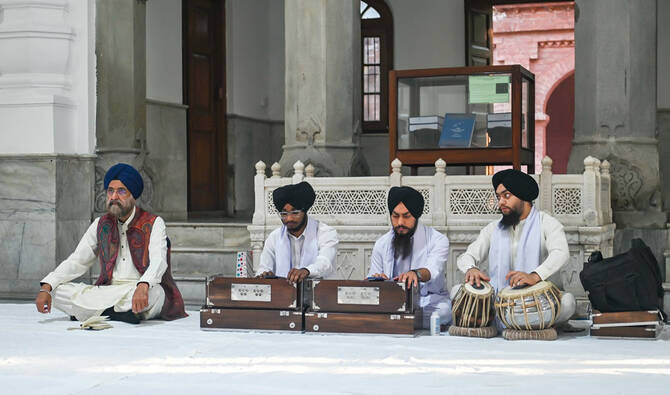
Sikh devotees workshipping at a gurdwara inside Pakistan's southern Lahore city's Atishon College on February 13, 2026. (Atichison College)
2 / 2
Short Url
Updated 13 February 2026
Follow

Historic Sikh prayer held at Lahore’s Aitchison College gurdwara after nearly 80 years

  • Ceremony marks 140th anniversary of colonial-era institution
  • Shrine had remained closed since Partition due to absence of Sikh students

ISLAMABAD: A Sikh worship service was held today, Friday, at the historic gurdwara inside Lahore’s Aitchison College, reopening the shrine for prayer nearly eight decades after it fell out of regular use following the 1947 Partition.

Founded in 1886 to educate the sons of royalty and prominent families of undivided Punjab, Aitchison College once served students from Muslim, Hindu and Sikh backgrounds. After Partition, which created Pakistan and India and triggered mass migration along religious lines, Sikh enrollment ended and the gurdwara ceased functioning as an active place of worship, though the college continued to maintain the building.

Friday’s ceremony took place as part of events marking the elite school’s 140th anniversary.

“A historic and emotional Sikh worship service was held at the Gurdwara on the campus of Aitchison College,” the institution said in a statement announcing the ceremony.

The gurdwara was designed by renowned Sikh architect Ram Singh of the then Mayo School of Arts, now the National College of Arts. Its foundation stone was laid in 1910 by Maharaja Bhupinder Singh of Patiala, a former Aitchison student who studied there from 1904 to 1908, and the Patiala royal family supported fundraising for its construction. Completed shortly afterward, it served as a daily prayer space for Sikh pupils attending the school.

About 15 Sikh alumni of Aitchison College are currently living in India and have recalled attending evening prayers at the gurdwara, describing its black-and-white marble flooring and castle-like interior architecture.

The campus also houses other pre-Partition places of worship, including a mosque built in 1900 by the Nawab of Bahawalpur and a Hindu temple whose foundation stone was laid in 1910 by the Maharaja of Darbhanga.

Over the decades, Aitchison College has educated prominent figures from across pre-Partition Punjab and modern South Asia, including former Pakistani prime ministers Imran Khan, Mir Zafarullah Khan Jamali and Feroz Khan Noon, as well as Indian cricket captain Iftikhar Ali Khan Pataudi and members of princely families such as the Maharaja of Patiala.


Pakistan says defense pact with Saudi Arabia elevated brotherly ties to ‘new heights’

Updated 25 February 2026
Follow

Pakistan says defense pact with Saudi Arabia elevated brotherly ties to ‘new heights’

  • Pakistan, Saudi Arabia signed strategic defense pact last year pledging aggression against one will be treated as attack on both
  • Deputy PM Ishaq Dar says enduring bonds with Islamic and Arab nations form vital pillar of Pakistan’s foreign policy 

ISLAMABAD: Deputy Prime Minister Ishaq Dar said on Wednesday that Pakistan’s defense pact with Saudi Arabia elevated its brotherly ties with the Kingdom to “new heights,” stressing that close ties with Arab and Islamic nations form a key pillar of Islamabad’s foreign policy. 

Pakistan and Saudi Arabia signed a Strategic Mutual Defense Agreement on Sept. 17 last year, pledging that aggression against one country would be treated as an attack on both, enhancing joint deterrence and formalizing decades of military and security cooperation.

Both nations agreed in October 2025 to launch an economic cooperation framework to strengthen trade and investment ties. 

“In the Middle East, our landmark Strategic Mutual Defense Agreement with Saudi Arabia has elevated our brotherly ties to new heights,” Dar said while speaking at the Pakistan Governance Forum 2026 event in Islamabad. 

The Pakistani deputy prime minister was speaking on the topic “Navigating International Relations Amidst Changing Geo-Politics.”

Dar noted that Pakistan has reinforced partnerships with other Middle Eastern nations such as the UAE, Qatar, Jordan, Oman, Egypt and Bahrain. He said these partnerships have yielded “concrete agreements” in investment, agriculture, infrastructure, and energy sectors. 

“Our enduring bonds with Islamic and Arab nations form a vital pillar of our foreign policy, and we will continue to expand our partnerships across Asia, Latin America, and Africa,” he said. 

Dar pointed out that the presidents of Kazakhstan, Uzbekistan and Kyrgyzstan have undertaken visits to Pakistan in recent months, reflecting Central Asian nations’ desire to boost cooperation with Islamabad.

On South Asia, the Pakistani deputy PM said Pakistan has successfully transformed its fraternal ties with Bangladesh into “a substantive partnership.”

“Similarly, the trilateral mechanism involving China, Pakistan, and Bangladesh has been launched with a view to expanding and deepening regional cooperation and synergy,” the Pakistani minister said. 

He said Islamabad has strengthened its “all-weather” partnership with China via the second phase of the multi-billion-dollar China-Pakistan Economic Corridor agreement and “unwavering support” from both sides for each other’s core interests. 

Dar said Pakistan had also reinvigorated its partnership with the US, advancing cooperation in trade, technology, investment, and regional stability. 

“This calibrated approach has enhanced our ability to navigate complexity with skill and confidence, ensuring that our national interests are served without compromising our core foreign policy principles,” he said.