


LONDON: With climate change and resource scarcity looming, the global green technology sector is leading the charge to create a cleaner energy future.
Green technology (greentech) is a broad term for innovative companies that are working toward carbon-neutral solutions for a sustainable planet.
In tandem with its historically hydrocarbon-powered economy, the UAE is now a pioneer in energy diversification, launching some of the world’s most innovative solar, wind and waste-to-energy projects.
Home to a growing population and rising energy demand, the UAE is leveraging its abundant renewable resources and global technology partners to dramatically reduce its carbon footprint. Chief among its collaborators is the UK, which has a long history of greentech expertise and implementation.
According to Sarah Heineman, head of renewable energy at the UK Department for International Trade, there is vast potential for investment and cross-collaboration between the UK and UAE within the greentech industry.
“The British energy sector has one of the most advanced energy systems in the world. It is at the forefront of the transition to decarbonize power generation and has attracted significant private investment into innovation,” she said.
“Over the last five years, relative power emissions in the UK have fallen faster than in any other G10 nation,” Heineman noted, adding that Britain was the first major economy to pass laws for net zero carbon emissions.
Ambitious UAE energy vision
The UAE has shown foresight in the greentech space by laying out its ambitious Energy Strategy 2050. According to the International Renewable Energy Agency, green energy has advanced rapidly in the GCC countries since 2014.
The Gulf project pipeline reached almost seven gigawatts of new power generation capacity by 2018, after record-breaking bids in renewable energy auctions in the UAE and Saudi Arabia made solar power cost-competitive with conventional energy technologies.
HIGHLIGHTS
• In tandem with its historically hydrocarbon-powered economy, the UAE is now a pioneer in energy diversification, launching some of the world’s most innovative solar, wind and waste-to-energy projects.
• Home to a growing population and rising energy demand, the UAE is leveraging its abundant renewable resources and global technology partners to dramatically reduce its carbon footprint. Chief among its collaborators is the UK, which has a long history of greentech expertise and implementation.
As well as being home to the world’s largest single-site solar park, Dubai is pioneering waste-to-energy innovation with the Al-Warsan project — which has the capacity to process 1.9 million tons of municipal solid waste per year and power around 135,000 homes.
The UAE’s transition to cleaner energy is helping Britain make the shift to net zero in the UK too. Abu Dhabi-owned energy firm Masdar is leading investment, research and development, and commercialization of renewables in the UAE, and has made multi-billion pound investments in three offshore wind farms in the UK. It has also invested millions in Britain’s electric vehicle charging infrastructure.
Clean energy innovation
A 2018 UN report revealed that global investment in renewable energy and green technology processes surpassed $200 billion in 2017; $2.9 trillion has been invested in sources like solar and wind power since 2004.
In the UK, academia and research centers work closely with greentech companies to develop and commercialize innovative technologies to meet global demand. As the government continues to invest in the sector, Britain has inked hundreds of patents for leading environmental solutions.
“The UK — with its strong pedigree in renewables — is well-placed to help the UAE power ahead with its innovative energy vision and achieve its ambitious targets,” said Patrick Moody, British ambassador to the UAE.
UK greentech startups
British startups have already made significant inroads in helping to shape the UAE’s greentech sector. Northern Ireland-based Kiverco has been chosen to design and build the solution that will recycle all waste from Expo 2020 Dubai — a global event staged over six months that will see 25 million visits.
Kiverco installed the plant in early 2020, which will divert the highest percentage of landfill waste than any previous Expo. The recycling solutions will recover ferrous metals, non-ferrous metals, plastic bottles, plastic film, paper and cardboard. Organic waste from the sprawling Expo 2020 Dubai South site will be converted into fertilizer, and construction material will be reused in roads.
Global sales manager at Kiverco, Con Gallagher, said: “The UAE is leading the charge when it comes to sustainable policies. Kiverco now has five active plants in the Gulf region. We are seeing more and more interest as governments turn their focus to mass-recycling strategies.”
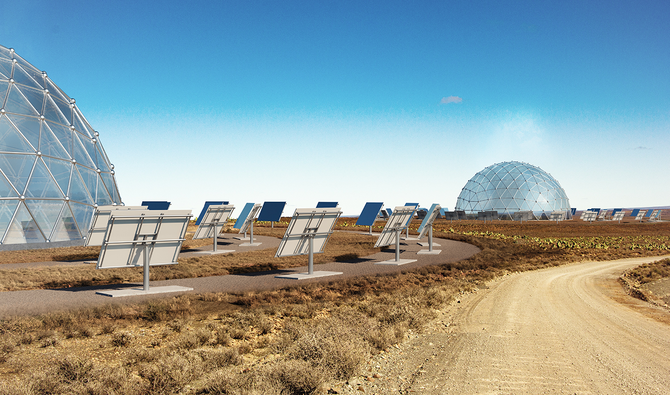
UK-based Solar Water Plc., the world’s first carbon-neutral hydro-infrastructure dome, designed to produce clean water for municipal and industrial consumption, is in talks with the UAE government to implement its innovative glass technology.
The dome houses vast parabolic mirrors that capture the sun’s heat; this energy evaporates incoming seawater, which condenses and precipitates as fresh water, creating a constant water cycle within the dome. Salt is extracted from the brine as a by-product and sold commercially, ensuring that neither salt nor brine is returned to the ocean.
“In the last nine months, even amid the coronavirus pandemic, we have created a pipeline of projects in the Middle East,” said David Reavley, CEO of Solar Water. “I think there will be enormous demand over the next two or three decades. We are solving a big problem as the world progresses into climate change vulnerability.”
Patrick Moody, British ambassador to the UAE, concluded: “The UK’s thriving renewable energy sector has the expertise and practical know-how to harness the UAE’s abundant renewable resources and futuristic sustainability vision. I see great potential for collaboration between the UK and the UAE.”