

Reopening of King Fahd Causeway will help boost both kingdoms’ economies

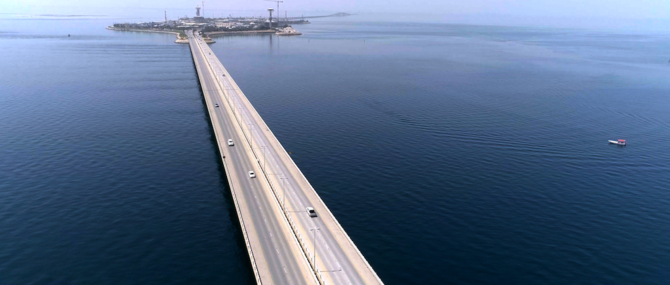
The King Fahad Causeway is one of the largest construction achievements in the region. (Supplied)
Short Url
Updated 10 January 2021
Follow

Reopening of King Fahd Causeway will help boost both kingdoms’ economies

  • The reopening of the King Fahd Causeway in March will help give the economies of Saudi Arabia and Bahrain a further boost

RIYADH: Tourism and trade links between Bahrain and Saudi Arabia grew 43 percent year-on-year in the third quarter of 2020, but the reopening of the King Fahd Causeway in March will help give the economies of the two countries a further boost after the impact of the coronavirus disease (COVID-19) pandemic.

“The recent announcement made about permanently opening the King Fahad Causeway will strengthen these ties even further,” Dr. Ali Al-Moulani, president of the Bahrain Economists Society, said in a press statement on Sunday.

“Prior to the pandemic, Bahrain welcomed around 11 million tourists with over 88 percent coming through the causeway…The number of visitors from Saudi Arabia is set to gradually go back to normal levels following this announcement and is expected to add around $2.9 billion to Bahrain’s economy this year based on average tourist spending in 2019,” he added.

Saudi Arabia is reopening travel via air, land and sea from March 31, 2021, according to the country’s Ministry of the Interior.

According to the King Fahad Causeway Authority, January 2020 scored the highest number of users in a single month, with 3,095,963 passengers moving through, or around 99,870 per day. This represented an increase of 22.2 percent compared to the same period in 2019.

The King Fahad Causeway is one of the largest construction achievements in the region. Opening in 1986, it has played a prominent role in the region and helped to strengthen relations between Saudi Arabia and Bahrain. Around 390 million users have travelled along the causeway since its opening.

Bahrain Customs have recently announced installing high-tech artificial intelligence scanners on the bridge, automating data collection and allowing shipment inspections to take place before reaching the border.

According to the King Fahad Causeway Authority website, the causeway is 25 kilometers in length, with the Saudi portion beginning at Al-Aziziyyah, located south of Al-Khobar city, and the Bahrain portion beginning right from Al-Jasra, west of Manama.


Post-break return of students drives surge in education spending, SAMA data shows

Updated 58 min 20 sec ago
Follow

Post-break return of students drives surge in education spending, SAMA data shows

RIYADH: Spending on education in Saudi Arabia increased by 141.1 percent for the week ending Jan. 24, as students returned to the classroom after the mid-year break.

This was accompanied by a 7 percent increase in spending on books and stationery, which reached SR146.17 million ($38.9 million).

According to the latest data from the Saudi Central Bank, the over POS value dropped 10.6 percent to SR12.52 billion, with transactions representing a 9.7 percent week-on-week decrease to 213.62 million.

This week saw negative changes across all the remaining sectors. Spending on bakeries and pastries saw an 18.4 percent decline to SR229.71 million, while gas stations saw an 11 percent drop. Professional and business services decreased by 11.6 percent.

Expenditure on apparel and clothing fell by 19.7 percent to SR985.94 million, followed by a 2.8 percent drop in spending on jewelry.

Spending on car rentals in the Kingdom fell by 14.7 percent, while airlines saw a 9.3 percent decrease to SR38.16 million.

Expenditure on food and beverages saw a 7.9 percent decline to SR1.88 billion, claiming the largest share of the POS. Restaurants and cafes retained the second position despite an 18.5 percent decrease to SR1.50 billion.

Geographically, Riyadh accounted for the largest share of total POS spending, but still saw a 6 percent dip to SR4.46 billion, down from SR4.74 billion the previous week. The number of transactions in the capital settled at 69.07 million, down 6.8 percent week on week.

In Jeddah, transaction values decreased by 13.6 percent to SR1.75 billion, while Dammam reported a 4.8 percent decrease to SR640.59 million.

POS data, tracked weekly by SAMA, provides an indicator of consumer spending trends and the ongoing growth of digital payments in Saudi Arabia. 

The data also highlights the expanding reach of POS infrastructure, extending beyond major retail hubs to smaller cities and service sectors, supporting broader digital inclusion initiatives. 

The growth of digital payment technologies aligns with the Kingdom’s Vision 2030 objectives, promoting electronic transactions and contributing to the Kingdom’s broader digital economy.