

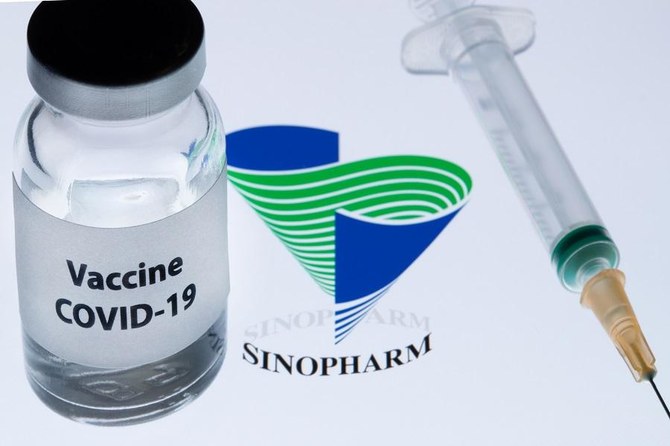
China gives its first COVID-19 vaccine approval to Sinopharm

No detailed efficacy data of the vaccine has been publicly released but its developer. (File/AFP)
Short Url
Updated 31 December 2020
Follow

China gives its first COVID-19 vaccine approval to Sinopharm

  • Sinopharm subsidiary China National Biotec Group said the vaccine 79.34% effective in preventing people from developing the disease
  • More than 3 million additional doses have been given since Dec. 15 as the drive to vaccinate priority groups gathers pace

BEIJING: China approved its first COVID-19 vaccine for general public use on Thursday, a shot developed by an affiliate of state-backed pharmaceutical giant Sinopharm, as it braces for greater transmission risks over the winter.
No detailed efficacy data of the vaccine has been publicly released but its developer, Beijing Biological Products Institute, a unit of Sinopharm subsidiary China National Biotec Group (CNBG), said on Wednesday its vaccine was 79.34% effective in preventing people from developing the disease based on interim data.
The approval, announced by the National Medical Products Administration, comes after the UAE this month became the first country to roll out the vaccine to the public.
While China has been slower than several other countries in approving COVID-19 vaccines, it has been inoculating some citizens for months with three different shots still undergoing late-stage trials.
China launched an emergency use program in July aimed at essential workers and others at high risk of infection and as of the end of November, had administered more than 1.5 million doses using at least three different products — two developed by CNBG and one by Sinovac.
More than 3 million additional doses have been given since Dec. 15 as the drive to vaccinate priority groups gathers pace.
While the efficacy of the Sinopharm shot trails the more than 90% success rate of rival vaccines from Pfizer Inc. and its partner BioNTech and Moderna Inc, it points to progress China has made in the global race to develop successful COVID-19 vaccines.
Four other vaccines from Sinovac, CNBG’s Wuhan unit, CanSino Biologics and the Chinese Academy of Sciences are also in late stage trials, underscoring China’s efforts to develop a homegrown vaccine to challenge Western rivals.
President Xi Jinping has pledged to make China’s vaccines a global public good and it has won several large supply deals with countries including Indonesia and Brazil — the most populous countries in Southeast Asia and Latin America respectively.

Call to get vaccinated
While China has kept new outbreaks of the coronavirus under control, it is ramping up the emergency program to contain the risks over the winter. The virus emerged a year ago in a market in the central city of Wuhan.
The South China Morning Post reported that China would vaccinate as many as 50 million people from high-priority groups before the Lunar New Year holiday in February.
“We call on people ... to take an active part in vaccination to protect themselves, family members and others, which is also contributing to global epidemic control,” Zeng Yixin, an official with National Health Commission, told a briefing on Thursday.
The price of the vaccine would depend on the scale of use, but the “premise” was that it would be free for the public in China, he said.
The vaccine’s approval is officially “regulatory,” a conditional green light given to vaccines deemed urgently needed to cope with major public health emergencies even though complete clinical trials have yet to be completed.
The approval comes as Britain on Wednesday approved a second COVID-19 vaccine, a shot developed by Oxford University and AstraZeneca, as it battles a major winter surge driven by a new variant of the virus.


India contains Nipah virus outbreak, some Asian countries tighten health screenings

Updated 5 sec ago
Follow

India contains Nipah virus outbreak, some Asian countries tighten health screenings

  • Two Nipah cases had been detected since December and that all identified contacts had been quarantined and tested
  • Earlier Nipah outbreaks were reported in West Bengal in 2001 and 2007, recent cases found in southern Kerala state
NEW DELHI: Indian authorities said they had contained a Nipah virus outbreak after confirming two cases in the eastern state of West Bengal, as several Asian countries tightened health screenings and airport surveillance for travelers arriving from India.
India’s Health Ministry said Tuesday that two Nipah cases had been detected since December and that all identified contacts had been quarantined and tested. The ministry did not release details about the patients but said 196 contacts had been traced and all tested negative.
“The situation is under constant monitoring, and all necessary public health measures are in place,” the ministry said.
Nipah, a zoonotic virus first identified during a 1990s outbreak in Malaysia, spreads through fruit bats, pigs and human-to-human contact. There is no vaccine for the virus, which can cause raging fevers, convulsions and vomiting. The only treatment is supportive care to control complications and keep patients comfortable.
The virus has an estimated fatality rate of between 40 percent and 75 percent, according to the WHO, making it far more deadly than the coronavirus.
There were no reported cases of the virus outside India, but several Asian countries introduced or reinforced screening measures at airports as a precaution. The safety measures were put in place after early media reports from India suggested a surge in cases, but health authorities said those figures were “speculative and incorrect.”
Indonesia and Thailand increased screening at major airports, with health declarations, temperature checks and visual monitoring for arriving passengers. Thailand’s Department of Disease Control said thermal scanners had been installed at arrival gates for direct flights from West Bengal at Bangkok’s Suvarnabhumi Airport.
Myanmar’s Health Ministry advised against nonessential travel to West Bengal and urged travelers to seek immediate medical care if symptoms develop within 14 days of travel. It said fever surveillance introduced during the COVID-19 pandemic at airports has been intensified for passengers arriving from India, with laboratory testing capacity and medical supplies readied.
Vietnam’s Health Ministry on Tuesday urged strict food safety practices and directed local authorities to increase monitoring at border crossings, health facilities and communities, according to state media.
China said it was strengthening disease prevention measures in border areas. State media reported that health authorities had begun risk assessments and enhanced training for medical staff, while increasing monitoring and testing capabilities.
Earlier Nipah outbreaks were reported in West Bengal in 2001 and 2007, while recent cases have largely been detected in southern Kerala state. A major outbreak in 2018 killed at least 17 people in Kerala.