Lebanese blame ‘brutal’ Syrian regime over refugee attack

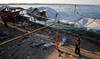
Syrian refugees salvage belongings from the wreckage of their shelters at a camp set on fire overnight in the northern Lebanese town of Bhanine on December 27, 2020, following a fight between members of the camp and a local Lebanese family. (AFP)
Short Url
Updated 29 December 2020
Follow

Lebanese blame ‘brutal’ Syrian regime over refugee attack

  • Claims of hypocrisy after Damascus calls for migrant protection

BEIRUT: An arson attack that destroyed a Syrian refugee camp in northern Lebanon has led to widespread criticism of the Assad regime for failing to help or repatriate its displaced citizens.

In the wake of the attack that forced 370 people to flee the camp late on Saturday, Lebanese political leaders accused the Syrian regime of intimidating refugees in the country and deliberately hindering their return.

The accusations came as the Lebanese army confirmed that eight people — two Lebanese and six Syrian nationals — had been arrested in connection with the arson attack, which followed a pay dispute between Syrian workers and their Lebanese employers.

The Syrian Arab News Agency quoted an official source in the foreign ministry calling on Lebanon to “secure protection and care for the displaced Syrians.”

The official source also repeated calls for refugees “forced to leave the country by an unjust war to return to their homeland,” saying that “every effort is being made to facilitate their return.”

However, Lebanon’s Foreign Ministry said that it had received no communication from Syrian officials, either directly or through the embassy in Damascus.

Head of the Progressive Socialist Party Walid Jumblatt accused the Syrian regime of hypocrisy over its condemnation of the attack on the camp and calls to punish the perpetrators.

“This regime gang has destroyed entire villages and cities in Syria, and violated Lebanon with acts of terror and assassination,” he said.

However, former Hezbollah chief Sheikh Subhi Al-Tufayli said that the media campaign calling for the return of Syrian refugees “raises fears of a dirty project that aims to solve the refugee problem by handing them over to the murderous regime in Damascus.”

On Monday, UNHCR spokesman Khaled Kabbara visited the charred campsite to inspect damage.

According to the refugee agency, most of the 370 residents have since been housed in other camps in the region or have found accommodation with locals.

About 1.5 million Syrians live in Lebanon, including 1 million registered as refugees with the UN, Lebanese government figures show. However, large numbers of Syrians are also believed to have entered the country surreptitiously and are unregistered.

Syrian refugees make up 25 percent of the Lebanese population, with 17 percent living in camps, UNHCR has said.

A recent referendum showed that 96 percent of the refugees want to return to Syria as soon as they feel safe.

The social media debate over the return of Syrian refugees to their homeland included praise for Saudi Arabia following urgent assistance provided by KSrelief to residents left without shelter after Saturday’s arson attack.

Syria’s Ambassador to Lebanon, Ali Abdul-Karim, told the Syrian Al-Watan newspaper that the Syrian foreign ministry had contacted the embassy to check on the refugees’ welfare.

“Some Lebanese have opened their homes to the Syrians who have lost their shelter,” he said.

The Syrian envoy also called on Lebanon to “punish those responsible and those who caused harm to the displaced Syrians.”


Syrian military tells civilians to evacuate contested area east of Aleppo amid rising tensions

Updated 3 sec ago
Follow

Syrian military tells civilians to evacuate contested area east of Aleppo amid rising tensions

  • Syria’s military has announced it will open a “humanitarian corridor” for civilians to evacuate from an area in Aleppo province
  • This follows several days of intense clashes between government forces and the Kurdish-led Syrian Democratic Forces
DAMASCUS: Syria’s military said it would open a corridor Thursday for civilians to evacuate an area of Aleppo province that has seen a military buildup following intense clashes between government and Kurdish-led forces in Aleppo city.
The army’s announcement late Wednesday — which said civilians would be able to evacuate through the “humanitarian corridor” from 9 a.m. to 5 p.m. Thursday — appeared to signal plans for an offensive in the towns of Deir Hafer and Maskana and surrounding areas, about 60 kilometers (40 miles) east of Aleppo city.
The military called on the Kurdish-led Syrian Democratic Forces and other armed groups to withdraw to the other side of the the Euphrates River, to the east of the contested zone.
Syrian government troops have already sent troop reinforcements to the area after accusing the SDF of building up its own forces there, which the SDF denied. There have been limited exchanges of fire between the two sides, and the SDF has said that Turkish drones carried out strikes there.
The government has accused the SDF of launching drone strikes in Aleppo city, including one that hit the Aleppo governorate building on Saturday shortly after two Cabinet ministers and a local official held a news conference there.
The tensions in the Deir Hafer area come after several days of intense clashes last week in Aleppo city that ended with the evacuation of Kurdish fighters and government forces taking control of three contested neighborhoods. The fighting killed at least 23 people, wounded dozens more, and displaced tens of thousands.
The fighting broke out as negotiations have stalled between Damascus and the SDF, which controls large swaths of northeast Syria, over an agreement to integrate their forces and for the central government to take control of institutions including border crossings and oil fields in the northeast.
Some of the factions that make up the new Syrian army, which was formed after the fall of former President Bashar Assad in a rebel offensive in December 2024, were previously Turkiye-backed insurgent groups that have a long history of clashing with Kurdish forces.
The SDF for years has been the main US partner in Syria in fighting against the Daesh group, but Turkiye considers the SDF a terrorist organization because of its association with the Kurdistan Workers’ Party, or PKK, which has waged a long-running insurgency in Turkiye. A peace process is now underway.
Despite the long-running US support for the SDF, the Trump administration has also developed close ties with the government of interim Syrian President Ahmad Al-Sharaa and has pushed the Kurds to implement the integration deal. Washington has so far avoided publicly taking sides in the clashes in Aleppo.
The SDF in a statement warned of “dangerous repercussions on civilians, infrastructure, and vital facilities” in case of a further escalation and said Damascus bears “full responsibility for this escalation and all ensuing humanitarian and security repercussions in the region.”
Adm. Brad Cooper, commander of US Central Command, said in a statement Tuesday that the US is “closely monitoring” the situation and called for “all parties to exercise maximum restraint, avoid actions that could further escalate tensions, and prioritize the protection of civilians and critical infrastructure.” He called on the parties to “return to the negotiating table in good faith.”
Al-Sharaa blasts the SDF
In a televised interview aired Wednesday, Al-Sharaa praised the “courage of the Kurds” and said he would guarantee their rights and wants them to be part of the Syrian army, but he lashed out at the SDF.
He accused the group of not abiding by an agreement reached last year under which their forces were supposed to withdraw from neighborhoods they controlled in Aleppo city and of forcibly preventing civilians from leaving when the army opened a corridor for them to evacuate amid the recent clashes.
Al-Sharaa claimed that the SDF refused attempts by France and the US to mediate a ceasefire and withdrawal of Kurdish forces during the clashes due to an order from the PKK.
The interview was initially intended to air Tuesday on Shams TV, a broadcaster based in Irbil — the seat of northern Iraq’s semi-autonomous Kurdish region — but was canceled for what the station initially said were technical reasons.
Later the station’s manager said that the interview had been spiked out of fear of further inflaming tensions because of the hard line Al-Sharaa took against the SDF.
Syria’s state TV station instead aired clips from the interview on Wednesday. There was no immediate response from the SDF to Al-Sharaa’s comments.