

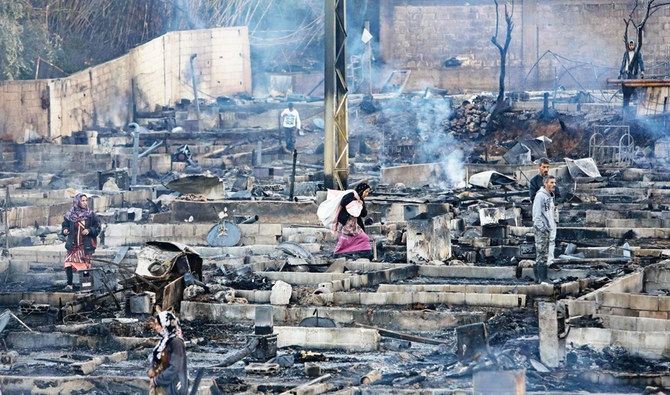

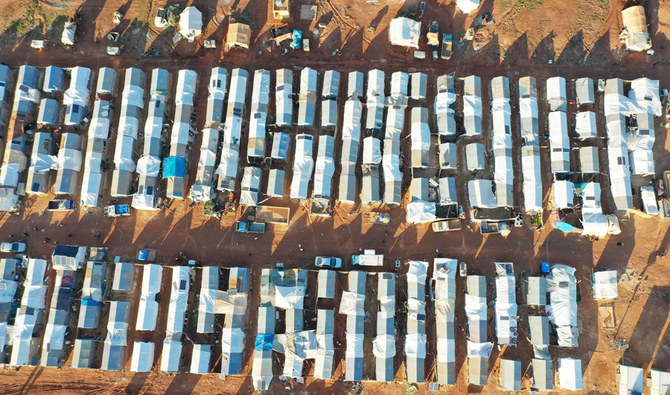

BEIRUT: More than 300 Syrian refugees, including 50 children, were forced to flee after their informal camp in northern Lebanon was set ablaze and burnt to the ground early on Sunday.
Firefighters fought the blaze for more than four hours but were unable to save any of the 100 tents or equipment in the camp.
The fire followed a fight between a Lebanese family and Syrians living in the camp in Bhannine in the Al-Miniyeh district, about 100 km from Beirut, the Lebanese army said.
Troops later carried out raids and arrested two Lebanese men and six Syrians as part of the investigation. Military weapons and ammunition were seized during the raids and further arrests were expected.
“Lebanese youths fired in the air and intentionally set fire to Syrian refugee tents after the dispute,” the Lebanese army command said.
Syrian refugees returned to the site later on Sunday as they searched for household items and personal belongings to salvage.
A number of refugees said that a group of Lebanese men — at least one of whom was armed— set fire to the tents after a dispute with Syrian youths led to violence.
Refugees were forced to huddle on a nearby road until 3 a.m. without shelter after the blaze.
FASTFACT
The fire followed a fight between a Lebanese family and Syrians living in the camp in Bhannine in the Al-Miniyeh district, about 100 km from Beirut, according to the Lebanese army.
Members of the Lebanese Civil Defense managed after hours of hard work to put out the fire. No casualties were reported.
Tawfiq Hamed, coordinator of the Future Movement in Al-Miniyeh, told Arab News that a dispute over the payment of wages to Syrian workers harvesting oranges had developed into a fight.
A crisis cell was formed to aid the refugees after many fled in fear of reprisals, spending the night in nearby orchards without food, water or blankets.
Several Lebanese residents in surrounding areas volunteered to host the Syrian refugees.
Mustafa Wehbe, Bhannine’s mayor, said: “The attackers blocked the front and back entrances to the camp, and cut the electrical wires feeding it before they set it on fire. People cried for help and fled, running barefoot between the flames, leaving their belongings behind. Families were separated (during the incident).”
The King Salman Humanitarian Aid and Relief Center (KSrelief) stepped in to help the refugees, restore the camp and find temporary housing.
The Syrian refugees in Lebanon are guests, and we must help and support them until they return to their country.
Sheikh Abdul Latif Derian, Grand mufti, Lebanon
The attack brought widespread condemnation. Grand Mufti Sheikh Abdul Latif Derian described it as “a heinous crime” and said the perpetrators “deserve severe punishment for this disgraceful act against humanity.”
Derian said that “the Syrian refugees in Lebanon are guests, and we must help and support them until they return to their country.”
He called on security forces to find the attackers and “stop the strife between siblings in the region.”
Ramzi Zohra, the regional governor, said that the attack “is condemned by everyone.”
The Progressive Socialist Party called on the security services to protect the region against such incidents, while the Islamic Group in the North desacriubed the attack as “a violation of rights, an affront and a major crime.”
Violent clashes between Syrian workers and Lebanese also took place in the northern town of Bcharre a month ago, leading to the death of a Lebanese man, Joseph Touq, 28. A Syrian worker later surrendered to security services, but relatives of the victim threatened workers in the area and set fire to their houses.
The Euro-Mediterranean Human Rights Monitor at the time condemned “collective punishment against Syrian refugees.”


