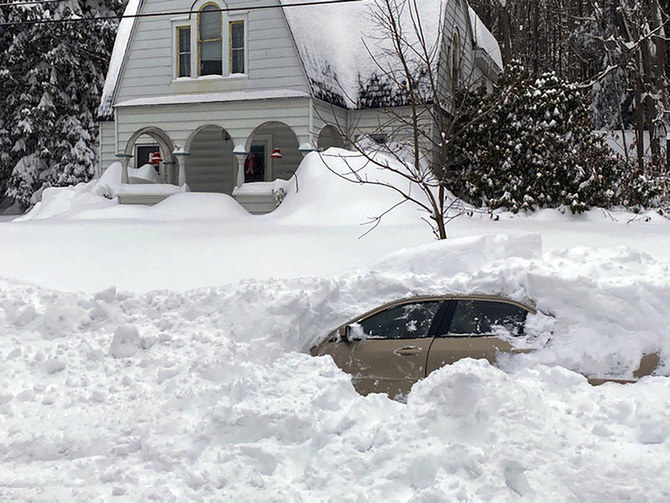
NEW YORK: A man who drove off the road in this week’s snowstorm spent 10 hours trapped in his car after a passing plow and rapidly accumulating snow buried it, finally managing to get a 911 call through and being rescued in the nick of time by a New York state trooper.
Kevin Kresen, 58, of Candor, drove off the road in the town of Owego and became “plowed in by a truck,” state police said.
“If he was in there for another hour his body temperature would have gone lower, and I’m convinced he wouldn’t have made it,” State Police Sgt. Jason Cawley, who rescued the man, said in an interview.
Kresen drove into a ditch around midnight and called 911 through the wee hours of Thursday but had trouble connecting. The vehicle became completely disabled, authorities said, leaving Kresen without heat.
“He finally got through a few times and was geolocated, but not very well because of the spottiness of the reception,” Cawley said.
First responders narrowed the call to a 3-mile stretch along the Susquehanna River in Owego, outside Binghamton, which got over 40 inches of snow in the storm. The storm covered Kresen’s car in snow, and at least one plow passed by as he remained trapped.
Cawley climbed miles of snowbanks, finally happening on one that looked slightly different and was in front of a house. He believed at first that he was looking at a row of mailboxes.
“I reached in to find which address I was at when I punched the side window of a car,” Cawley said. “I was a little shocked because I was actually standing almost on top of the car.”
The 22-year-veteran of the State Police cleared off the glass and asked whether anyone was inside.
“’I’m inside the car and I can’t feel my feet,’” Kresen told him.
“My heart jumped,” Cawley said. He dug Kresen out with the help of a passerby.
Kresen was suffering from hypothermia and frostbite and had gotten to the point where he had stopped shivering, Cawley said.
“That’s a very bad place to be when your body has stopped making heat and stopped trying to warm itself,” he said.
Kresen, whose speech was slurring, was helped into a marked police car and then driven to an ambulance, where he began warming up.
“He was grateful to have been pulled out,” said Cawley, who called the case his “first Arctic rescue.”


![]()

Motorist rescued after 10 hours in car buried by snow plow
Short Url
https://arab.news/9etkp
Motorist rescued after 10 hours in car buried by snow plow
- Kresen drove into a ditch around midnight and called 911 through the wee hours of Thursday but had trouble connecting
- Kresen was suffering from hypothermia and frostbite when rescuers found him


Latest updates


© 2026 SAUDI RESEARCH & PUBLISHING COMPANY, All Rights Reserved And subject to Terms of Use Agreement.