

Return of millions of Afghans from Pakistan and Iran pushes Afghanistan to the brink, UN warns

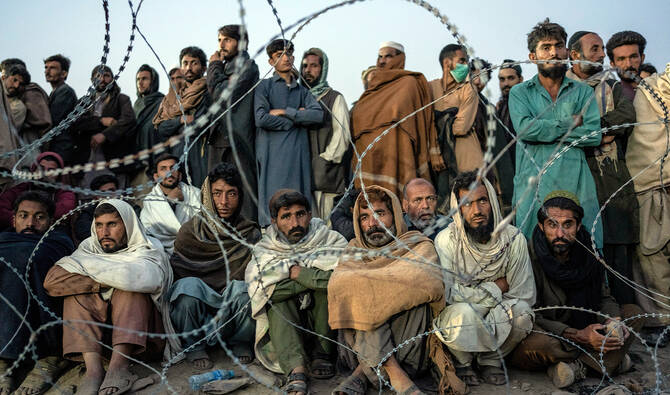
Afghan refugees wait to register in a camp near the Torkham Pakistan-Afghanistan border in Torkham, Afghanistan, on November 4, 2023. (AP/File)
Short Url
Updated 14 February 2026
Follow

Return of millions of Afghans from Pakistan and Iran pushes Afghanistan to the brink, UN warns

  • Afghan authorities provide care packages for those returning that include food aid, cash, a telephone SIM card and transportation
  • But the returns have strained resources in a country struggling with a weak economy, severe drought and two devastating earthquakes

GENEVA: The return of millions of Afghans from neighboring Pakistan and Iran is pushing Afghanistan to the brink, the U.N. refugee agency said on Friday, describing an unprecedented scale of returns.

A total of 5.4 million people have returned to Afghanistan since October 2023, mostly from the two neighboring countries, UNHCR’s Afghanistan representative Arafat Jamal said, speaking to a U.N. briefing in Geneva via video link from Kabul, the Afghan capital.

“This is massive, and the speed and scale of these returns has pushed Afghanistan nearly to the brink,” Jamal said.

Pakistan launched a sweeping crackdown in Oct. 2023 to expel migrants without documents, urging those in the country to leave of their own accord to avoid arrest and forcible deportation and forcibly expelling others. Iran also began a crackdown on migrants at around the same time.

Since then, millions have streamed across the border into Afghanistan, including people who were born in Pakistan decades ago and had built lives and created businesses there.

Last year alone, 2.9 million people returned to Afghanistan, Jamal said, noting it was “the largest number of returns that we have witnessed to any single country.”

Afghanistan’s Taliban rulers have criticized the mass expulsions.

Afghanistan was already struggling with a dire humanitarian situation and a poor human rights record, particularly relating to women and girls, and the massive influx of people amounting to 12% of the population has put the country under severe strain, Jamal said.

Already in just the month and a half since the start of this year, about 150,000 people had returned to Afghanistan, he added.

Afghan authorities provide care packages for those returning that include some food aid, cash, a telephone SIM card and transportation to parts of the country where they might have family. But the returns have strained resources in a country that was already struggling to cope with a weak economy and the effects of a severe drought and two devastating earthquakes.

In November, the U.N. development program said nine out of 10 families in areas of Afghanistan with high rates of return were resorting to what are known as negative coping mechanisms — either skipping meals, falling into debt or selling their belongings to survive.

“We are deeply concerned about the sustainability of these returns,” Jamal said, noting that while 5% of those who return say they will leave Afghanistan again, more than 10% say they know of someone who has already left.

“These decisions, I would underscore, to undertake dangerous journeys, are not driven by a lack of a desire to remain in the country, on the contrary, but the reality that many are unable to rebuild their viable and dignified lives,” he said.


Pakistan to auction 5G spectrum tomorrow ahead of phased rollout in major cities

Updated 7 sec ago
Follow

Pakistan to auction 5G spectrum tomorrow ahead of phased rollout in major cities

  • 5G services will initially begin in Islamabad, Lahore, Karachi, Peshawar and Quetta
  • Regulator will auction 11 bands to Ufone, Zong and Jazz via electronic bidding system

ISLAMABAD: Pakistan will hold an auction for 5G spectrum tomorrow, Tuesday, as the government prepares to launch next-generation mobile services in five major cities in bid to improve Internet speeds and connectivity, top officials said on Monday.

The development comes at a time of mounting pressure on Pakistan’s telecommunication networks and Internet service providers, with users and businesses frequently complaining of slow speeds and disruptions as a limited spectrum struggles to serve the South Asian nation of over 240 million.

Pakistan has more than 130 million broadband connections but access remains uneven, though its IT exports reached a record $3.8 billion in Fiscal Year 2024–25, up from $3.2 billion the previous year, marking an 18 percent year-on-year increase, according to the Pakistan Software Export Board.

The 5G spectrum auction will begin at 10am on Tuesday through an electronic system at the Pakistan Television headquarters, according to Pakistan Telecommunication Authority’s (PTA) Director-General for Licensing Aamir Shahzad.

“In the first phase, six spectrum bands will be auctioned among mobile network operators Ufone, Zong and Jazz, followed by bidding for five additional bands until 4pm,” he said at a briefing in Islamabad.

PTA Chairman Hafeez-ur-Rehman said a mock trial had already been conducted and all three telecom operators had been briefed on the bidding process.

The auction will not follow an open bidding format as each spectrum band would be auctioned separately, according to officials. The government expects the launch of 5G services to improve digital connectivity without increasing costs for consumers.

“The introduction of 5G will not raise data prices and there will be no additional burden on consumers,” the PTA chairman said.

IT Minister Shaza Fatima Khawaja said the government was encouraging wider adoption of 5G-compatible devices in Pakistan.

“Our aim is that as many people as possible use 5G mobile phones,” she said, adding that about 95 percent of mobile phones in Pakistan are locally manufactured.

According to officials, 5G services will initially be rolled out in Islamabad, Lahore, Karachi, Peshawar and Quetta, before expanding nationwide as the infrastructure develops.

Khawaja said Pakistan currently uses 274-megahertz spectrum which has been in use since 1987, and the upcoming auction will make a 600-megahertz spectrum available.

She said the auction would be conducted through specialized software and streamed live to ensure transparency.

PTA DG Licensing Shahzad said Pakistan currently has one of the lowest spectrum allocations in the region, and the government has prepared a nine-year plan for complete 5G rollout.

Under the plan, telecom operators will add around 3,000 new network sites each year, with initial 5G speeds expected to reach 50 megabits per second (Mbps).

PTA officials also said Pakistan currently offers some of the world’s cheapest mobile data services and assured that consumer protection would remain a priority.

Around 500,000 5G-enabled mobile phones have been produced in Pakistan in recent months, while five local manufacturers have already started producing more such devices, they added.