Snowstorm buries northwest US, with more on the way

1 / 2
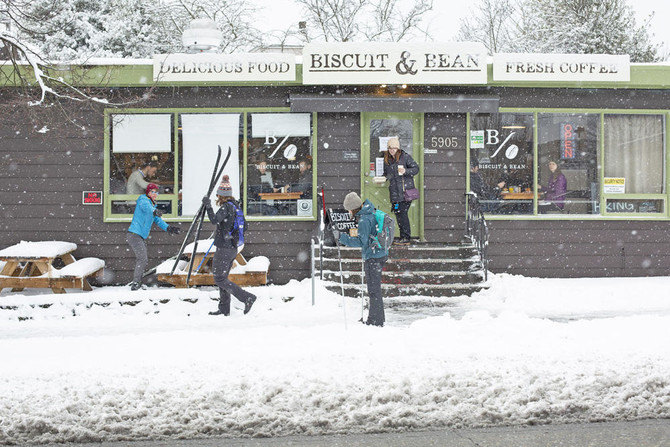
People arrive on skis at a cafe after a large storm blanketed the city with snow on February 9, 2019 in Seattle, Washington. ( David Ryder/Getty Images/AFP)
2 / 2
People play on a hill in the Phinney Ridge neighborhood after a large storm blanketed the city with snow on February 9, 2019 in Seattle, Washington.(David Ryder/Getty Images/AFP)
Updated 10 February 2019
Follow

Snowstorm buries northwest US, with more on the way

  • More than a foot of snow (30.5 cm) was recorded in some areas, including on the Olympic Peninsula
  • The National Weather Service said additional snow could fall Saturday, and another storm was expected early next week

SEATTLE: A winter storm that blanketed Washington state with snow and forced the cancelation of more than 200 flights moved south into Oregon as meteorologists warned Saturday that yet more was on the way.
In Seattle, where heavy snowfall is a rarity, residents cleared out grocery store shelves and left work early Friday afternoon as the storm arrived. On Saturday, many got out ski gear and sleds and took to neighborhood hills or even streets that were too steep for cars to navigate.
In Tacoma, hundreds of people turned out for a snowball fight in a park after someone who lives nearby suggested it on Facebook. They took cover behind picnic tables and used sleds as shields.
“This is a perfect morning to bundle up and play in the snow, but stay off the roads if possible,” Gov. Jay Inslee wrote on Twitter.
More than a foot of snow (30.5 cm) was recorded in some areas, including on the Olympic Peninsula, in the nation’s latest bout of winter weather. In central Washington, blowing snow and drifts 3 to 4 feet (0.9 to 1.2 meters) deep forced the closure of US 2 and Interstate 90. The Grant County Sheriff’s Office warned that snow drifts were blocking many roads.
“Snow conditions are worsening minute to minute, so don’t expect travel conditions to improve,” the sheriff’s office wrote.
The National Weather Service said additional snow could fall Saturday, and another storm was expected early next week.
About 180 people spent the night at an emergency shelter set up at Seattle Center, with officials going out again on Saturday to get other homeless residents to safety. Inslee declared a state of emergency over the storm, and sliding cars caused crashes on highways, though traffic was light. The state transportation department said crews had to clear several trees that had fallen across roads in the Tacoma area.
In Portland, a tanker truck slid into a sport-utility vehicle on an interchange between Interstates 5 and 84 on Saturday, blocking the ramp for hours.
Other parts of the country were also wrestling with difficult weather. Residents of Hawaii were bracing for coastal flooding amid extreme surf predictions. A California man died in rough waters off of Maui on Friday, Hawaii News Now reported.
In California, more than 120 visitors and staff members were rescued Thursday after being trapped by up to 7 feet (2 meters) of snow in a Sierra Nevada resort for five days.
Another winter storm was on the way to the region.
In Yosemite National Park, as many as 50 housing structures near Half Dome Village were damaged by trees toppled during a snowstorm earlier this week, displacing more than 160 employees who provide food, lodging and other services for visitors.
Elsewhere, more than 148,000 customers lost power in Michigan following days of freezing rain. The Consumers Energy utility said power would be restored by late Sunday.
In Washington, about 50,000 people lost power. In Seattle, snowfall from Sunday and Monday lingered into the week as below-freezing temperatures gripped the area. A 59-year-old man died Thursday from exposure at a Seattle light rail station.
Residents in Portland and Seattle who are more accustomed to rain than snow waited in long lines to buy shovels and de-icer.
Autumn Sang was at a mobbed grocery store in Tualatin, Oregon, on Friday stocking up for the coming storm for herself and her neighbor, who is disabled and doesn’t have a car.
Sang said she had never seen the store so crowded. She grew up in southern Oregon, where snow is more common, and wasn’t fazed by the forecast.
“I love it. I’m excited about it,” she said of the snow. “I think that Portlanders, most of them are city people and they come from a lot of different places, so they’re not so used to it. It’s like, ‘Use your brain! If you don’t have to go out, don’t go out.’ “


Trump takes unconventional approach to communicating to the public about war in Iran

Updated 03 March 2026
Follow

Trump takes unconventional approach to communicating to the public about war in Iran

  • The communications strategy opened Trump to criticism that he hadn’t done enough to explain the rationale and objectives of the war

Typical of an unconventional presidency, the Trump administration waited more than 48 hours to make any live, public communication to the American people about why it had decided to go to war with Iran.
President Donald Trump discussed why he launched the attack prior to a White House ceremony honoring military heroes on Monday but took no questions from reporters. Earlier in the day, Defense Secretary Pete Hegseth and Joint Chiefs of Staff Chairman Dan Caine briefed journalists at the Pentagon.
The two days previous, Trump delivered two pretaped statements that were released on Truth Social, the social media site owned by the president’s media company, and granted telephone interviews to more than a dozen journalists — several of which produced fragmented responses that, to some, clouded as much as they cleared up.
The communications strategy opened Trump to criticism that he hadn’t done enough to explain the rationale and objectives of the war, even as the American military suffered its first casualties. By contrast, Israeli Prime Minister Benjamin Netanyahu, who has teamed with the US against Iran, delivered two statements the day the war began and addressed reporters Monday at the site of a missile attack that killed nine people. The Israeli military has held multiple press briefings each day.
“The American people need a commander in chief, and he has been absent in that role,” Rahm Emanuel, White House chief of staff under President Barack Obama, said on CNN Monday. Emanuel, a Democrat, is contemplating a run for the presidency in 2028.
An unconventional strategy leads to criticism
Peter Baker, chief White House correspondent for The New York Times, wrote on social media that “after Trump launched a new war on Iran, he did not rush back to the White House to make an Oval Office address to rally the nation as other presidents have done. He stayed at Mar-a-Lago to attend a glitzy political fundraiser.”
That post provoked a response from Steven Cheung, White House communications director. “Imagine being a reporter so consumed with Trump Derangement Syndrome that he wants President Trump to mimic the failed policies of the past. The truth is that President Trump spent the majority of his time monitoring the situation in a secure facility, in constant contact with world leaders, and made multiple addresses to the nation that garnered hundreds of millions of views. He also took dozens of calls with reporters.”
The calls included one with Baker’s colleague at The Times, Zolan Kanno-Youngs. Trump’s mobile phone number is known to many of the reporters who cover him, and the president often takes their calls for on-the-spot interviews. Besides The Times, he spoke in the aftermath of the attack to journalists for ABC, CBS, NBC, CNN, CNBC, Fox News Channel, The Atlantic, The Washington Post, Axios, Politico and an Israeli television station.
Most of the calls were brief and marginally illuminating; Politico’s Dasha Burns said Trump answered but said he was too busy to talk. The public couldn’t hear what Trump said in the interviews and was dependent upon what the journalists chose to report on the conversations.
“I spoke to President Trump today and he told me that the operation in Iran is going to go very fast,” Libby Alon, a reporter for Channel 14 News in Israel, wrote about her interview on X. “It’s doing very well, and (will) make the people of Israel very happy, and the people of the world very happy.”
The Times reported that in its six-minute chat, Trump “offered several seemingly contradictory visions of how power might be transferred to a new government — or even whether the existing Iranian power structure would run that government or be overthrown.”
In one of his two conversations with Trump, ABC News’ Jonathan Karl said when he asked about the death of Iranian Ayatollah Ali Khamenei, the president said: “I got him before he got me. They tried twice. Well I got him first.” CNN’s Jake Tapper went on the air minutes after his conversation Monday, saying Trump told him “the big one is coming soon,” an apparent reference to a future attack.
Asked for comment, White House spokeswoman Anna Kelly said: “President Trump is the most transparent and accessible president in American history. The American people have never had a more direct and authentic relationship with a president of the United States than they have with President Trump.”
Hegseth briefing concentrates on friendly reporters
Pentagon reporters learned late Sunday about Hegseth’s briefing. Reporters from The Associated Press, Reuters, ABC, CBS, NBC, CNN, Fox News Channel and Stars & Stripes were permitted into the briefing room, but Hegseth did not call on them. Instead, he took questions from NewsNation and Trump-friendly outlets like the Daily Caller, Daily Wire, One America News and the Christian Broadcasting Network. Most mainstream news outlets left their regular stations at the Pentagon last fall rather than agree to Hegseth’s rules restricting their work.
Hegseth denounced the “foolishness” of people wanting to know details of the operation in advance, such as whether Americans would commit to more than air power, and said the operation would continue as long as it took to achieve objections. He initially ignored NBC News’ Courtney Kube when she called out a question: “President Trump put a four-week time limit on it. Are you saying he’s wrong?”
Later, Hegseth denounced Kube for asking “the typical NBC sort of gotcha-type question. President Trump has all the latitude in the world to talk about how long it might take — four weeks, two weeks, six weeks, it could move up, it could move back. We’re going to execute at his command the objectives he set out to achieve.”
Unlike Pentagon briefings in past administrations, reporters were given assigned seats, with the Trump-friendly outlets seated in front. Jennifer Griffin, Hegseth’s former colleague at Fox News Channel who left the Pentagon with other reporters after not accepting his new rules, was seated in the last row.