

Pakistan urges peaceful dispute settlement, respect for law at Inter-Parliamentary Union hearing

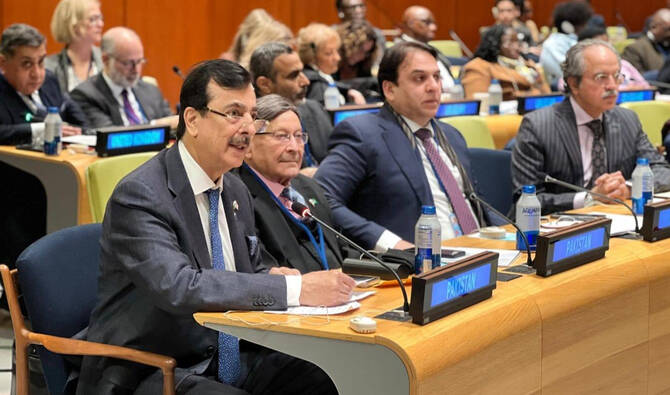
Pakistani Senate Chairman Yusuf Raza Gilani (left) addresses the Inter-Parliamentary Union (IPU) annual hearing at the UN headquarters in New York, US, on February 13, 2026. (Senate of Pakistan)
Short Url
Updated 14 February 2026
Follow

Pakistan urges peaceful dispute settlement, respect for law at Inter-Parliamentary Union hearing

  • The annual hearing focused on advancing peace, sustainable development, democratic governance and effective multilateralism
  • Islamabad calls for renewed trust in UN that must be rooted in strengthened cooperation, backed by sustainable financing

ISLAMABAD: Pakistan on Friday called for the respect for international law and meaningful progress in peaceful settlement of disputes at Inter-Parliamentary Union (IPU) annual hearing, in accordance with the United Nations (UN) Charter and Security Council resolutions.

Held under the theme ‘Parliaments and the United Nations: Better together, delivering for the people,’ the 2026 IPU annual hearing on Feb. 12-13 focused on advancing peace, sustainable development, democratic governance, and effective multilateralism, including contributions to the UN’s Pact for the Future and broader reform efforts.

Pakistani Senate Chairman Yusuf Raza Gilani, who was leading a six-member parliamentary delegation, delivered the national statement at the IPU annual hearing at the UN headquarters, calling for democratic, transparent, and accountable decision-making in order to enhance the UN’s credibility, according to the Senate of Pakistan.

“Parliaments are indispensable partners in ensuring national ownership of international commitments,” he was quoted as saying by the Senate. “Reform is essential. But it must be ‘Reform for All, Privilege for None’.”

The Senate chairman highlighted the continuing importance of the United Nations as the cornerstone of multilateral cooperation, stressing that the organization’s universal membership and Charter-based mandate remain central to promoting global peace and security.

“Overlapping crises, including climate change, violent conflicts, and growing social and economic inequalities, continue to challenge the UN’s ability to deliver,” he said. “These pressures disproportionately affect the Global South, eroding hard-won development gains.”

He underscored that no single nation could address these systemic challenges alone, calling for renewed trust in the UN that must be rooted in strengthened multilateral cooperation, backed by adequate, predictable, and sustainable financing to enable the organization to fulfill its mandates effectively.


Pakistan top IT association backs $1 billion AI plan announced at Indus Summit

Updated 4 sec ago
Follow

Pakistan top IT association backs $1 billion AI plan announced at Indus Summit

  • Private sector pledges support for AI push, calls tech sector engine of future growth
  • Government to fund 1,000 AI PhDs, train one million professionals under digital strategy

KARACHI: Pakistan’s main software industry association on Tuesday backed the government’s plan to invest $1 billion in artificial intelligence by 2030, pledging private-sector support for what officials describe as a national push toward digital transformation.

The commitment was announced during Indus AI Week in Islamabad, held earlier this month, where Prime Minister Shehbaz Sharif outlined plans to fund artificial intelligence development, including scholarships and workforce training.

The Pakistan Software Houses Association (P@SHA), representing IT exporters and technology firms, said the private sector would play a central role in implementing the strategy.

“The IT sector is no longer merely a participant in Pakistan’s economy,” said Sajjad Syed, the association’s chairman, in a statement. “It is the fundamental engine of our future growth.”

“The commitments made at the Indus AI Summit provide a much-needed, evidence-based structural framework,” he added. “P@SHA, representing the collective strength of Pakistan’s software and tech enterprises, stands fully prepared to translate this policy into export-driven, practical realities.”

Syed said the integration of AI was no longer optional, describing it as a “matter of global survival and economic sovereignty.”

The government said the initiative includes funding for 1,000 PhD scholarships in artificial intelligence and a federal mandate to train one million non-IT professionals in advanced technology skills.

The Indus AI Week event drew participation from local and international technology companies, universities, and investors, according to organizers. It included technical bootcamps and industry panels aimed at accelerating AI adoption.

Pakistan’s IT exports reached $2.2 billion in July–December FY26, marking a 20 percent year-on-year increase, the statement said, as the country seeks to expand its technology sector to support foreign exchange earnings.

The AI push comes as Islamabad looks to modernize its digital infrastructure and attract technology investment while positioning the country as a competitive player in emerging technologies.