Algeria's Abdelmadjid Tebboune says needs up to 3 weeks to recover from COVID-19

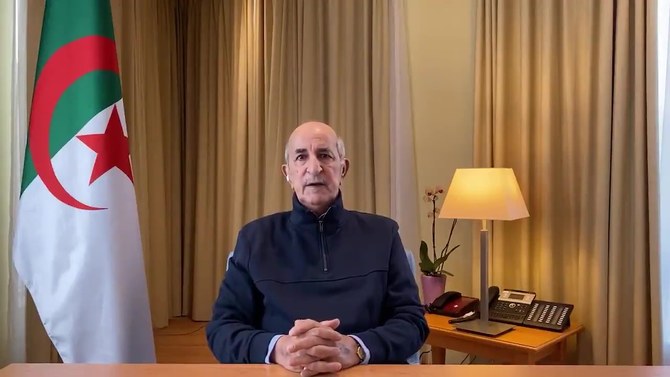
A video grab taken from the personal twitter account of Algeria’s President Abdelmadjid Tebboune on Dec. 13, 2020 shows him delivering a speech to a camera next to an Algerian flag. (AFP/Twitter Handout)
Short Url
Updated 13 December 2020
Follow

Algeria's Abdelmadjid Tebboune says needs up to 3 weeks to recover from COVID-19

  • The video was broadcast on state television and published on Tebboune’s Twitter feed
  • His absence had sparked concerns of an institutional crisis

ALGIERS: Algeria’s President Abdelmadjid Tebboune said Sunday he was recovering from the COVID-19 illness, in his first televised appearance since he was hospitalized in Germany almost two months ago.
“Thanks to God... I have started on the road to recovery,” the 75-year-old said a day after the first anniversary of his election.
“It may take two or three weeks but, God willing, I will recover all my bodily strength.”
The video was broadcast on state television and published on Tebboune’s Twitter feed.
He did not indicate his location, but the Twitter feed carried the comment “we will meet soon on the territory of the nation.”
Tebboune was hospitalized in Germany on October 28, and Algerian authorities later announced that he had the COVID-19 illness.
His absence had sparked concerns of an institutional crisis, weeks after voters approved a revised constitution on record low turnout in a referendum widely seen as a maneuver to neutralize the long-running Hirak protest movement.
Tebboune has been unable to sign the revised constitution into law because he must be on Algerian soil to do so.
He also has until December 31 to sign off on a 2021 budget.
But he said Sunday he was following developments in Algeria “day by day, if not hour by hour.”
Visibly thinner and wearing a casual jacket, he sat at a desk next to an Algerian flag.
Tebboune won last year’s widely boycotted December 12 presidential election, following months of mass protests that had swept his predecessor Abdelaziz Bouteflika from office.


Egypt coordinates with Greece to return victims of migrant boat, warns against irregular routes

Updated 50 min 49 sec ago
Follow

Egypt coordinates with Greece to return victims of migrant boat, warns against irregular routes

  • Egypt’s measures have drawn international support, with the European Union pledging €200 million in grants in March 2024 to bolster border management

Egypt’s Foreign Minister Badr Abdelatty has instructed the Egyptian embassy in Athens to step up coordination with Greek authorities, Ahram Online reported on Tuesday. 

The move aims to support survivors and expedite the repatriation of the victims’ bodies once legal procedures are completed.

The ministry added that the embassy has been in contact with the families of those who died to arrange the transfer of the remains back home.

Offering its condolences to the victims’ families, the ministry renewed its warning to citizens about the risks of irregular migration, urging Egyptians to safeguard their lives by using legal and regulated travel channels.

Egypt has intensified its efforts to curb irregular migration since launching a national strategy in 2016, with officials stressing that the country will not be used as a transit route to Europe.

Authorities say no migrant boats have departed from Egyptian shores since the strategy was introduced, despite Egypt hosting nearly 10 million foreign nationals, including refugees, asylum seekers, and migrants from 133 countries.

The approach has continued to evolve over the years, most recently with the adoption of the 2024–2026 national action plan by the National Committee for Combating and Preventing Illegal Migration and Trafficking in Persons.

Earlier initiatives have also supported these efforts, including the 2019 “Lifeboats” programme, which allocated EGP 250 million to create job opportunities in villages considered most vulnerable to irregular migration.

Egypt’s measures have drawn international support, with the European Union pledging €200 million in grants in March 2024 to bolster border management, search-and-rescue capabilities, and efforts to combat migrant smuggling.