

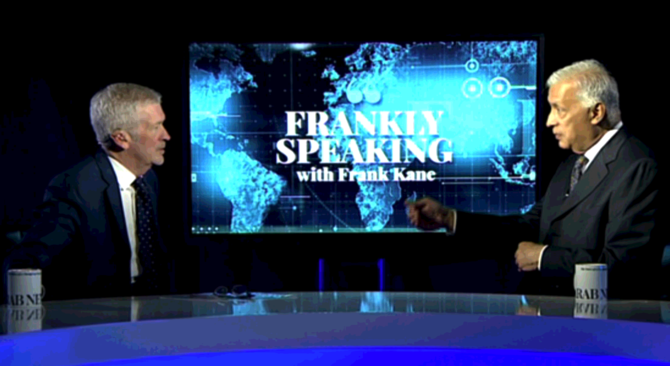

ISLAMABAD: Former Pakistani Prime Minister Shaukat Aziz on Sunday credited Saudi Arabia’s “elder brother” approach for the strong bilateral and economic relations between the two countries, reaffirming Riyadh’s “critical” role in Islamabad’s foreign policy.
“Saudi Arabia is a very very very critical part of our relationships and foreign policy,” Aziz said during an interview with Arab News’ newly launched political show Frankly Speaking, hosted by Frank Kane on Sunday..
“With Saudi Arabia, it’s different. When I looked at Saudi Arabia, as a relationship, it was like looking at your elder brother. You know they care for each other and sometimes if we did something which we shouldn’t have done, they’ll say ‘hey what did you do?’,” he added.
Aziz began his 30-year career with Citibank in Karachi before moving overseas in 1975.
He served as a senior executive in Saudi Arabia in the late 1990s and was appointed as Pakistan’s Finance Minister in 1999, before assuming the top office from 2004-2007.
Pakistan and Saudi Arabia have historically enjoyed very close ties, with the former dependent on the Gulf state’s oil supplies and financial aid during severe economic disruptions.
Saudi Arabia is home to more than 2.5 million Pakistani expatriates whose remittances form a major portion of Pakistan’s foreign reserves every year.
The two countries also share strong defense ties, participating in military training and drills from time to time, especially in the face of geopolitical issues, particularly with India, Iran or Israel.
Aziz says while the “sectarian element of the foreign policy is not very pronounced,” the key is for Pakistan to “maintain a relationship” which is “peaceful and avoid any tensions” with Saudi or Iran.
“We have a long border with Iran... so our strategy with them is to maintain a relationship which is peaceful and avoid any tensions. Naturally, we have our own sovereignty to protect... and we also have friends in the world like Saudi Arabia who are considered really very strategic partners for Pakistan, that keeps changing once in a while,” he said.
On whether Pakistan would follow the example of Gulf countries in normalizing its relations with Israel, Aziz said that the country’s leadership would need to consider the “domestic scene” but that the “door should always be open.”
“Domestic politics would have to be considered...I’m sure privately every country keeps in touch with everybody... but I can tell you that having relations with a country is now not necessarily something which should really be as big an issue as it has been made by all of us over the years. It doesn’t mean that if I know you, I agree with everything you say and do and vice versa, so I think the door should be open,” he said.
Having experienced first-hand the violent extremism in Pakistan in 2004, Aziz said that, just like Saudi, Pakistan too had overcome its security challenges.
“The security apparatus of Saudi Arabia and I’ve lived in Saudi, so I can tell you, is superb — they’re very good. On the other hand, their population is also much lower than, Pakistan is a huge massive people. Having said that, if you go out (in Pakistan), security is much better, street crime and all that stuff is way down, and there is total freedom for men and women to drive, do anything they want, go to the market places that are all full of people.
Drawing attention to the Kingdom’s social, religious and cultural transformations in an ever-changing landscape, Aziz said Riyadh’s ongoing reforms were “the best thing” that has happened in years.
Saudi Vision 2030, an ambitious plan to establish Saudi Arabia as a global investment powerhouse was launched by Crown Prince Mohamed bin Salman in 2016. It aims to reduce the Kingdom’s dependency on oil revenues, transform the nation’s economy and nurture a vibrant society.
“In Saudi Arabia, I think the best thing which has happened in the last few years, His Royal Highness Crown Prince and His Majesty and all the other leadership of the country, they have done reforms which you could never even consider or think about,” he said Aziz.
Comparing it to his three-part formula for structural reforms in Pakistan, Aziz said that for any initiative to be successful, “you have to measure its reaction and impact” on various sectors in society.
“That’s a judgment call. When I was in Pakistan my reform was in three words: Liberalize, deregulate, privatize, and we went on these three en masse, there were riots, unions went on strike, you know all those things happened in my time and my country. But if you do it right, it works out, and it all works out with the result your GDP grows, and your growth rate grows,” he added.
The reformist spirit was also observed in the way the Kingdom handled the coronavirus outbreak; he said when Saudi Arabia took “immediate action” to contain the spread of the deadly disease in January when many countries were still debating the seriousness of the pandemic.
“When a pandemic like the one we faced happens, you have to consider very carefully how you react to it, and I think Saudi Arabia’s response was more than adequate, more than what was needed,” Aziz said.
In February, Saudi Arabia held the first meeting of the COVID-19 Follow-Up, banned travel to China — the then epicenter of the outbreak — and by early March suspended Umrah for overseas pilgrims and Saudi nationals and residents.
As businesses reeled from coronavirus restrictions, the Saudi government launched several financial support packages and initiatives to help small and medium-sized enterprises sustain their businesses and pay their employees.
Aziz praised Saudi Arabian Monetary Authority (SAMA), the kingdom’s central bank and finance ministry for their swift and decisive action.
“I would say that the quality of the technocrats in SAMA and the Ministry of Finance were world class,” he said.
“(Saudi Arabia) is really creating an enabling environment to get your business back to where it should be.”


