

Pakistan expecting investment in port infrastructure by global shipping giant Maersk — minister

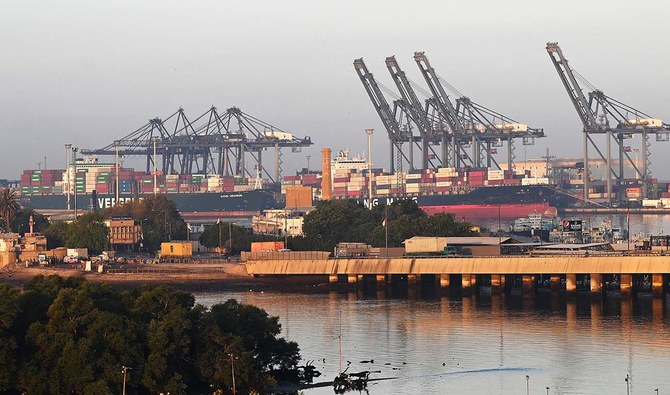
Shipping containers are seen stacked on a ship at a sea port in Karachi on April 6, 2023. (AFP/File)
Short Url
Updated 07 May 2024
Follow

Pakistan expecting investment in port infrastructure by global shipping giant Maersk — minister

  • AP Moller-Maersk has a market share of around 20 percent in Pakistan’s containerized import-export activities
  • Qaiser Ahmed Sheikh says there is a lot of interest in Pakistan’s port as a global hub for transshipment

KARACHI: Pakistan is expecting investment from a Denmark-based global shipping giant, AP Moller–Maersk (Maersk), in its port terminal and infrastructure, the Pakistani maritime affairs minister said on Tuesday, amid growing global interest in Pakistani ports.

The statement comes more than a week after Maersk Chief Executive Officer Keith Svendsen’s visit to Pakistan, where he met top officials to explore opportunities in Pakistan’s maritime sector.

Maritime Affairs Minister Qaiser Ahmed Sheikh told Arab News the Danish shipping firm was interested in investing in a terminal and port as well as allied infrastructure, including connecting bridges.

“We had very good discussions with them and they had shown eagerness and told us that they will submit proposal in a few days,” he said. “They want to take a terminal. There is some area where there is depth in the sea, where big ships can be anchored.”

Maersk has grown into a leading provider of logistics and supply-chain services across Pakistan. It has around 20 percent market share in Pakistan’s containerized import-export activities, according to Pakistan’s information ministry.

In January, the Danish shipping firm announced new smart logistics and warehouse facilities in China, Norway and Pakistan.

“With a vast network of warehousing and depot facilities across the country, including our flagship logistics hub in Port Qasim, Karachi — a sprawling 27-acre complex encompassing over 650,000 square feet of warehouse space — we ensure unparalleled support to Pakistani exporters and importers,” the shipping company said in a written response to Arab News.

“In total, Maersk now operates over a 1.5 million square feet footprint across 7 cities in Pakistan.”

Sheikh said many companies were interested in investing in the Karachi Port Trust (KPT) despite a limited space available there.

“We have limited space available in KPT and many, including foreign, companies are taking interest in it, particularly in the deep-water areas where water depth is high and we have the location,” he said.

“The point is that there is a lot of interest in Pakistan’s port right now because they are seeing this as a global hub for transshipment and they will also run the feeder vessels in the Gulf from here.”

To a question about a visiting Saudi delegation, the maritime affairs minister said “there are many breakthroughs” during the visit. “They are looking for areas of mutual interest which both sides can benefit from,” he added.

The South Asian nation has already signed an agreement with Abu Dhabi (AD) Ports Group which is investing about $395 million for the development of a container and cargo terminal under a government-to-government (G2G) agreement between the United Arab Emirates and Pakistan.


IMF hails Pakistan privatization drive, calls PIA sale a ‘milestone’

Updated 10 January 2026
Follow

IMF hails Pakistan privatization drive, calls PIA sale a ‘milestone’

  • Fund backs sale of national airline as key step in divesting loss-making state firms
  • IMF has long urged Islamabad to reduce fiscal burden posed by state-owned entities

KARACHI: The International Monetary Fund (IMF) on Saturday welcomed Pakistan’s privatization efforts, describing the sale of the country’s national airline to a private consortium last month as a milestone that could help advance the divestment of loss-making state-owned enterprises (SOEs).

The comments follow the government’s sale of a 75 percent stake in Pakistan International Airlines (PIA) to a consortium led by the Arif Habib Group for Rs 135 billion ($486 million) after several rounds of bidding in a competitive process, marking Islamabad’s second attempt to privatize the carrier after a failed effort a year earlier.

Between the two privatization attempts, PIA resumed flight operations to several international destinations after aviation authorities in the European Union and Britain lifted restrictions nearly five years after the airline was grounded following a deadly Airbus A320 crash in Karachi in 2020 that killed 97 people.

“We welcome the authorities’ privatization efforts and the completion of the PIA privatization process, which was a commitment under the EFF,” Mahir Binici, the IMF’s resident representative in Pakistan, said in response to an Arab News query, referring to the $7 billion Extended Fund Facility.

“This privatization represents a milestone within the authorities’ reform agenda, aimed at decreasing governmental involvement in commercial sectors and attracting investments to promote economic growth in Pakistan,” he added.

The IMF has long urged Islamabad to reduce the fiscal burden posed by loss-making state firms, which have weighed public finances for years and required repeated government bailouts. Beyond PIA, the government has signaled plans to restructure or sell stakes in additional SOEs as part of broader reforms under the IMF program.

Privatization also remains politically sensitive in Pakistan, with critics warning of job losses and concerns over national assets, while supporters argue private sector management could improve efficiency and service delivery in chronically underperforming entities.

Pakistan’s Cabinet Committee on State-Owned Enterprises said on Friday that SOEs recorded a net loss of Rs 122.9 billion ($442 million) in the 2024–25 fiscal year, compared with a net loss of Rs 30.6 billion ($110 million) in the previous year.