

Saudi foreign minister to Arab News: No Israelis attended Pompeo meeting

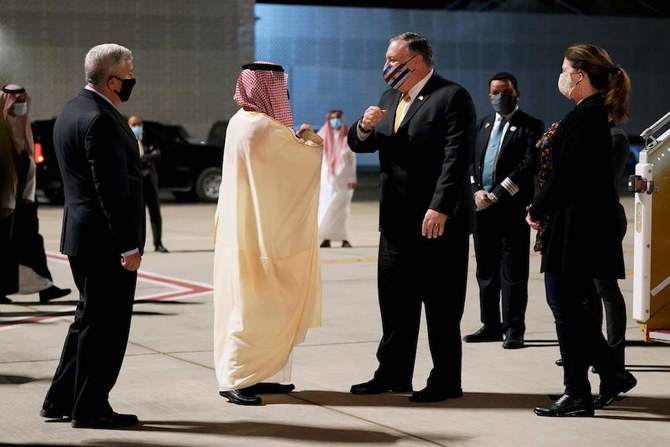
US Ambassador to Saudi Arabia John Abizaid (left) and Saudi foreign minister Prince Faisal bin Farhan greet US Secretary of State Mike Pompeo and his wife Susan as they arrive at Neom, Saudi Arabia. (AFP)
Short Url
Updated 24 November 2020
Follow

Saudi foreign minister to Arab News: No Israelis attended Pompeo meeting

  • Prince Faisal bin Farhan says no Israeli officials were at meeting between crown prince and Mike Pompeo
  • 'No such meeting occurred. The only officials present were American and Saudi.'

RIYADH: Saudi Arabia’s foreign minister told Arab News on Monday that there were no Israeli officials at a meeting between Crown Prince Mohammed bin Salman and the US Secretary of State.

Prince Faisal bin Farhan has denied reports that Israeli Prime Minister Benjamin Netanyahu joined talks in NEOM with Mike Pompeo on Sunday.

He said the meeting was only attended by Saudis, Pompeo himself and the US ambassador to the Kingdom, John Abizaid.

“The only non-Saudis at the meeting with HRH the crown prince were Secretary Pompeo and the US ambassador,” Prince Faisal told Arab News.

Earlier the foreign minister dismissed the reports from his Twitter account.

“I have seen press reports about a purported meeting between HRH the Crown Prince and Israeli officials during the recent visit by @SecPompeo,” Prince Faisal bin Farhan said. “No such meeting occurred. The only officials present were American and Saudi.”

Pompeo met with the crown prince in the northern city of NEOM on Sunday evening as part of his regional tour.

They “reviewed friendship relations, areas of bilateral cooperation between the two countries and ways to enhance them,” Saudi Press Agency reported. They also discussed the latest developments in the Middle East.

The meeting was attended by Prince Faisal and Abizaid.

Recent agreements with the UAE, Bahrain and Sudan to establish relations with Israel have led to speculation that other Arab states may follow.

Saudi Arabia has said there must be a peace agreement first between Israel and the Palestinians before the Kingdom establishes relations with Israel.

Shortly after the UAE agreement with Israel was announced, Prince Faisal said Saudi Arabia would continue to adhere to the Arab Peace Plan in its relations with Israel.

The plan, which was sponsored by the Kingdom in 2002, said ties with Israel would be normalized once a peace agreement was reached with the Palestinians that included an independent state with East Jerusalem as its capital.

The plan would see Israel withdraw from Palestinian territories occupied since 1967.

“When we sponsored the Arab Peace Plan in 2002, we fully envisioned that there would eventually be relations between all Arab states, including Saudi Arabia, and Israel if the condition is met,” Prince Faisal said in August.

“Saudi Arabia remains committed to peace as a strategic option based on the Arab Peace Plan and relevant international resolutions enabling the Palestinian people to establish their own state with East Jerusalem as its capital.”


Airbus seeks to strengthen Saudi defense ties

Updated 10 sec ago
Follow

Airbus seeks to strengthen Saudi defense ties

MALHAM: Airbus is aiming to deepen its strategic relationship with Saudi Arabia, a “core customer” in the region, according to Head of Air Power, Airbus Defense and Space Jean-Brice Dumont.

“Saudi Arabia is one of our customers in the region that we have a very strong link with,” Dumont told Arab News on the sidelines of the World Defense Show in Riyadh.

“We have a very strong link with decades of history of Airbus in the country, be it for helicopters, but in my case for military aircraft.

He said the Kingdom was “sort of a hometown for us for these flying platforms and for the maintenance, repair, and overhaul of these platforms.”

Airbus has a longstanding partnership with Saudi Arabia in both commercial and defense aircraft that dates back nearly 50 years.

“We have already invested quite significantly in the region,” Dumont said. “Notably, we have a JV (joint venture) with SAMI (Saudi Arabia Military Industries) in Saudi Arabia and that, I believe is the beginning of a longer journey. But so far, when we see what’s happening in the region, it’s already quite good.”

In 2021 SAMI, a wholly owned subsidiary of the Public Investment Fund and the National Champion of Military Industries Localization, and Airbus signed an agreement to form a joint venture on military aviation services and maintenance, repair and overhaul capabilities.

During the interview Dumont also looked ahead, detailing the strategic roadmap for 2026–2030 that moves beyond traditional hardware toward a digitally-dominant battlefield.

“I think we are reaching the end or the limits of the ‘fighter goes alone’ kind of model,” he said. “Now, the fighters need to communicate, to command drones, to be themselves receiving information by a mass, high-throughput data link so that they can play their role — their new role — in the battlefield.”

He also spoke about how the A330 aircraft was moving beyond its basic reputation as a “flying gas station” to become a high-tech “command center” in the sky.

“The A330 can be first much more automated. The air-to-air refueling can be automatic, and we have developed that capability,” he explained.

“On the other hand, it’s a big platform flying high, which can act as a command-and-control node in the system of systems that the air forces are all aspiring to.”

On the Eurofighter, he said it was “a bit symmetrical,” while speaking about the “buzz” around artificial intelligence he said that while neural networks have been embedded in Airbus platforms for nearly 20 years, the next decade would see AI move to the forefront of decision-making.

From mission preparation to real-time command, he said, the goal is to process vast amounts of data to act faster than the adversary.

“The one who gets that right has won,” he said.