Crown Prince Mohammed bin Salman: Saudi Arabia devoted G20 presidency to stronger, more sustainable world

1 / 4
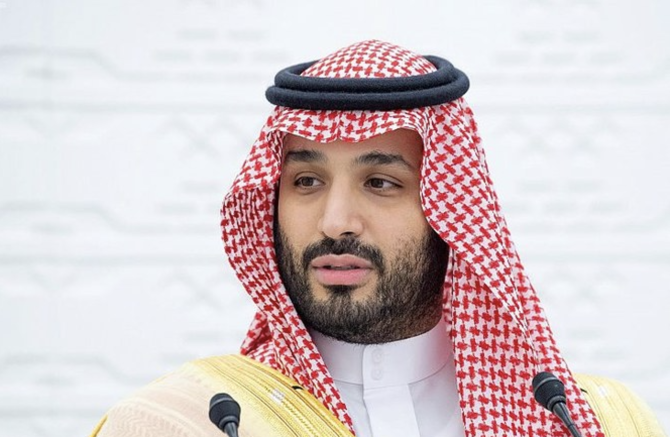
Saudi Arabia’s Crown Prince Mohammed bin Salman delivers the closing remarks at 15th G20 Summit on Nov. 22, 2020 in Riyadh, Saudi Arabia. (SPA)
2 / 4
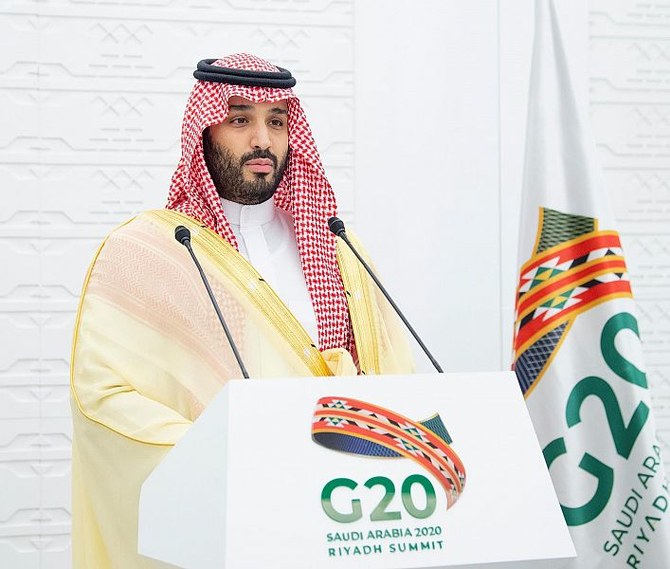
Saudi Arabia’s Crown Prince Mohammed bin Salman delivers the closing remarks at 15th G20 Summit on Nov. 22, 2020 in Riyadh, Saudi Arabia. (SPA)
3 / 4
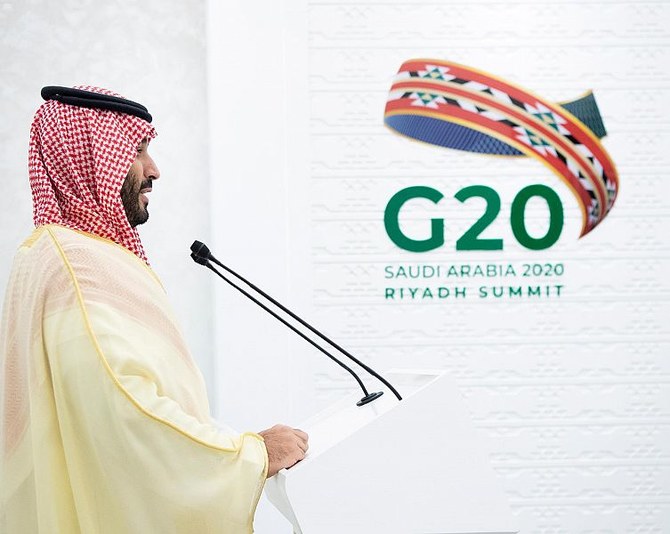
Saudi Arabia’s Crown Prince Mohammed bin Salman delivers the closing remarks at 15th G20 Summit on Nov. 22, 2020 in Riyadh, Saudi Arabia. (SPA)
4 / 4
Saudi Arabia’s Crown Prince Mohammed bin Salman delivers the closing remarks at 15th G20 Summit on Nov. 22, 2020 in Riyadh, Saudi Arabia. (SPA)
Short Url
Updated 22 November 2020
Follow

Crown Prince Mohammed bin Salman: Saudi Arabia devoted G20 presidency to stronger, more sustainable world

  • Kingdom would continue to support international efforts to combat coronavirus
  • Saudi Arabia contributed $500m to the $21bn pledged by G20 countries after COVID-19 outbreak

RIYADH: Saudi Arabia has devoted its G20 presidency to building a stronger, more robust and sustainable world, Crown Prince Mohammed bin Salman said on Sunday.
Speaking on the final day of the G20 Summit hosted in Riyadh, the crown prince said the Kingdom would continue to support international efforts to provide vaccines and treatments for COVID-19, in a “fair and affordable manner.”
“This pandemic knows no borders,” he said. “It has reached all countries and affected, directly and indirectly, every person living on this planet, which has necessitated the activation of the pivotal role played by the G20.”
The crown prince said G20 leaders met twice throughout the Kingdom’s presidency — the first time this has happened since its formation.
An extraordinary meeting in March, as COVID-19 swept around the world, adopted “unprecedented measures and coordinated actions” to act as a foundation for global recovery, he said.
Speaking on behalf of King Salman, chair of this year’s summit, the crown prince thanked heads of states, international organizations, the business community and civil societies who contributed throughout the Kingdom’s presidency.

“We stand today at the end of an exceptional year in which we had the privilege and responsibility of the G20 presidency,” he said. “Since the beginning of this year, we set one goal, ‘Realizing Opportunities of the 21st Century For All,’ which includes themes such as: empowering people, safeguarding the planet, and shaping new frontiers.”
He added that these themes are now more relevant than ever, in light of the pandemic.
The crown prince said Saudi Arabia contributed $500 million to the $21 billion pledged by G20 countries after the outbreak.
The crown prince said G20 countries “injected over $11 trillion into the global economy to support businesses and protect individuals’ livelihoods.”
They provided emergency support to vulnerable, emerging or low income countries to help fight the pandemic in the form of debt relief worth more than $14 billion.
Aside from the coronavirus pandemic, the G20 endorsed a platform to reduce carbon emissions and ensure cleaner, affordable and more sustainable energy, he added.
He said that they adopted the Riyadh Initiative on the Future of the World Trade Organization (WTO), which would provide support toward trade reforms, as well as “efforts to empower women and youth through quality education and financial inclusion.”
“It has been an exceptional challenge but an absolute honor to hold the G20 Presidency during this trying year,” the crown prince said.


Najran farmers find sugarcane cultivation viable, promising lucrative economic returns

Updated 07 December 2025
Follow

Najran farmers find sugarcane cultivation viable, promising lucrative economic returns

  • Mountain regions in Najran have a temperate climate and abundant water resources, suitable for sugarcane production

NAJRAN: Farmers in Saudi Arabia’s southwestern region of Najran are finding that sugarcane production is a viable enterprise, the Saudi Press Agency reported.

One farmer, Ibrahim Shakwan, confirmed to SPA the success of his 7.3-hectare sugarcane farm and noted “growing regional interest due to its high productivity and lucrative economic returns.”

Najran was chosen as a trial area for sugarcane production owing to the temperate climate, diverse soils, and abundant water resources in its mountainous parts. The experiment is in line with Saudi Vision 2030, which calls for enhancing food security and self-sufficiency.

Other regions in the Kingdom’s southwest, such as Jazan, Asir and Baha, have features similar to Najran.

Sugarcane is easily propagated via cuttings that yield a high number of plantable pieces. (SPA)

Sugarcane is easily propagated via cuttings that yield a high number of plantable segments. Planting occurs primarily in the summer, although seedlings can be planted year round. 

Effective cultivation methods include selecting disease-resistant varieties, proper soil preparation, and balanced irrigation and fertilization, according to the report.

The crop is harvested about eight months after planting, with fertilization ending three months before and irrigation ceasing 20 days prior to harvest to boost sugar concentration and improve juice quality, which is rich in natural sugars, vitamins, and minerals.

Several countries in the Middle East have long been growing sugarcane, with Egypt and Iran the key producers. 

Botanists believe sugarcane was first cultivated 10,000 years ago in what is now New Guinea in the southwest Pacific Ocean, where the environment is humid, according to an article titled Sugar Please published in the Aramcoworld magazine in 2012.