

Pakistan PM to leave for Kabul on Thursday for talks on Afghan peace process

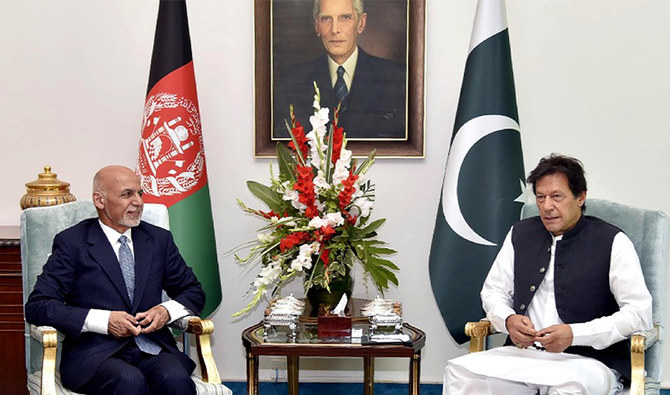
FILE PHOTO: In this handout picture released by Pakistan's Press Information Department (PID) on June 27, 2019, visiting Afghan President Ashraf Ghani (L) talks with Pakistani Prime Minister Imran Khan during a meeting in Islamabad. (AFP)
Short Url
Updated 18 November 2020
Follow

Pakistan PM to leave for Kabul on Thursday for talks on Afghan peace process

  • Kabul visit on the invitation of Afghan President Ashraf Ghani will be Imran Khan's first trip to Afghanistan since assuming office in 2018
  • PM’s adviser on commerce is already in Kabul for discussions on bilateral trade relations

ISLAMABAD: Pakistan Prime Minister Imran Khan is leaving for Afghanistan on Thursday for talks on the Afghan peace process, the PM’s office confirmed.
Khan's Kabul visit is on the invitation of Afghan President Ashraf Ghani and will be his first trip to Afghanistan since assuming office in 2018.
“The focus (of the visit) would be on further deepening the fraternal bilateral relations between Pakistan and Afghanistan, the Afghan peace process, and regional economic development and connectivity,” the PM's office said in a statement on Wednesday.
During the trip, Khan is going to meet with Ghani who visited Pakistan in June 2019. Earlier, the two leaders met on the sidelines of the 14th Organization of Islamic Cooperation Summit in Makkah in May 2019.
Foreign Minister Shah Mahmood Qureshi and the prime minister’s adviser on commerce, Abdul Razak Dawood will be in the delegation.

The prime minister will travel to Afghanistan at a time when ongoing peace negotiations between the Afghan government and the Taliban have hit a stalemate and violence is on the rise. Afghan officials and the United States — which is facilitating the peace talks — believe that Pakistan has influence over the Taliban and can convince its top leaders to move toward a ceasefire.
“The people of Pakistan and Afghanistan are linked through immutable bonds of history, faith, culture, kinship, values and traditions. The Prime Minister’s visit will help foster a stronger and multi-faceted relationship between the two brotherly countries,” the PM office's statement said.
Dawood is already in Kabul for talks on bilateral trade relations and the Afghanistan-Pakistan Transit Trade Agreement (APTTA), which allows Kabul to use Pakistan’s land to transport goods to India.
Pakistan and landlocked Afghanistan had signed a transit trade agreement in 1965 that was revised in 2010 to help facilitate movement of goods between the two countries.
The next APTTA meeting is going to take place in Islamabad in December.


Pakistan, China to sign multiple MoUs at major agriculture investment conference today

Updated 18 January 2026
Follow

Pakistan, China to sign multiple MoUs at major agriculture investment conference today

  • Hundreds of Chinese and Pakistani firms to attend Islamabad event
  • Conference seen as part of expanding CPEC ties into agriculture, trade

KARACHI: Islamabad and Beijing are set to sign multiple memorandums of understanding (MoUs) to boost agricultural investment and cooperation at a major conference taking place in the capital today, Monday, with hundreds of Chinese and Pakistani companies expected to participate.

The conference is being billed by Pakistan’s Ministry of National Food Security and Research as a platform for deepening bilateral agricultural ties and supporting broader economic engagement between the two countries.

“Multiple memorandums of understanding will be signed at the Pakistan–China Agricultural Conference,” the Ministry of National Food Security said in a statement. “115 Chinese and 165 Pakistani companies will participate.”

The conference reflects a growing emphasis on expanding Pakistan-China economic cooperation beyond the transport and energy foundations of the flagship China-Pakistan Economic Corridor (CPEC) into agriculture, industry and technology.

Under its first phase launched in 2015, CPEC, a core component of China’s Belt and Road Initiative, focused primarily on transportation infrastructure, energy generation and connectivity projects linking western China to the Arabian Sea via Pakistan. That phase included motorways, power plants and the development of the Gwadar Port in the country's southwest, aimed at helping Pakistan address chronic power shortages and enhance transport connectivity.

In recent years, both governments have formally moved toward a “CPEC 2.0” phase aimed at diversifying the corridor’s impact into areas such as special economic zones, innovation, digital cooperation and agriculture. Second-phase discussions have highlighted Pakistan’s goal of modernizing its agricultural sector, attracting Chinese technology and investment, and boosting export potential, with high-level talks taking place between planning officials and investors in Beijing.

Agri-sector cooperation has also seen practical collaboration, with joint initiatives examining technology transfer, export protocols and value-chain development, including partnerships in livestock, mechanization and horticulture.

Organizers say the Islamabad conference will bring together government policymakers, private sector investors, industry associations and multinational agribusiness firms from both nations. Discussions will center on investment opportunities, technology adoption, export expansion and building linkages with global buyers within the framework of Pakistan-China economic cooperation.