Post-Brexit trade talks enter crunch week

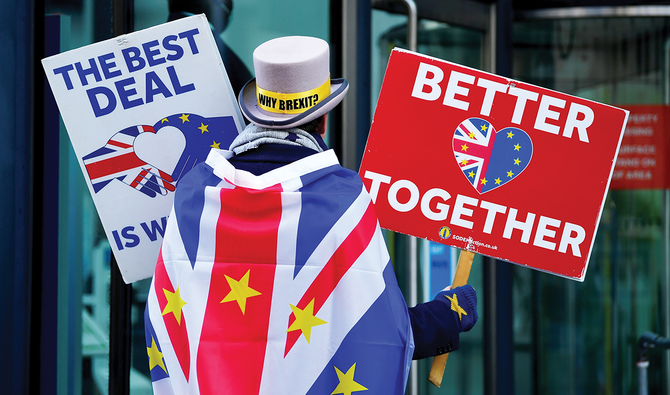
Anti-Brexit protester Steve Bray demonstrates in front of the conference center where Brexit trade deal negotiations are taking place in London. (Reuters)
Short Url
Updated 16 November 2020
Follow

Post-Brexit trade talks enter crunch week

  • British, EU negotiators determined not to give ground

BRUSSELS: British and EU negotiators launched a desperate final stretch of trade talks on Sunday, with both sides determined not to give ground, despite the looming threat of failure.

Britain’s David Frost returned to meet his EU counterpart Michel Barnier after a shake-up in Number 10 personnel left some wondering if London might soften its stance.

But there was no sign of that in the message that Prime Minister Boris Johnson’s envoy tweeted as he headed back to Brussels.

“We are working to get a deal, but the only one that’s possible is one that is compatible with our sovereignty and takes back control of our laws, our trade, and our waters,” Frost said.

“That has been our consistent position from the start and I will not be changing it.”

On Friday, Johnson’s senior aide Dominic Cummings — one of the architects of the “leave” victory in the 2016 Brexit referendum — was sacked, amid faction fighting in Number 10, but there has been no sign this will change the direction of trade talks.

Britain left the EU in January, but the full economic effect of the bitter divorce will be felt at the end of the year when an 11-month transition period closes.

Relations between Britain and Europe could then be governed by a trade deal, but only if negotiations currently underway deliver, which is hardly guaranteed given still wide divergences.

Frost said the parties now “largely have common draft treaty texts, though significant elements are of course not yet agreed. We will work to build on these and get an overall agreement if we can.

“But we may not succeed,” he warned.

Officials on both sides of the Channel are looking to an EU leaders video summit on Thursday as the de facto last chance for a breakthrough, leaving just enough time for the EU Parliament to ratify an agreement.

This gives Barnier and Frost four days and nights to bridge differences that have remained unchanged since March.

“Logic and reason would all point to a deal,” said one EU diplomat with a close eye on the talks.

“But if anything became clear in the past three years, when it comes to Brexit, economic rationale and pure logic are not enough to explain what’s happening,” the diplomat said.

Failure would see Britain’s ties with the European economy governed by WTO rules, slapping high tariffs, quotas, and other impediments to cross-Channel trade that flowed unencumbered for decades.

Today’s British economy, the sixth biggest in the world, was built on EU membership, with the London financial hub and a tapestry of car plants and multinationals enjoying access to the EU’s 450 million consumers and complex supply chains.

Given the danger, British big business implored the government to find a middle ground and replicate the benefits of membership as closely as possible, even if this came with the condition that the UK align closely with EU rules.

But, when the pro-Brexit Johnson became prime minister last year, London went the other way, asking for a zero-tariff deal on goods and services that must, he insisted, leave the country sovereign to make its own decisions.

With positions starkly apart, the talks became bogged down on three core issues.

Fishing has been the least economically significant but most politically explosive issue, with Europe eager to keep open access to the UK’s bountiful waters.

Fishermen in France, Belgium, Denmark, and the Netherlands have trawled British waters for centuries, but London wants access rethought to satisfy Britain’s coastal communities, which voted strongly for Brexit.

Belgian Greens MEP Philippe Lamberts said, on fishing, Europeans giving ground was “inevitable” but that any trade deal agreed now “won’t be great.”

The other obstacle is the lack of faith among the Europeans that once outside the EU single market Britain will play fair in terms of competition rules, even with a deal.

This view sharpened when Johnson’s government introduced a bill in parliament that effectively ripped up the terms of the divorce pact, potentially in violation of international law.

Under the trade deal, will British companies enjoy easier rules on the environment or food safety only to sell their goods cheaply in the EU, where their rivals must abide by stricter measures?

Seeking to maintain what it calls a “level playing field,” the EU is demanding that Britain commit to not backtrack on standards as well as to cooperate on how these evolve in the future.

The EU is also worried about how Britain will subsidize companies. Too much taxpayer largesse could prove unfair toward firms in Europe, where state aid oversight is strict.

To solve those problems, the EU is insisting that the deal hold some sort of emergency mechanism, that could swiftly inflict penalties if either side breaks the terms.

“Either the British accept and we then move on to difficult negotiations on fisheries, or they refuse, and we will then be out of time and the negotiations fail,” a senior European diplomat warned.


Saudi-built AI takes on financial crime

Updated 30 January 2026
Follow

Saudi-built AI takes on financial crime

  • Mozn’s FOCAL reflects the Kingdom’s growing fintech ambitions

RIYADH: As financial institutions face increasingly complex threats from fraud and money laundering, technology companies are racing to build systems that can keep pace with evolving risks. 

One such effort is FOCAL, an AI-powered compliance and fraud prevention platform developed by Riyadh-based enterprise artificial intelligence company Mozn.

Founded in 2017, Mozn was established with a focus on building AI technology tailored to regional market needs and regulatory environments. Over time, the company has expanded its reach beyond Saudi Arabia, developing advanced AI solutions used by financial institutions in multiple markets. It has also gained international recognition, including being listed among the World’s Top 250 Fintech Companies for the second consecutive year.

In January 2026, Mozn’s flagship product, FOCAL, was named a Category Leader in Chartis Research’s RiskTech Quadrant 2025 for both AML Transaction Monitoring and KYC (Know Your Customer) Data and Solutions, placing it among 10 companies globally to receive this designation.

Malik Alyousef, co-founder of Mozn and chief technology officer of FOCAL, told Arab News that the platform initially focused on core anti-money laundering functions when development began in 2018. These included customer screening, watchlists, and transaction monitoring to support counter-terrorism financing efforts and the detection of suspicious activity.

As financial crime tactics evolved, the platform expanded into fraud prevention. According to Alyousef, this shift introduced a more proactive model, beginning with device risk analysis and later incorporating tools such as device fingerprinting, behavioral biometrics, and transaction fraud detection.

More recently, FOCAL has moved toward platform convergence through its Financial Crime Intelligence layer, a vendor-neutral framework designed to bring together multiple systems into a single interface for investigation and reporting. The approach allows institutions to gain a consolidated view without replacing their existing technology infrastructure.

“Our architecture eliminates blind spots in financial crime detection. It gives institutions a complete view of the user journey, combining transactional and non-transactional behavioral data,” Alyousef said.

DID YOU KNOW?

• Some electronic money institutions using the platform have reported fraud reductions of up to 90 percent.

• The platform combines anti-money laundering and fraud prevention into a single financial crime intelligence system.

• FOCAL integrates with existing banking systems without requiring institutions to replace their technology stack.

Beyond its underlying architecture, Alyousef pointed to several areas where FOCAL aims to differentiate itself in a competitive market. One is its emphasis on proactive fraud prevention, which assesses risk throughout the customer lifecycle — from onboarding and login behavior to ongoing account activity — with the goal of stopping fraud before losses occur.

He described the platform as an “expert-led model,” highlighting the availability of on-the-ground support for system design, tuning, assessments, and continuous optimization throughout its use.

“FOCAL is designed to be extended,” Alyousef added, noting its adaptability and the ability for clients to customize schemas, rules, and data fields to match their business models and risk tolerance. This flexibility, he said, allows institutions to respond more quickly to emerging fraud patterns.

Alyousef also emphasized the importance of local context in the platform’s development.

“The platform incorporates regional regulatory requirements and language considerations. Global tools often struggle with local context, naming conventions and compliance nuances — we are designed specifically with these realities in mind,” he said.

FOCAL is currently used by a range of organizations, including traditional banks, digital banks, fintech firms, electronic money institutions, payment companies, and other financial service providers. Alyousef said results from live deployments have been significant, with some large EMI clients reporting fraud reductions of up to 90 percent.

“Clients benefit not only from reduced fraud losses but also from an improved customer experience, as the system minimizes unnecessary friction and false rejections,” he said. “Beyond financial services, we also work with organizations in e-commerce and telecommunications.”

Looking ahead, Alyousef said the company sees agentic AI as a key direction for the future of financial crime prevention, both in the region and globally. Mozn, he added, is investing heavily in this area to enhance investigative workflows and operational efficiency, building on the capabilities of its Financial Crime Intelligence layer.

“We are pioneers in introducing agentic AI for financial crime investigation and rule-building. Our roadmap increasingly emphasizes automation, advanced machine learning and AI-assisted workflows to improve investigator productivity and reduce false positives.”

As AI tools become more widely available, Alyousef warned that the risk of misuse by criminals is also increasing, raising the bar for defensive technologies.

“Our goal is to stay ahead of that curve and to contribute meaningfully to positioning Saudi Arabia and the region as globally competitive leaders in AI,” he said.