

Jordan confronts tribal shooting tradition

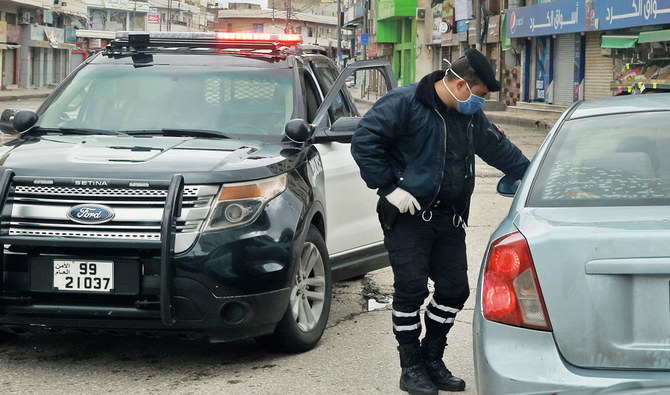
A policeman speaks to a driver at a checkpoint in capital Amman during a nationawide curfew imposed by the authorities in order to control the spread of the novel coronavirus, on March 21, 2020. (AFP)
Short Url
Updated 15 November 2020
Follow

Jordan confronts tribal shooting tradition

  • The royal comment produced quick results, with the country’s Minister of Interior resigning and Jordanian security forces completing a massive campaign to collect unlicensed weapons

AMMAN: The Kingdom of Jordan is looking for ways to eliminate the celebratory tribal practice of shooting firearms in the air following several high-profile incidents.

The national debate on the issue came to a head on Wednesday after groups of people celebrated the victory of local leaders in the country’s 19th parliamentary elections.

Celebrations kicked off as the country faced the first day of a total lockdown, which was issued after a spike in coronavirus cases, hospitalizations and deaths.

The celebrations, which were filmed and distributed on social media, were met with widespread condemnation by the public, many of which who endured the lockdown at home.

King Abdullah, using his official Twitter account, labeled the actions a “clear violation of the law and an act against the health and safety of society.” He added that the “law should be applied to all without exception.”

The royal comment produced quick results, with the country’s Minister of Interior resigning and Jordanian security forces completing a massive campaign to collect unlicensed weapons.

Police chief Hussein Hawatmeh told Jordan’s Al-Mamlaka TV that 18 parliamentary candidates and 324 citizens were arrested with weapons. He said 29 weapons were confiscated and 478 vehicles were being searched for.

Jordan’s police say that no records are kept of victims who die from stray bullets in mass celebrations. Al-Mamlaka TV estimated that from 2013 to 2018, between 1,500 and 1,869 people died in such incidents, while the injury rate was far higher.

Bashir Daaja, former Jordanian police spokesman and security expert, told Arab News that the act of celebratory shooting is part of a tribal tradition.

“This act has been inherited from previous generations and was started when communities had to personally protect themselves and therefore owned weapons. On happy occasions they would shoot in the air, allowing tribal leaders to exhibit their firepower.”

HIGHLIGHT

Celebratory tribal practice of shooting firearms were met with widespread condemnation by the public, many of which who endured the lockdown at home.

Daaja said there is no longer a need for local communities to protect themselves in the presence of a strong government.

Mamoun Abu Nowar, a retired Jordanian Air Force general, told Arab News that there is no need for the “exaggerated situation” where “so many people own all kinds of weapons and use them in this way.”

Abu Nowar called for the country to make a decisive choice between tribal and civil society. “We can’t have a civil country and tribalism at the same time.”

Social scientist Hussein Al-Khozahe told Arab News that celebratory gunfire is a cultural issue, but that issue stems from deeper tribal concerns.

“People had come from desert life and they needed to protect themselves from outsiders,” he said. Weapons were handed down and became part of societal pride, Al-Khozahe added.

“The weapons are now used to remind the central government of their political presence and their importance. They are saying ‘we are here and you must remember us.’”

Al-Khozahe said the rise in unemployment and the absence of economic development has led young people back to tribal life. “They feel that the tribe can provide a safety net more than the government can.”

Marwan Muasher, former Jordanian deputy prime minister, told Arab News that he does not believe the issue stems from a tribal problem.

“We make a mistake by saying that this is a case of tribal society. After 100 years since the establishment of Jordan, the citizens have a right to demand the rule of law without discrimination.”

Jordanian government sources have said that more than 1 million unlicensed weapons are kept by people mostly outside Jordan’s major cities.

One of the problems facing regulators are the country’s lax weapon laws.

Bashir Daaja, a former police spokesman, said the the possession of an unlicensed weapon is only a misdemeanor. “That means the punishment is the confiscation of the weapon and a 25 Jordanian dinar ($35) fine.”

Daaja said regulators should make the possession of unlicensed firearms a felony, which is subject to three years’ imprisonment.


WEF panel told grassroots aid workers keep Sudan afloat even as conflict puts them at risk 

Updated 21 January 2026
Follow

WEF panel told grassroots aid workers keep Sudan afloat even as conflict puts them at risk 

  • Speakers warned that without urgent action to protect humanitarian access and support local responders, Sudan’s crisis will continue to deepen and destabilize the wider region

LONDON: Grassroots Sudanese aid groups are filling critical humanitarian gaps left by limited international access, but their volunteers are facing hunger, arrest and deadly risks as the conflict enters its fourth year, speakers warned at the World Economic Forum in Davos on Wednesday. 

More than 20 million people in Sudan are facing acute hunger, while more than 11 million have been displaced, making it the largest displacement crisis in the world. As fighting continues and access for international agencies tightens, community-led networks have become a primary lifeline for civilians across the country. 

“We need to strengthen local capacity and support community-led solutions like Emergency Response Rooms and mutual aid groups, with a more localized and decolonized humanitarian response,” said Hanin Ahmed, a Sudanese activist and Emergency Response Room leader. 

Ahmed described how volunteers were delivering food, medical support and protection services in areas that international organizations struggled to reach. However, she warned that these efforts came at immense personal cost.

Volunteers are often displaced themselves, facing food insecurity, arrest, kidnapping, and in some cases, killing by the warring parties. Famine, she said, was no longer confined to traditionally affected regions.

“There is famine not only in Darfur, but also in Khartoum, the capital,” Ahmed told the panel, pointing to widespread unemployment, disease outbreaks, and rising cases of gender-based violence across multiple states. 

Despite the scale of the crisis, Ahmed emphasized that Sudanese communities retained both the willingness and capacity to recover if adequately supported.

“Sudanese people are willing to resolve this war if supported,” she said. 

Panelists stressed that hunger in Sudan was not driven by a lack of aid, but by deliberate barriers to its delivery. 

“The story of Sudan’s war is a story of impunity,” said David Miliband, president and chief executive officer of the International Rescue Committee.

“To tackle impunity, we need to challenge restrictions on humanitarian access, end sieges, and address the profiteering that fuels the conflict,” he added.  

Miliband said that while humanitarian funding remained critically low, access constraints were the primary factor preventing life-saving assistance from reaching civilians. Only 28 percent of the UN humanitarian appeal for Sudan had been funded, he said, compounding the effects of obstruction on the ground. 

Meanwhile, where assistance was available, needs continued to outstrip capacity. Barham Salih, the UN High Commissioner for Refugees, described visiting refugee-hosting areas along Sudan’s borders, where people arrived after experiencing extreme violence, deprivation and trauma.

“Ten liters of water per person per day is far below emergency standards,” Salih said.

“Only 16 percent of those who need mental health support are receiving it, and only one in three families in need of shelter actually have access,” he added.  

Salih stressed that statistics failed to capture the scale of human suffering. “Behind every number is a human life,” he said, recounting testimonies of abuse, rape and killings from refugees who had crossed the border only hours earlier. 

As humanitarian systems inside Sudan continue to falter, the consequences are increasingly felt beyond its borders.

Neighboring countries including Chad, Kenya, Egypt and Uganda are hosting large numbers of Sudanese refugees despite limited infrastructure and resources. 

“What starts in Sudan does not stay in Sudan,” Miliband said. “This is a crisis with regional implications.”  

While host governments have kept borders open and adopted inclusive policies that allow refugees access to services and livelihoods, panelists warned that generosity alone could not sustain the response without stronger international support. 

The discussion in Davos highlighted that Sudan’s humanitarian crisis was shaped not by a lack of solutions, but by who is allowed to deliver aid, where, and under what conditions.