
Millenia-old gold coins from the Islamic period discovered in Jerusalem

Archaeologist at the Israel Antiquities Authority Evgeniya Rabinovich shows a small pottery jug with four pure gold coins found inside it, at the archaeological rescue excavation site in the Old City of Jerusalem, on November 9, 2020. (AFP)
Short Url
Updated 10 November 2020
Follow

Millenia-old gold coins from the Islamic period discovered in Jerusalem

AMMAN: Archaeologists discovered a trove of gold coins in East Jerusalem over the summer that date back to the Abbasid period around 1,100 years ago, it has emerged.

The 450 gold coins, all in good condition, were discovered on Aug. 18, but the find was only publicized on Monday.

“This is the first time we have discovered this kind of treasure in fifty years,” Palestinian Kamil Sari, the head of the northern regional office of the Israeli Antiquities Authority, told Arab News.

“After the archeologists digging near the Western Wall in the old city of Jerusalem had taken pottery jars for close cleaning and inspection, a volunteer sifting through found the coins.”
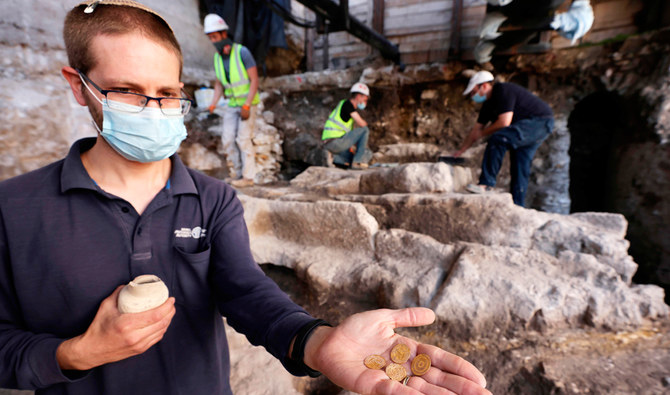


Archaeologist at the Israel Antiquities Authority David Gellman shows a small pottery jug with four pure gold coins found inside it, at the archaeological rescue excavation in the Old City of Jerusalem, on November 9, 2020. (AFP)

Sari said that some of the coins were made of pure gold, and dated to 946 AD. Some were minted in the city of Ramleh, and the others were minted in Cairo.

The Haifa-based archeological official told Arab News that a month ago more coins from the Islamic period were discovered.

Nazim Al-Jubeh, a Palestinian archeologist and professor of history and archeology at Bir Zeit University, told Arab News: “This was an important discovery because it helps illuminate the Abbasid period which some have tried to dismiss as being a step back in civilization after the successful Byzantine period.”

The discovery, made in occupied East Jerusalem near to Al-Aqsa Mosque, has been described by the Israeli Antiquities Authority as a “rare” find.
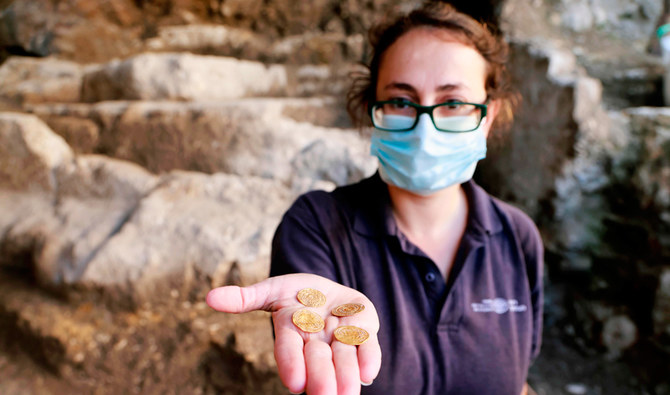


Archaeologist at the Israel Antiquities Authority Evgeniya Rabinovich shows a small pottery jug with four pure gold coins found inside it, at the archaeological rescue excavation site in the Old City of Jerusalem, on November 9, 2020. (AFP)

The Associated Press (AP) said that the trove, “which was unearthed by youth volunteers, also included hundreds of smaller clippings from gold coins that would have served as smaller denominations.”

AP quoted Robert Kool, a coin expert, who said “an initial analysis indicates the coins date from the late 9th century, considered the golden age of the Abbasid Caliphate that controlled most of the Near East and North Africa.”

Nazmi Al-Jubeh said that archeologists from around the world, including Israel, were slowly changing the narrative about the Abbasid, Umayyad, and Ayyubid Islamic periods.
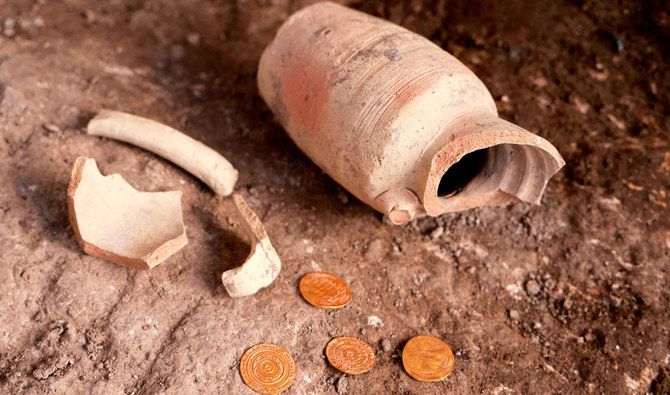


A small pottery jug with four pure gold coins found inside it by the Israel Antiquities Authority are displayed at the archaeological rescue excavation site in the Old City of Jerusalem, on November 9, 2020. (AFP)

“Previously archeologists have claimed that, since they had no major monuments representing them, that means that their civilization was nothing to talk about.”

Al-Jubeh said that the latest discovery, plus much of the discoveries of recent years, had caused historians and archeologists to revise their theories.

He said that the coins, found in occupied Palestinian lands, should be returned to Palestine as per international law.

A senior Jordanian source familiar with the situation told Arab news that Palestinians and Jordanians annually submit a report to UNESCO demanding the return of all archeological discoveries taken from the occupied territories in violation of international law.


Egypt vows to prevent escalation between Lebanon and Israel amid tensions over Hezbollah

Updated 4 sec ago
Follow

Egypt vows to prevent escalation between Lebanon and Israel amid tensions over Hezbollah

  • “Egypt will spare no effort in continuing its tireless endeavors to keep Lebanon away from any escalation,” Madbouly told reporters
  • Madbouly’s visit also focused on strengthening bilateral ties and addressing pressing regional development

BEIRUT: Egypt is doing all it can to prevent further escalation between Lebanon and Israel amid tension between the two neighbors over the disarmament process of the militant Hezbollah group, the country’s prime minister said Friday during a visit to the Lebanese capital.
Egypt, which signed a peace treaty with Israel in 1979, has been working for months to deescalate the regional tensions and Prime Minister Mustafa Madbouly’s visit to Beirut comes after similar trips to the small Arab nation by Egypt’s foreign minister and intelligence chief.
“Egypt will spare no effort in continuing its tireless endeavors to keep Lebanon away from any escalation,” Madbouly told reporters during a joint briefing with his Lebanese counterpart Nawaf Salam.
Madbouly’s visit also focused on strengthening bilateral ties and addressing pressing regional developments.
Madbouly’s meetings in Beirut came as the committee monitoring the enforcement of a US-brokered ceasefire that halted the latest war between Israel and Hezbollah a year ago held another meeting Friday.
Friday’s gathering along the Lebanon-Israel border was the second meeting of the mechanism after Israel and Lebanon appointed civilian members to a previously military-only committee. The group also includes the United States, France and the UN peacekeeping force deployed along the border.
A statement issued by the US Embassy in Beirut said that military participants offered operational updates and remained focused on deepening the cooperation by finding ways to increase coordination through the mechanism. It added that all participants agreed that a strengthened Lebanese army, the guarantors of security in the border area known as the south Litani Sector, “is critical to success.”
The embassy added that civilian participants meanwhile focused on setting conditions for residents to return safely to their homes, advancing reconstruction, and addressing economic priorities. It added that they underscored that durable political and economic progress is essential to reinforcing security gains and sustaining lasting peace.
The embassy said meeting participants reaffirmed that progress on security and political tracks remain mutually reinforcing and essential “to ensuring long-term stability and prosperity for both parties.”
The Lebanese government has said that the army should have the whole border area south of the Litani River cleared from Hezbollah’s armed presence by the end of the year.
The latest Israel-Hezbollah war began on Oct. 8, 2023, a day after Hamas-led militants attacked southern Israel, after Hezbollah fired rockets into Israel in solidarity with Hamas. Israel launched a widespread bombardment of Lebanon in September 2024 that severely weakened Hezbollah, followed by a ground invasion.
Israel has carried out almost daily airstrikes since then, mainly targeting Hezbollah members, but also killing 127 civilians, according to the office of the UN High Commissioner for Human Rights.
Also Friday, the Israeli military said that a Hezbollah operative who was captured from Lebanon last year played a major role in the group’s secretive maritime force. The military added that Imad Amhaz was trained in Iran and Lebanon to carry out maritime operations.
A Hezbollah official said the group will not comment on the video released by the Israeli military of Amhaz, describing him as “a Lebanese citizen who was kidnapped.” The official spoke on condition of anonymity because he was not authorized to speak to the media.