

Tunisian startup 3D prints solar-powered bionic hands

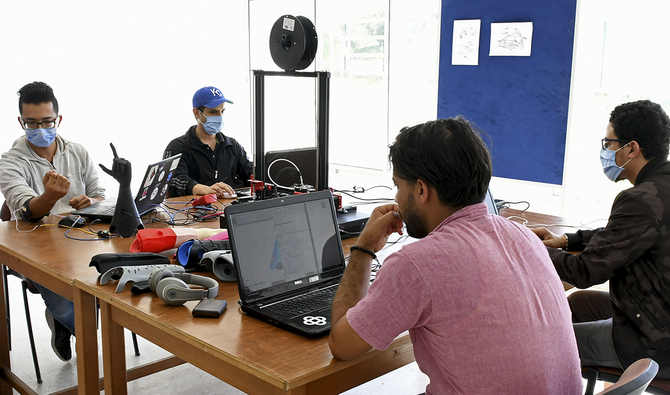
Tunisian engineers test a prototype of an artificial hand on October 20, 2020 at Cure Bionics startup in Sousse. (AFP)
Short Url
Updated 04 November 2020
Follow

Tunisian startup 3D prints solar-powered bionic hands

  • The device works with sensors attached to the arm that detect muscle movement

SOUSSE, Tunisia: A Tunisian startup is developing a 3D-printed bionic hand, hoping the affordable and solar-powered prosthetic will help amputees and other disabled people across Africa.

Unlike traditional devices, the artificial hand can be customised for children and youths, who otherwise require an expensive series of resized models as they grow up.

The company Cure Bionics also has plans to develop a video game-like virtual reality system that helps youngsters learn how to use the artificial hand through physical therapy.

Mohamed Dhaouafi, the 28-year-old founder and CEO of Cure Bionics, designed his first prototype while still an engineering student in his home city Sousse.

“One team member had a cousin who was born without a hand and whose parents couldn’t afford a prosthesis, especially as she was still growing up,” he said.

“So we decided to design a hand.”

Dhaouafi launched his startup in 2017 from his parents’ home, at a time when many of his classmates chose to move abroad seeking higher salaries and international experience.

“It was like positive revenge,” he told AFP. “I wanted to prove I could do it. I also want to leave a legacy, to change people’s lives.”

Dhaouafi pointed to hurdles in Tunisia, where it can be hard or impossible to order parts via large online sales sites. There is a lack of funding and, he said, “we lack visionaries within the state.”

But by pooling money raised through sponsored competitions and seed investment from a US company, he was able to recruit four young engineers.

They are now fine-tuning designs, writing code and testing the artificial hand.

The device works with sensors attached to the arm that detect muscle movement, and AI-assisted software that interprets them to transmit instructions to the digits.

The hand itself has a wrist that can turn sideways, a mechanical thumb and fingers that bend at the joints in response to the electronic impulses.

To teach youngsters how to use them, Cure has been working on a virtual-reality headset that “gamifies” the physical therapy process.

“Currently, for rehabilitation, children are asked to pretend to open a jar, for example, with the hand they no longer have,” said Dhaouafi.

“It takes time to succeed in activating the muscles this way. It’s not intuitive, and it’s very boring.”

In Cure’s version, the engineer said: “We get them to climb up buildings like Spiderman, with a game score to motivate them, and the doctor can follow up online from a distance.”

3D printing meanwhile makes it possible to personalize the prosthesis like a fashion accessory or “a superhero’s outfit,” said Dhaouafi.

Cure hopes to market its first bionic hands within a few months, first in Tunisia and then elsewhere in Africa, where more than three quarters of people in need have no access to them, according to the World Health Organization.

“The aim is to be accessible financially but also geographically,” said Dhaouafi.

The envisaged price of around $2,000 to $3,000 is substantial, but a fraction of the cost of bionic prostheses currently imported from Europe.

Cure also aims to manufacture as close as possible to the end users, with local technicians measuring the patients and then printing individually fitted devices.

“An imported prosthesis today means weeks or even months of waiting when you buy it, and again with each repair,” the inventor said.

The bionic hand is made of Lego-like parts that can be replaced if damaged or to match a child’s physical growth.

It can also be solar-powered via a photovoltaic charger for use in regions without a reliable electricity supply.

The 3D printing of rudimentary prostheses started about a decade ago and is becoming standard.

It is not a magic solution because specialized medical know-how is still crucial, said Jerry Evans, who heads Nia Technologies, a Canadian non-commercial organization that helps African hospitals manufacture 3D-printed lower limbs.

“3D printing is still in its early stages,” he said, “but it is a major game changer in the field of prosthetics and orthotics.”

“Developing countries will probably leapfrog to these technologies because the cost is much lower.”


Mapping Saudi soils to grow better crops

Updated 19 December 2025
Follow

Mapping Saudi soils to grow better crops

  • Palm trees, root crops, and coastal plants reveal the land’s story

RIYADH: Saudi Arabia’s land tells stories written beneath the feet. From fertile plains and rugged highlands to vast deserts, the Kingdom’s diverse landscapes shape what can grow, where it grows, and how agriculture can thrive.

Alongside geography and climate, soil conditions play a decisive role in agricultural success. Understanding soil types across the Kingdom helps determine which crops can flourish and what interventions may be needed to sustain them.

In an interview with Arab News, Turki Almutairi, a senior environmental specialist at the National Afforestation Center under the National Center for Vegetation Cover Development and Combating Desertification, outlined the main soil types found across Saudi Arabia.

High amount of salt makes the soil unfit for the production of most crops, even if the soil is fertile. (Supplied)

“The dominant soil in the Kingdom are sandy desert soils, alongside calcareous soils in the central region. Rocky and stony soils are present along mountainous and hilly landscapes,” he said.

“Alluvial soils are common in wadies (valleys), while saline and sodic soils are located in depressions (Sabkhas) and along coastlines. Pockets of clayed soils can be also found around few sites along the Kingdom.”

The Kingdom’s vast territory gives rise to unique soil characteristics in each region, enabling different crops to grow depending on local conditions.

“Soil is the growing medium for plants. The role of soil includes structural stabilization, providing nutrients and a communication medium for plants,” Basil Nasir, soil lead at engineering consultancy William Sale Partnership, told Arab News.

Basil Nasir, soil lead at the engineering consultant company, William Sale Partnership (WSP). (Supplied)

According to Nasir, assessing soil use is essential before determining whether it is fertile or infertile, as different soils support different plant types.

“The soil used for trees differs from the soil used for ornamental plants and from the soil used for aquatic plants. It varies according to the specific needs of each plant, and based on this, we determine what the soil requires and assess its fertility,” he said.

Nasir explained that soil characteristics are shaped by both physical and chemical components. In addition to water and air, mineral particles such as sand, silt and clay are key indicators of soil health. Organic matter, derived from plant and animal remains, forms the fourth major component.

The balance between these elements determines soil behavior. One important physical trait is water-holding capacity, which influences what types of plants a soil can support.


Opinion

This section contains relevant reference points, placed in (Opinion field)

“If the soil is like dunes, adding water will cause it to run off, but if the soil is clay, its ability to retain water will be very high. If you add water and return the next day, you will find that the water is still there,” said Nasir.

Chemical properties, such as whether soil is alkaline or acidic, are equally important. Understanding both physical and chemical traits allows for proper assessment and treatment when needed.

“What determines whether a plant is suitable for a particular environment is primarily the plant's nature. For example, some plants have fibrous roots and therefore do not require well-draining soil,” Nasir added.

“A palm tree, for example, does not care whether it was planted in one soil or the other because its roots are fibrous. Therefore, palm trees are strong plants and are suitable to grow in both dry and wetlands, while preferring sandy areas.”

Soil Salinity can be treated through Soil leaching which means washing the soil with certain amount of water to reduce the salt in it. (Supplied)

Crops such as potatoes, onions, carrots and beetroots — where the edible part grows underground — typically thrive in sandy soils. As a result, plantations of these crops are commonly found in northern regions such as Hail and in Wadi Ad-Dawasir.

In the eastern region, including Al-Ahsa, wetlands are more common due to climatic conditions. Growing plants in such environments often requires human intervention.

“Plants that are coastal or could be found in lagoons or lakes must have some sort of soil around them, like lotus flowers and mangrove trees.”

“An important parameter to keep in mind is that there is no air in its soil, and they are adapted to this condition. However, the lack of air, along with the presence of organic matter, will create a situation where anaerobic bacteria react with the soil, potentially causing diseases we can easily avoid,” said Nasir.

He emphasized that removing organic matter from such soils is essential to ensure plant survival in aquatic environments.

Mountainous and rocky regions in Saudi Arabia are generally volcanic, resulting in low water-holding capacity and challenging growing conditions. However, volcanic ash contributes to high fertility, allowing certain crops to flourish.

As a result, western regions support tree crops such as coffee, mangoes, some banana varieties and pomegranates.

There are various types of soils such as clay, sandy, silty and loamy. Each type provides excellent conditions for specific plants. (Supplied)

As development accelerates across the Kingdom, soil improvement efforts are expanding under the National Greening Program.

“Soil is considered fundamental for the National Greening Program’s objectives. Understanding the soil variability along the Kingdom is a precondition for fostering sustainable soil management,” Almutairi told Arab News.

Adding, “In this line, the NGP is working towards the establishment of the Saudi Soil Information System (TURBA-KSA), which consists of mapping soils and its functional properties in the Kingdom using state-of-the-art technology.”

He also noted the creation of the “Land Rehabilitation Watch” to report, verify and monitor land rehabilitation nationwide.

“This milestone allows the Kingdom to understand how soil and land health are progressing against national and international targets of land degradation neutrality. Documenting good soil and land management practices is also important, so that those successful practices could be scaled up along the Kingdom, which is a priority task for NGP,” he said.

Raising public awareness is another key pillar of the program.

“Assessing different emerging technologies and soil amendments is a daily activity of NGP, as it then provides technical support to partners on the selection and application of these technologies.”

DID YOU KNOW?

• Saudi Arabia cultivates around 1 million hectares, mainly in Riyadh, Qassim, Hail, and Jouf.

• Farming follows the seasons: winter brings onions, garlic, and carrots, while summer yields watermelon, tomatoes, and cucumbers.

• The Kingdom is a top date producer, with over 31 million palm trees generating nearly 1.54 million tons, especially in Riyadh and Qassim.

Almutairi stressed that soil is often overlooked because it lies unseen beneath the surface, despite its critical role.

Yet soil produces 95 percent of food, stores water, holds more carbon than vegetation and the atmosphere, suppresses contaminants, regulates water, carbon and nutrient cycles, and hosts microorganisms linked to the human microbiome.

He emphasized the need to engage the general public, particularly urban communities disconnected from nature. Education helps people understand where food comes from and how contact with soil — such as walking barefoot — can support well-being. Healthy soils also contribute to cleaner water and air, he added.

Almutairi also called for stronger advocacy among decision-makers, noting that investment in healthy soils supports climate action, food security and sustainable development.

He concluded that key strategies include officially observing UN World Soil Day on Dec. 5, integrating soil education into curricula, launching annual social media campaigns, using art to raise awareness, and organizing public events that connect soils to everyday life.