

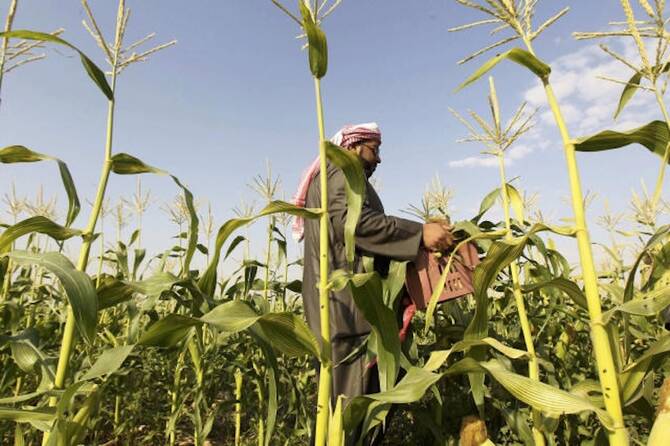
Small creatures with big impact: The role of beneficial insects in the environment

Mohaned Al-Arnaout, a plant specialist with over 32 years of experience, explained how earthworms enhance soil quality and support the plant cycle. (SPA)
Short Url
Updated 22 November 2025
Follow

Small creatures with big impact: The role of beneficial insects in the environment

  • Bees, beetles and others vital for soil health, pollination
  • Saudi studying insects, says NCW’s Mohammed Qurban

RIYADH: In the heart of the Kingdom’s deserts, an invisible yet dedicated army is quietly protecting plants, improving soil, and supporting the ecological balance.

While Saudi Arabia is commonly known for its arid landscapes, it is also home to various insect species that play an essential role in environmental protection.

As the country moves forward with its green agenda and continues to support it with sustainable initiatives, understanding the science and benefits of insects becomes critical to achieving these objectives.

One of the sustainability initiatives took place last summer when the National Center for Wildlife launched its “Decade Land Expedition to Explore Terrestrial Ecosystems.”

The NCW’s initiative is a comprehensive research mission for terrestrial ecosystems, to document the biodiversity, density and distribution of wildlife, with local and international experts and researchers.

Mohammed Qurban, CEO of the NCW, said the data enables the organization to “develop effective strategies for protecting species and raising awareness of the importance of preserving biodiversity.”

And also to “document this great biological richness at the global level, and enhancing the Kingdom’s role in regional and international environmental agreements.”

Through the study and many other initiatives, officials are highlighting the seriousness of securing a thriving environment for the future, including protecting the smallest contributors.

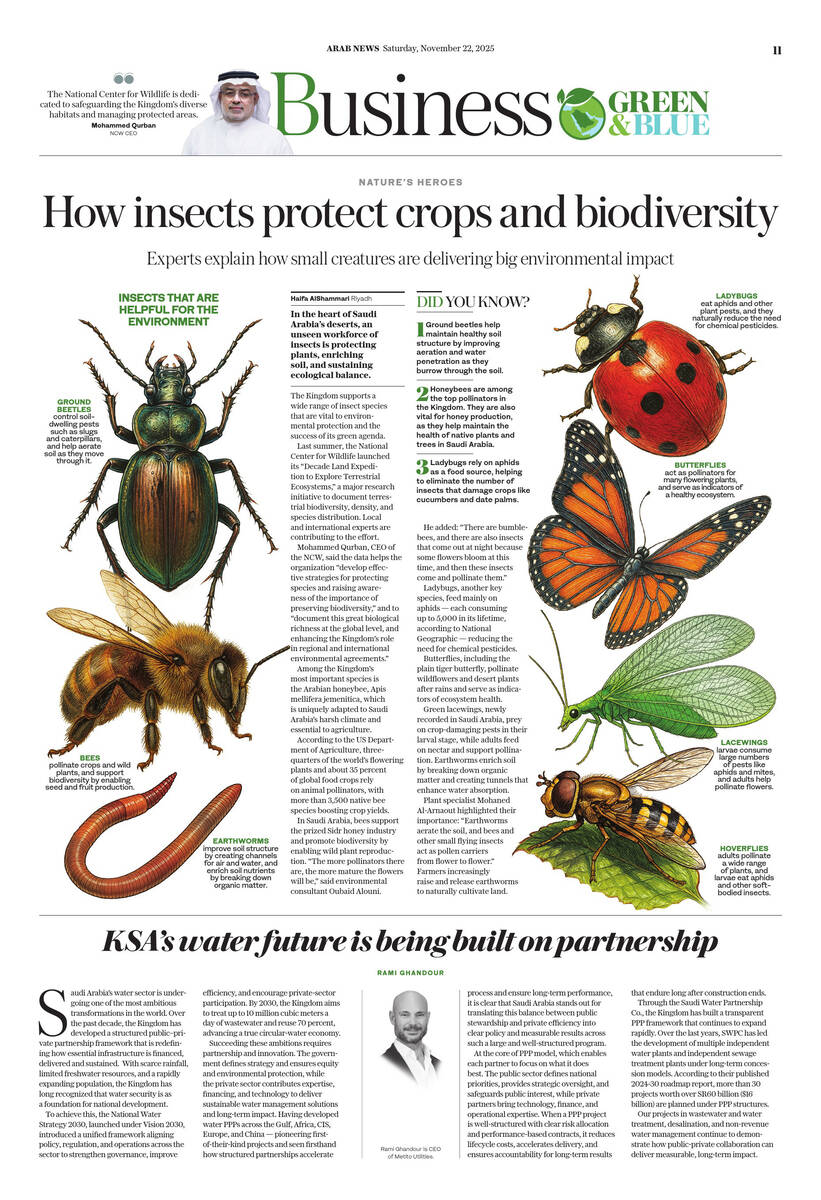
No insect is more critical to the Kingdom’s environment than the honeybee. The Arabian honeybee, scientifically known as Apis mellifera jemenitica, is unique for its adaptation to the country’s harsh climate and is essential to the agricultural industry.

In addition, according to the US Department of Agriculture, three-quarters of the world’s flowering plants and around 35 percent of the world’s food crops rely on animal pollinators for reproduction. And over 3,500 species of native bees contribute to increased crop production.

Animal pollinators such as bees, butterflies and moths, birds and bats, beetles, and other insects are responsible for one out of every three bites of food people eat daily, reported the USDA.

DID YOU KNOW?

• Ground beetles help maintain healthy soil structure by improving aeration and water penetration as they burrow through the soil, and they also support the growth of palm trees, grain crops, and garden plants.

• Honeybees are among the top pollinators in the Kingdom. They are also vital for honey production, as they help maintain the health of native plants and trees in Saudi Arabia.

• Ladybugs rely on aphids as a food source, helping to eliminate the number of insects that damage crops like cucumbers and date palms.

In the Kingdom, bees support the Sidr honey industry, which is both a cultural and economic treasure. But beyond their agricultural importance, bees promote biodiversity by helping plants reproduce in the wild, thereby maintaining a balanced ecosystem.

“The more pollinators there are, the more mature the flowers will be,” said environmental consultant Oubaid Alouni.

He added: “There are bumblebees, and there are also insects that come out at night because some flowers bloom at this time, and then these insects come and pollinate them.”

Another example is ladybugs which are beneficial for farmers and home gardeners. This species relies mainly on aphids as a food source and each has the ability to consume up to 5,000 insects in its lifetime, according to National Geographic.

Reducing the number of harmful pests lowers the need for chemical pesticides and provides healthier soil and safer food. Releasing ladybugs is also encouraged by environmentalists as it is a sustainable alternative to traditional pest control methods.

Opinion

This section contains relevant reference points, placed in (Opinion field)

Another tiny friend of the environment is the butterfly. Butterflies are important pollinators for wildflowers and desert plants after seasonal rains. One type, the plain tiger butterfly, thrives in warm climates and helps maintain plant diversity in the Kingdom.

They are also sensitive to their surroundings, making their presence in the wild an indicator of the ecosystem’s health.

Green lacewings are another species with powerful environmental benefits. Although they are typically native to North America, three lacewing species have been newly recorded in Saudi Arabia, according to the National Institutes of Health.

Like ladybugs, green lacewing larvae prey on aphids, mites, and other pests that ruin crops and threaten agriculture. Adult lacewings, however, feed on nectar, contributing to the pollination process of native plants and agricultural fields.

For local farmers looking to reduce chemical use, adding lacewings to the field could offer a greener alternative to traditional pesticides and a safer solution for people and the soil.

Further, living mainly underground or in shaded areas, ground beetles are also beneficial insects. They hunt harmful pests including slugs and caterpillars that attack plant roots, and improve aeration and water penetration as they burrow through the soil.


Mohammed Qurban, CEO of the National Center for Wildlife. (Supplied)

Also, earthworms break down organic matter into nutrient-rich compost, helping plants grow stronger and healthier. These small species make tunnels to allow better water absorption.

Additionally, as the country invests in sustainable farming, earthworms have become key partners in building fertile and productive soil.

Mohaned Al-Arnaout, a plant specialist with over 32 years of experience, explained how earthworms enhance soil quality and support the plant cycle.

“Vegetation cover always multiplies with weather factors, most of which are insects and dust, like beneficial insects such as bees and earthworms. Earthworms aerate the soil, and bees and other small flying insects act as pollen carriers from flower to flower,” he said.

“Some farmers produce earthworms and release them into the soil to aerate it naturally. They raise them in enclosures to reproduce, and then, before the planting process, they plow the land, release the earthworms, and then plant seeds.

“The earthworms then perform the same function as humans, plowing and aerating the soil, and creating air pockets between the roots.”

Insects, whether honeybees or earthworms, are all natural support systems for the environment and agriculture, and protecting them is one strategy to secure the Kingdom’s future.


Mapping Saudi soils to grow better crops

Updated 19 December 2025
Follow

Mapping Saudi soils to grow better crops

  • Palm trees, root crops, and coastal plants reveal the land’s story

RIYADH: Saudi Arabia’s land tells stories written beneath the feet. From fertile plains and rugged highlands to vast deserts, the Kingdom’s diverse landscapes shape what can grow, where it grows, and how agriculture can thrive.

Alongside geography and climate, soil conditions play a decisive role in agricultural success. Understanding soil types across the Kingdom helps determine which crops can flourish and what interventions may be needed to sustain them.

In an interview with Arab News, Turki Almutairi, a senior environmental specialist at the National Afforestation Center under the National Center for Vegetation Cover Development and Combating Desertification, outlined the main soil types found across Saudi Arabia.

High amount of salt makes the soil unfit for the production of most crops, even if the soil is fertile. (Supplied)

“The dominant soil in the Kingdom are sandy desert soils, alongside calcareous soils in the central region. Rocky and stony soils are present along mountainous and hilly landscapes,” he said.

“Alluvial soils are common in wadies (valleys), while saline and sodic soils are located in depressions (Sabkhas) and along coastlines. Pockets of clayed soils can be also found around few sites along the Kingdom.”

The Kingdom’s vast territory gives rise to unique soil characteristics in each region, enabling different crops to grow depending on local conditions.

“Soil is the growing medium for plants. The role of soil includes structural stabilization, providing nutrients and a communication medium for plants,” Basil Nasir, soil lead at engineering consultancy William Sale Partnership, told Arab News.

Basil Nasir, soil lead at the engineering consultant company, William Sale Partnership (WSP). (Supplied)

According to Nasir, assessing soil use is essential before determining whether it is fertile or infertile, as different soils support different plant types.

“The soil used for trees differs from the soil used for ornamental plants and from the soil used for aquatic plants. It varies according to the specific needs of each plant, and based on this, we determine what the soil requires and assess its fertility,” he said.

Nasir explained that soil characteristics are shaped by both physical and chemical components. In addition to water and air, mineral particles such as sand, silt and clay are key indicators of soil health. Organic matter, derived from plant and animal remains, forms the fourth major component.

The balance between these elements determines soil behavior. One important physical trait is water-holding capacity, which influences what types of plants a soil can support.


Opinion

This section contains relevant reference points, placed in (Opinion field)

“If the soil is like dunes, adding water will cause it to run off, but if the soil is clay, its ability to retain water will be very high. If you add water and return the next day, you will find that the water is still there,” said Nasir.

Chemical properties, such as whether soil is alkaline or acidic, are equally important. Understanding both physical and chemical traits allows for proper assessment and treatment when needed.

“What determines whether a plant is suitable for a particular environment is primarily the plant's nature. For example, some plants have fibrous roots and therefore do not require well-draining soil,” Nasir added.

“A palm tree, for example, does not care whether it was planted in one soil or the other because its roots are fibrous. Therefore, palm trees are strong plants and are suitable to grow in both dry and wetlands, while preferring sandy areas.”

Soil Salinity can be treated through Soil leaching which means washing the soil with certain amount of water to reduce the salt in it. (Supplied)

Crops such as potatoes, onions, carrots and beetroots — where the edible part grows underground — typically thrive in sandy soils. As a result, plantations of these crops are commonly found in northern regions such as Hail and in Wadi Ad-Dawasir.

In the eastern region, including Al-Ahsa, wetlands are more common due to climatic conditions. Growing plants in such environments often requires human intervention.

“Plants that are coastal or could be found in lagoons or lakes must have some sort of soil around them, like lotus flowers and mangrove trees.”

“An important parameter to keep in mind is that there is no air in its soil, and they are adapted to this condition. However, the lack of air, along with the presence of organic matter, will create a situation where anaerobic bacteria react with the soil, potentially causing diseases we can easily avoid,” said Nasir.

He emphasized that removing organic matter from such soils is essential to ensure plant survival in aquatic environments.

Mountainous and rocky regions in Saudi Arabia are generally volcanic, resulting in low water-holding capacity and challenging growing conditions. However, volcanic ash contributes to high fertility, allowing certain crops to flourish.

As a result, western regions support tree crops such as coffee, mangoes, some banana varieties and pomegranates.

There are various types of soils such as clay, sandy, silty and loamy. Each type provides excellent conditions for specific plants. (Supplied)

As development accelerates across the Kingdom, soil improvement efforts are expanding under the National Greening Program.

“Soil is considered fundamental for the National Greening Program’s objectives. Understanding the soil variability along the Kingdom is a precondition for fostering sustainable soil management,” Almutairi told Arab News.

Adding, “In this line, the NGP is working towards the establishment of the Saudi Soil Information System (TURBA-KSA), which consists of mapping soils and its functional properties in the Kingdom using state-of-the-art technology.”

He also noted the creation of the “Land Rehabilitation Watch” to report, verify and monitor land rehabilitation nationwide.

“This milestone allows the Kingdom to understand how soil and land health are progressing against national and international targets of land degradation neutrality. Documenting good soil and land management practices is also important, so that those successful practices could be scaled up along the Kingdom, which is a priority task for NGP,” he said.

Raising public awareness is another key pillar of the program.

“Assessing different emerging technologies and soil amendments is a daily activity of NGP, as it then provides technical support to partners on the selection and application of these technologies.”

DID YOU KNOW?

• Saudi Arabia cultivates around 1 million hectares, mainly in Riyadh, Qassim, Hail, and Jouf.

• Farming follows the seasons: winter brings onions, garlic, and carrots, while summer yields watermelon, tomatoes, and cucumbers.

• The Kingdom is a top date producer, with over 31 million palm trees generating nearly 1.54 million tons, especially in Riyadh and Qassim.

Almutairi stressed that soil is often overlooked because it lies unseen beneath the surface, despite its critical role.

Yet soil produces 95 percent of food, stores water, holds more carbon than vegetation and the atmosphere, suppresses contaminants, regulates water, carbon and nutrient cycles, and hosts microorganisms linked to the human microbiome.

He emphasized the need to engage the general public, particularly urban communities disconnected from nature. Education helps people understand where food comes from and how contact with soil — such as walking barefoot — can support well-being. Healthy soils also contribute to cleaner water and air, he added.

Almutairi also called for stronger advocacy among decision-makers, noting that investment in healthy soils supports climate action, food security and sustainable development.

He concluded that key strategies include officially observing UN World Soil Day on Dec. 5, integrating soil education into curricula, launching annual social media campaigns, using art to raise awareness, and organizing public events that connect soils to everyday life.