Cummins, Lyon floor England as Australia march toward Ashes triumph

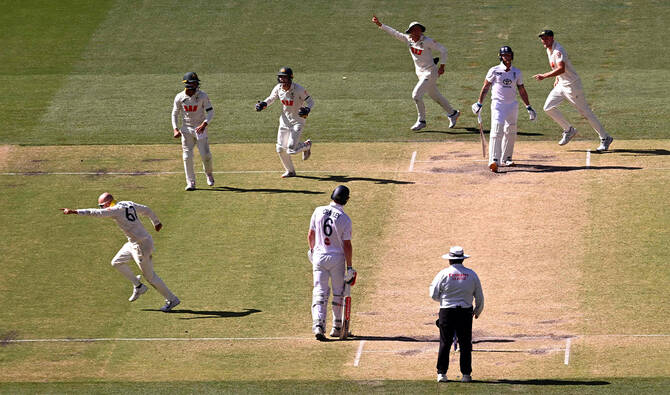
Australian spinner Nathan Lyon (left) celebrates bowling England batsman Ben Stokes (second right) on the fourth day of the third Ashes cricket Test match between Australia and England at the Adelaide Oval in Adelaide on December 20, 2025. (AFP)
Short Url
Updated 20 December 2025
Follow

Cummins, Lyon floor England as Australia march toward Ashes triumph

  • England batters seemed determined to squander the rare periods when they could reasonably be judged to be on top of the Australian attack
  • They needed at least one, and preferably two, to stand up like Travis Head who put on 170, nearly half Australia’s second-innings total of 349

ADELAIDE: Pat Cummins skittled England’s top order and Nathan Lyon spun out their soft underbelly to all but seal another Ashes series victory for Australia on day four of the third test at Adelaide Oval on Saturday.

Chasing a world record 435 runs to win, England were reduced to 207 ​for six at stumps, still 228 runs short of victory and having played no small part in their predicament through batting misadventure.

Jamie Smith, on two, and Will Jacks, on 11, were left to try to salvage something from the wreckage of another demolition day for the tourists.

With holders Australia 2-0 up in the five-test series after eight-wicket wins in Perth and Brisbane, they need only draw the match to retain the urn.

But there is little prospect of a rousing comeback win from an England squad that have failed to live up to expectations.

“Obviously very disappointing. Uphill battle from here,” England opener Zak Crawley told reporters.

“We came here to win the Ashes and we’re ‌staring down the ‌barrel now .... It’s been tough, they’re a very, very good side.... Obviously we’ve ‌been ⁠slightly ​short of ‌our best but credit to them.”

Questions have been asked of England’s preparations, selections and batting approach, and there were plenty more teachable moments from Saturday’s play at Adelaide Oval.

Their batters seemed determined to squander the rare periods when they could reasonably be judged to be on top of the Australian attack.

They needed at least one, and preferably two, to stand up like Travis Head who put on 170, nearly half Australia’s second-innings total of 349, to effectively bat England out of the game.

Instead, they were prey for Australia skipper Cummins, who took three top-order wickets and extracted gold from a ⁠still-firm pitch that proved unyielding, initially, for others.

In his first test since July, coming off a back injury, Cummins became the second test captain to take ‌150 wickets, joining Pakistan’s Imran Khan (187).

KEEPING THE CHAMPAGNE ON ICE

England’s Ben ‍Duckett was first to go, taking a half-hearted push ‍at a nagging ball and sending an edge flying chest-high to Marnus Labuschagne in the slips.

The shot was ‍neither Bazball aggression nor stout defense, something meekly in between.

Number three Ollie Pope fell for 17 in a similar vein, nicking off to the slips with a more hard-handed prod and watching in disbelief as Labuschagne dived forward to take a one-hander just above the grass.

Labuschagne raced around the wicket in open-mouthed celebration, and England were 31 for two.

Another collapse beckoned but Crawley (85) ​and Joe Root (39) dug in until just after tea.

Root was lucky not to be dismissed lbw when he failed to play a shot at the part-time spin of Head, only to be ⁠caught-behind off Cummins moments later, playing at a ball he should have left.

It was Cummins’ 13th dismissal of England’s master batter, the most by any bowler.

Root slapped his bat in frustration but his was a misdemeanour compared to the batting crime committed by Harry Brook, who was bowled for 30 by Nathan Lyon with a botched reverse sweep.

Lyon followed up by bowling captain Ben Stokes for five with a ball that pitched, straightened and crashed into middle and off-stump.

The collapse gathered pace as Crawley lumbered forward at Lyon, misjudged the flight and was gleefully stumped by the clinical Alex Carey.

He had batted well for his 85 to that point but his wicket came as the pressure rose, leaving England needing a miracle from Jacks and Smith. Each has struggled for runs when their team has been crying out for them.

Australia will keep the champagne on ice until victory is complete.

“We want to keep working hard and probably not look ‌too far ahead,” said Carey, who singled out Lyon for praise.

“I just thought Nathan was bowling really well and kept putting lots of energy on the ball. He toiled away all day and finally got some reward.”


Middle East war puts Asian Football Confederation in a tricky situation

Updated 59 min 5 sec ago
Follow

Middle East war puts Asian Football Confederation in a tricky situation

  • Asian football has long been structured around regions, with competitions split between East and West
  • With conflict in the Middle East escalating on Feb. 28, the AFC was forced into emergency mode as the knockout stages of its club competitions approach

DAMMAM: Football in Asia has never been an easy task to manage. Long flights, numerous time zones, conflicting calendars, vastly different football cultures and — perhaps more than any other confederation in the world — politics.
While the war in the Middle East falls under the AFC’s umbrella, its direct effects have so far been limited to the clubs in West Asia. Asian football has long been structured around regions, with competitions split between East and West, although for a period, the second-tier AFC Cup operated in five separate regions.
As a result, AFC club competitions in East Asia continued uninterrupted in the first week of March. A crowd of 31,225 watched Johor Darul Ta’zim’s historic 3-1 victory over Sanfrecce Hiroshima in the AFC Champions League Elite round of 16. Bangkok United defeated Tampines Rovers in the AFC Champions League Two quarter-final, and an all-Cambodian clash between Phnom Penh Crown and PKR Svay Rieng in the AFC Challenge League ended in a 4-1 victory for the visitors.
The situation in West Asia, however, is vastly different.
With the conflict in the Middle East escalating on Feb. 28, the AFC was forced into emergency mode as the knockout stages of its club competitions approach.
Within 24 hours, the confederation announced that all first-leg matches involving West Asian clubs in AFC competitions would be rescheduled until further notice. The same decision was taken for the second-leg matches fixtures just 48 hours later.
Domestic football has also been heavily disrupted. Leagues in Qatar, Bahrain, Kuwait and Lebanon have been postponed indefinitely, with matches continuing behind closed doors in Jordan.
Leagues in Saudi Arabia, Oman, Iraq and Syria continue to operate, but flights in the region are limited.
With the season already compressed by the FIFA Arab Cup, FIFA Intercontinental playoffs and the upcoming FIFA World Cup, member associations throughout the Middle East now find themselves scrambling alongside the AFC to solve a problem that ultimately lies outside their control.
Another issue looms on the horizon. The AFC Champions League final stage will be hosted in Saudi Arabia next month for the second year in a row. While football has not halted in the Kingdom and the security situation is stable, it remains to be seen whether East Asian clubs will be willing to travel if the conflict continues.
What is the real solution, fans ask?
One proposal that has been circulated is to centralize the knockout rounds from the Round of 16 stage instead of the quarter-finals. That option, however, presents its own challenges. East Asian clubs have already begun their journey in the round of 16, and the idea of centralized hosting has historically not been popular across the continent.
When Saudi Arabia and Qatar were selected to host the AFC World Cup Qualifiers fourth round last year, the decision sparked backlash from Indonesia, Iraq, Oman and the UAE. More recently, journalist Ali Al-Marshoud claimed on Saudi sports program “In the 90” that the UAE’s Al-Wasl rejected a proposal for their AFC Champions League Two quarter-final against Al-Nassr as a single-leg match in Jeddah.
The AFC therefore finds itself in a difficult position. It cannot control regional geopolitics, nor can it influence government policies. At the same time, there is no guarantee that East Asian clubs will travel to the region, or that West Asian clubs will agree to surrender their right to play matches at home.
The conflict has also begun to affect international football.
With the FIFA World Cup intercontinental playoffs scheduled for later this month and Iraq facing a crucial qualifier in Mexico on March 31, uncertainty continues to grow.
In a statement released by the Iraqi Football Association, officials confirmed they were in constant contact with FIFA and the AFC regarding potential travel complications.
Head coach Graham Arnold is currently unable to leave the UAE, while several players and staff have struggled to obtain visas to Mexico due to embassy closures. All the while flights through Iraqi airspace have been suspended.
Political complications are not new to Asian football. For years, Saudi and Iranian clubs played each other at neutral grounds. Conflicts in Syria, Palestine, Iraq and Lebanon also forced the AFC to adopt special arrangements at various times. And of course, the COVID-19 pandemic, which fundamentally reshaped the state of football in Asia.
Yet the current situation presents a different scale of challenge.
For the first time in modern history, the AFC must navigate a regional conflict that touches nearly every part of the confederation. With the season entering its decisive stages and the largest World Cup in history approaching, solutions must be found quickly, or Asian football risks a crisis that could reshape the continental game.