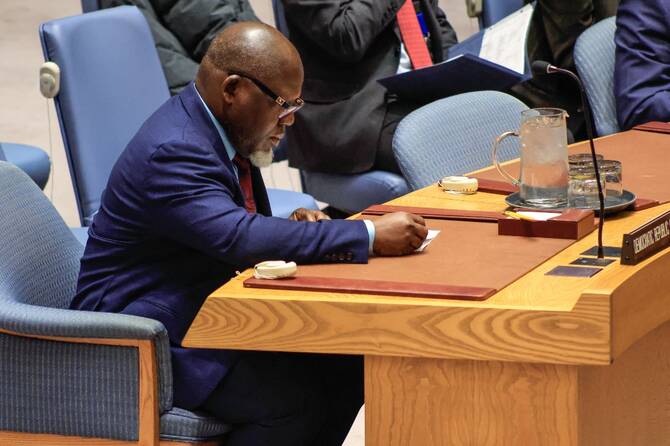
KINSHASA: The UN Security Council has urged Rwanda to withdraw its forces from eastern Congo and extended the UN peacekeeping mission in Congo, known as MONUSCO, for a year, as fighting in the region escalated despite a US-mediated peace deal.
The UN’s most powerful body on Friday condemned an offensive by the Rwanda-backed M23, demanded Rwanda stop supporting the rebels and withdraw its troops. The Security Council also renewed the peacekeepers’ mandate, keeping about 11,500 military personnel in the country, in a unanimously adopted resolution.
The resolution comes as M23 claimed Wednesday to have withdrawn from Uvira, a strategic city in eastern Congo it seized last week, after pressure from the US Congo’s government said the withdrawal was “staged” and that the rebels were still in the city.
US deputy ambassador Jennifer Locetta told the Security Council on Friday that M23 must immediately withdraw at least 75 kilometers (47 miles) away from Uvira.
M23 took control of the city last week in a deadly offensive that came despite a US-mediated peace agreement signed earlier this month by the Congolese and Rwandan presidents in Washington.
The accord didn’t include the rebel group, which is negotiating separately with Congo and agreed earlier this year to a ceasefire that both sides accuse the other of violating. However, the accord obliges Rwanda to halt support for armed groups like M23 and work to end hostilities.
Congo, the US and UN experts accuse Rwanda of backing M23, which has grown from hundreds of members in 2021 to around 6,500 fighters, according to the UN
More than 100 armed groups are vying for a foothold in mineral-rich eastern Congo, near the border with Rwanda, most prominently M23. The conflict has created one of the world’s most significant humanitarian crises, with more than 7 million people displaced, according to the UN agency for refugees.
The MONUSCO force arrived in Congo in 2010, after taking over from an earlier UN peacekeeping mission to protect civilians and humanitarian personnel and to support the Congolese government in its stabilization and peace consolidation efforts.
However, frustrated Congolese have said that no one is protecting them from rebel attacks, leading to protests against the UN mission and others that have at times turned deadly.
In 2023, at Congo’s request, the UN Security Council voted unanimously to draw down the peacekeeping force and gradually hand over its security responsibilities to Congo’s government.

UN urges Rwanda to leave eastern Congo and extends peacekeeping mission for a year
https://arab.news/4ert7
UN urges Rwanda to leave eastern Congo and extends peacekeeping mission for a year
- The UN condemned an offensive by the Rwanda-backed M23, demanded Rwanda stop supporting the rebels and withdraw its troops
Ramadan tests Pakistan’s daily wage workers but faith endures
- Reduced work hours during fasting month cut already fragile incomes
- Charities, local businesses step in as laborers try to support families back home
ISLAMABAD: Abdul Waqif grips a worn-out shovel and digs into the earth beneath the harsh midday sun, his body bent with age but still moving steadily.
Moments later, the 70-year-old hoists a heavy bag of cement onto his shoulders and carries it toward an under-construction house, all while fasting.
For Waqif and thousands of daily wage laborers across Pakistan, Ramadan is not just a month of spiritual devotion. It is also a month of shrinking incomes.
Waqif migrated from Mohmand tribal district in northwestern Pakistan to Islamabad two decades ago in search of work.
Like many laborers from rural and former tribal areas, he left behind limited local opportunities to earn a living in larger cities such as Islamabad, Lahore and Karachi.
In Pakistan, daily wage workers, particularly in construction and manual labor, are among the most economically vulnerable.
They are paid only for days worked, receive no job security or benefits, and often rely on informal arrangements. Any slowdown in economic activity directly affects their ability to feed their families.
Economic activity typically slows during Ramadan, when Muslims fast from dawn to sunset. Employers often reduce work hours or postpone physically demanding projects to ease the burden on fasting workers. While intended as a gesture of consideration, it means fewer working hours and fewer earnings.
For laborers such as Waqif, who earns between 1,000-1,200 rupees ($3.59-$4.31) a day, even a slight reduction in work can be devastating.
His suhoor, the pre-dawn meal before fasting begins, usually consists of a few chapatis from a nearby hotel. The hunger and thirst that follow him through the day are constant companions as he lifts bricks and mixes cement in the heat. But so is his faith.
“Allah gives me courage. I am hungry and thirsty, but I keep working,” Waqif said while wiping the sweat from his brow.
Back in Mohmand district, his wife, four daughters and two sons depend on the money he sends home. Every rupee matters.
“I support them with this work,” Waqif said. “I eat three meals a day here and I also have to save money for my children and send it to them.”
The reduction in work during Ramadan weighs heavily on him. “I don’t find much work in Ramadan, and I’m worried for my family,” Waqif said.
Finding food for suhoor is sometimes a challenge. On some mornings, someone offers him a piece of flatbread. Other times, he buys what little he can afford from a nearby eatery.
Muhammad Sajid, owner of Al-Hadi restaurant in Islamabad’s G-15 sector, says he tries to ease that burden by offering meals to laborers at half price.
“We don’t let anyone go hungry,” Sajid told Arab News. “We offer sehri and iftar as much as anyone can afford.”
The restaurant serves tea, yogurt, several types of curries and parathas.
Charity groups also expand operations during Ramadan, when community support traditionally increases. The Junaid Welfare Foundation runs a roadside dastarkhwan, or communal meal spread, serving hundreds daily.
Haq Rawan Shareefi, a manager at the foundation, said about 500 people are provided iftar meals each day. The cost of one person’s iftar is 200 rupees.
“That means, on iftar and sehri, our expenses range from 150,000 rupees to 200,000 rupees,” Shareefi said.
For Waqif, breaking his fast at sunset brings temporary relief from the physical strain of the day. But the financial uncertainty remains.
“I ask Allah for this,” he said. “May Allah give me strength to earn an honest living for my children.”


